
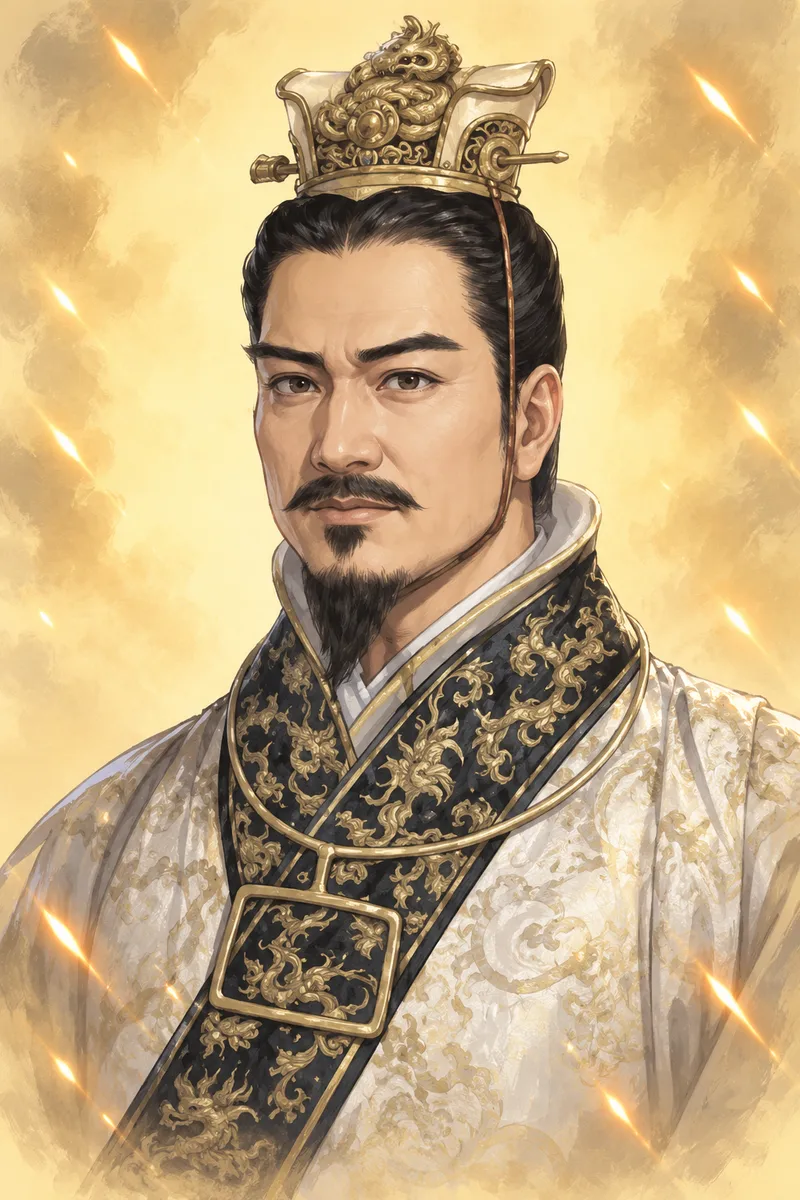

Wu Rui (吴芮, Ngô Nhuệ; d. 201 BC; King Wen of Changsha 长沙文王), was an eminent military leader and the only non-royal vassal king (yixing wang) whose family survived the ruthless purges of early Western Han, reigning as the founding King of Changsha.
Originally serving as Magistrate of Poyang under the Qin Dynasty, Wu Rui was deeply beloved by the indigenous Baiyue peoples for his justice and kindness, earning the honored moniker ‘Lord of Poyang’ (番君). When Chen Sheng revolted in 209 BC, Wu Rui led thousands of Yue warriors to join Xiang Yu and Liu Bang in overthrowing Qin. Recognizing the rising virtue of Liu Bang, Wu Rui married his daughter to hero Ying Bu (英布) and threw his full military weight behind Han during the Chu-Han Contention.
In 202 BC, Liu Bang formally ennobled Wu Rui as King of Changsha, granting him Hunan and northern Jiangxi. Following the advice of his wise strategist Zhang Liang (Zhang Liang), Wu Rui practiced absolute political humility: he ceded major territories, reduced his army, and sent his brothers into common frontier service. Due to his selfless virtue, while all other vassal kings (Han Xin, Peng Yue, Ying Bu, Han Xin of Han) were executed or destroyed, Wu Rui’s Changsha kingdom survived untouched across five generations, a celebrated paradigm of wisdom in statecraft.
Contents
Role in History (Shiji)
Records of the Grand Historian (Shiji, vol. 89): “Wu Rui was loved by the Yue people; he aided Han in pacifying the empire. His heart was free of greed; thus alone among all vassal kings, the House of Changsha preserved its sacrifices through five generations.”
Wu Rui — Historical & Literary Timeline
Qin Dynasty
Lord of Poyang
Governs Poyang with immense popularity among the Baiyue peoples.
209 BC
Joining the Anti-Qin Revolt
Leads Yue troops to support Xiang Yu and Liu Bang.
202 BC
King of Changsha
Ennobled by Liu Bang as King of Changsha upon the founding of Han.
201 BC
Passing & Enduring Fief
Passes away peacefully; his kingdom endures untouched for five generations.
Key Relationships
Family
- Son & Successor Wu Chen (吴臣 – King Cheng of Changsha): Succeeded to the throne.
- Son-in-law Ying Bu (英布 – King of Huainan): Famed warrior whom Wu Rui sought to restrain.
Friends
- Master Strategist Zhang Liang (张良): Advisor who counseled Wu Rui on political humility.
- Han Emperor Liu Bang (Emperor Gaozu): Monarch who respected Wu Rui’s integrity.
Enemies
- Tyranny of Qin Corrupt Qin magistrates: Overthrown by Wu Rui’s Yue army.
Other
- Baiyue Tribes Indigenous peoples of Jiangnan: Revered Wu Rui as ‘Lord of Poyang’.
In Shiji
“He who grasps at power loses all; he who yields in humility preserves his clan through ten thousand generations.”
Historical Context
Wu Rui was the sole non-royal king to avoid Liu Bang’s purges, and his kingdom of Changsha became an economic and cultural hub whose relics (Mawangdui Han Tombs) are among China’s greatest archaeological treasures.