






















Contents
Biography & Historical Record
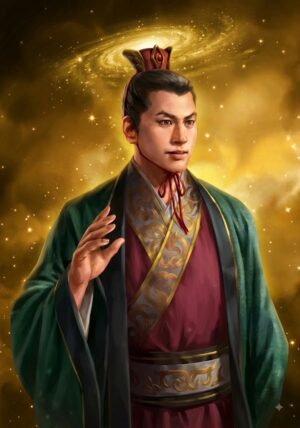
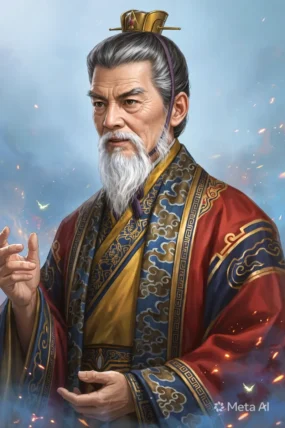
Liu Bei (刘备, Lưu Bị), courtesy name Xuande (玄德, Huyền Đức), was the founder and first emperor of Shu Han (蜀汉) — one of the Three Kingdoms — and the novel’s central virtuous lord from Chapter 1 through his death at Baidi in Chapter 85. He claimed descent from Prince Jing of Zhongshan while growing up poor in Zhuo Commandery, selling straw sandals with his mother before the Yellow Turban Rebellion drew him into war.
Historically, Liu Bei served Gongsun Zan (公孙瓒, Công Tôn Toản), Tao Qian (陶谦, Đào Khiêm), Cao Cao (曹操, Tào Tháo), Yuan Shao (袁绍, Viên Thiệu), and Liu Biao (刘表, Lưu Biểu) before Zhuge Liang (诸葛亮, Gia Cát Lượng)‘s Longzhong Plan guided him toward Jing Province, Yi Province, and Hanzhong. He proclaimed himself King of Hanzhong in 219 AD and Emperor of Shu Han in 221 AD after Cao Pi’s usurpation. Defeated at Yiling (222 AD) by Lu Xun (陆逊, Lục Tốn), he died at Baidi in 223 AD, entrusting Liu Shan (刘禅, Lưu Thiện) to Zhuge Liang.
In Romance of the Three Kingdoms he embodies benevolent rulership: Peach Garden oath with Guan Yu (关羽, Quan Vũ) and Zhang Fei (张飞, Trương Phi), Three Visits to recruit Zhuge Liang, refusal to abandon civilians at Changban, Red Cliffs alliance with Sun Quan (孙权, Tôn Quyền), and the tragic Yiling campaign to avenge Guan Yu.
Early Wanderings
From Zhuo Commandery volunteer to provincial guest, Liu Bei spent two decades without a secure base. After the Peach Garden oath he fought Yellow Turbans, briefly held Anxi, then followed Gongsun Zan (公孙瓒, Công Tôn Toản) against northern rivals and into the anti-Dong Zhuo coalition, where he and his brothers faced Lü Bu (吕布, Lã Bố) at Hulao. Relief of Beihai and aid to Tao Qian (陶谦, Đào Khiêm) brought the governorship of Xu Province — soon lost when Lü Bu seized Xiapi. Temporary alliance with Cao Cao (曹操, Tào Tháo) ended Lü Bu at White Gate Tower (199), yet the blood-decree plot and green-plum hero talk drove Liu Bei back to Xu, then into flight to Yuan Shao (袁绍, Viên Thiệu) after Cao Cao crushed him. Reunion with Guan Yu, Zhang Fei, and Zhao Yun (赵云, Triệu Vân) at Gucheng restored the core circle, but Runan’s failure sent him south to kinsman Liu Biao (刘表, Lưu Biểu) at Xinye — still a guest general, still without a kingdom of his own.
Jing & Longzhong
At Xinye Liu Bei survived Cai Mao (蔡瑁, Thái Mạo)‘s Xiangyang banquet plot (Dilu’s leap of the Tan Torrent in the novel), met Xu Shu, and made Three Visits to Longzhong for Zhuge Liang (诸葛亮, Gia Cát Lượng). The Longzhong Plan sketched Jing and Yi as successive bases against Cao Cao and in partnership or rivalry with Sun Quan (孙权, Tôn Quyền). Fire at Xinye and the civilian exodus to Changban — where Zhao Yun rescued infant Liu Shan — showed his reputation for benevolence under pressure. Alliance with Eastern Wu produced victory at Red Cliffs (208); southern Jing commanderies followed. Political marriage to Lady Sun at Ganlu Temple (Chapters 54–55) cemented and strained the Sun–Liu bond while Zhou Yu contested Jing. By then Liu Bei held enough of Jing to invite the next leap: entry into Yi.
Founding Shu & Yiling
Invited by Liu Zhang (刘璋, Lưu Chương) to oppose Zhang Lu, Liu Bei turned on his host after Zhang Song’s letters surfaced. With Pang Tong (庞统, Bàng Thống) and later Fa Zheng (法正, Pháp Chính) as guides, he took Chengdu (214) and built a Riverlands state. The Hanzhong campaign crowned him King of Hanzhong (219) after Huang Zhong (黄忠, Hoàng Trung) killed Xiahou Yuan at Dingjun; Ma Chao (马超, Mã Siêu) and the Five Tiger Generals framed the new martial order. When Cao Pi forced Han abdication, Liu Bei proclaimed Shu Han emperor at Chengdu (221). Guan Yu’s fall and Zhang Fei’s murder drove the Yiling expedition against Wu; Lu Xun (陆逊, Lục Tốn) burned the linked camps (222). Ill at Baidi, Liu Bei entrusted Liu Shan and the realm to Zhuge Liang and Li Yan, dying in 223 — closing the First Sovereign’s arc and opening Zhuge Liang’s Northern Expeditions.
Role in Romance of the Three Kingdoms
Chapter 1 (Three Heroes Swear Brotherhood in the Peach Garden): Liu Bei meets Guan Yu and Zhang Fei in Zhuozhou, swears the Peach Garden oath, and raises a militia against the Yellow Turbans — opening the entire epic.
Chapters 37–38: Three Visits to Longzhong win Zhuge Liang (诸葛亮, Gia Cát Lượng) and the Longzhong Plan to divide the realm among Cao Cao, Sun Quan, and Liu Bei’s own base.
Chapters 41–50: Exodus across Changban (Zhao Yun (赵云, Triệu Vân) rescues infant Liu Shan); alliance with Sun Quan; victory at Red Cliffs and seizure of southern Jing.
Chapters 60–65: Invited into Yi Province by Liu Zhang (刘璋, Lưu Chương); conquers the Riverlands and takes Chengdu.
Chapters 71–73 / 219 AD: Hanzhong campaign — Huang Zhong (黄忠, Hoàng Trung) kills Xiahou Yuan (夏侯渊, Hạ Hầu Uyên) at Dingjun; Liu Bei becomes King of Hanzhong.
Chapters 80–85: Emperor of Shu Han (221 AD); Yiling expedition against Wu; fire attack by Lu Xun (陆逊, Lục Tốn); deathbed entrustment to Zhuge Liang at Baidi (223 AD).
Liu Bei (刘备) — Historical & Literary Timeline
Chapter 1 / 184 AD
Peach Garden & Yellow Turbans
Oath with Guan Yu and Zhang Fei; volunteer militia against Zhang Jiao (张角, Trương Giác)‘s rebels.
Ch. 21 / 200 AD
Green plum heroes talk
Cao Cao calls Liu Bei the only true hero; Liu Bei flees to Yuan Shao after the girdle plot.
Ch. 37–38 / 207 AD
Three Visits
Recruits Zhuge Liang; adopts Longzhong Plan.
Ch. 41–50 / 208 AD
Changban & Red Cliffs
Civilian retreat; Zhao Yun rescues Liu Shan; allied victory over Cao Cao; four Jing commanderies.
Ch. 60–65 / 214 AD
Yi Province
Conquers Liu Zhang; capital at Chengdu.
Ch. 71–73 / 219 AD
Hanzhong King
Dingjun victory; King of Hanzhong; Five Tiger Generals roster.
221 AD
Emperor of Shu Han
Proclaims empire at Chengdu after Han abdication.
Ch. 84–85 / 223 AD
Yiling & Baidi death
Defeated by Lu Xun; entrusts Liu Shan and Shu to Zhuge Liang; dies at Baidi.
For detailed historical records, archives, and official chronicles, explore Liu Bei on Wikipedia.
Key Relationships
Family
- Son Liu Shan (刘禅, Lưu Thiện): Heir and second emperor; entrusted to Zhuge Liang at Baidi.
- Adopted son Liu Feng (刘封, Lưu Phong): Adopted heir who held Xinye; executed after failing to rescue Guan Yu (Chapter 76).
- Sons Liu Yong (刘永, Lưu Vĩnh) and Liu Li (刘理, Lưu Lý): Younger sons enfeoffed in Shu.
- Wife Lady Gan (甘夫人, Cam Phu nhân): Mother of Liu Shan.
- Wife Lady Mi, Mishi (糜夫人, Mi Phu nhân): Died at Changban in the novel (Chapter 41).
- Wife Lady Sun, Sun Shangxiang (孙尚香, Tôn Thượng Hương): Political marriage with Sun Quan’s sister (Chapters 54–55).
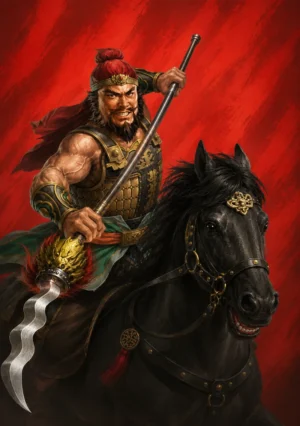
- Sworn brothers Guan Yu (关羽, Quan Vũ) and Zhang Fei (张飞, Trương Phi): Peach Garden oath (Chapter 1); see Relatives infobox.
- Father Liu Hong (刘弘, Lưu Hoằng): Zhuo official who died while Liu Bei was young (Sanguozhi Shu 2). Not the Jin inspector on /liu-hong/.
- Mother Madam Yan (燕氏, Yến Thị): Raised him selling mats and sandals after Hong’s death (Chapter 1 / tradition).
- Grandfather Liu Xiong (刘雄, Lưu Hùng): Fan magistrate; named in the Chapter 1 pedigree and Shu 2.
- Clan uncle Liu Yuanqi (刘元起, Lưu Nguyên Khởi): Paid his board under Lu Zhi (卢植, Lư Thực) and first called him no ordinary man (Shu 2 / Chapter 1).
- Ancestor Liu Sheng (刘胜, Lưu Thắng): Prince Jing of Zhongshan — the Western Han stem of the Chapter 1 genealogy.
Friends
- Zhuge Liang (诸葛亮, Gia Cát Lượng): Chancellor, Longzhong architect, Baidi regent.
- Zhao Yun (赵云, Triệu Vân): Champion who rescues Liu Shan at Changban.
- Fa Zheng (法正, Pháp Chính) and Pang Tong (庞统, Bàng Thống): Strategists of Yi and Hanzhong campaigns.
- Huang Zhong (黄忠, Hoàng Trung) and Ma Chao (马超, Mã Siêu): Among the Five Tiger Generals.
Enemies
- Cao Cao (曹操, Tào Tháo): Rival warlord and hero of the green plum banquet.
- Sun Quan (孙权, Tôn Quyền): Ally at Red Cliffs, enemy after Jing Province and Guan Yu’s death.
- Lu Xun (陆逊, Lục Tốn): Burns Liu Bei’s camps at Yiling (Chapter 84).
- Liu Zhang (刘璋, Lưu Chương): Deposed governor of Yi Province.
- Lü Bu (吕布, Lã Bố): Former ally who seized Xuzhou (Chapters 13–19).
Other
- Liu Biao (刘表, Lưu Biểu): Kinsman who sheltered Liu Bei at Xinye before Cao Cao’s southern drive.
- Tao Qian (陶谦, Đào Khiêm): Ceded Xuzhou on his deathbed.
- Gongsun Zan (公孙瓒, Công Tôn Toản): Early patron from You Province.
- Yuan Shao (袁绍, Viên Thiệu): Brief asylum after fleeing Cao Cao.
Comrades


Appearance

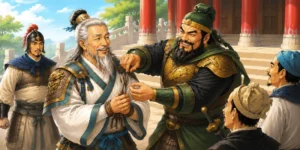



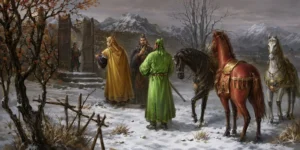
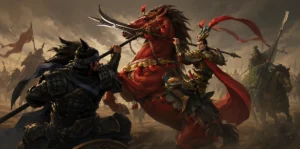

In Novel
Chapter 1
- Liu Bei (刘备, Lưu Bị): Descendant of Prince Jing of Zhongshan, courtesy name Xuande (玄德), who forged the Oath of the Peach Garden with Guan Yu (关羽, Quan Vũ) and Zhang Fei (张飞, Trương Phi) and raised a volunteer militia against the Yellow Turbans.
Chapter 2
- Liu Bei (刘备, Lưu Bị): Pacified Yellow Turban rebels at Yangcheng and Wancheng, receiving appointment as magistrate of Anxi.
Chapter 5
- Liu Bei (刘备, Lưu Bị): Joined the eighteen-warlord coalition with Gongsun Zan (公孙瓒, Công Tôn Toản) and participated in the duel against Lü Bu (吕布, Lã Bố) at Hulao Pass.
Chapter 7
- Liu Bei (刘备, Lưu Bị): Saved Gongsun Zan (公孙瓒, Công Tôn Toản) at the Battle of the Pan River, forming a lifelong bond with Zhao Yun (赵云, Triệu Vân).
Chapter 11
- Liu Bei (刘备, Lưu Bị): Rescued Kong Rong (孔融, Khổng Dung) at Beihai and marched to lift the siege of Xuzhou, where Tao Qian (陶谦, Đào Khiêm) thrice offered him the province.
Chapter 12
- Liu Bei (刘备, Lưu Bị): Accepted the governorship of Xuzhou upon Tao Qian’s death and subjugated local bandits.
Chapter 13
- Liu Bei (刘备, Lưu Bị): Sheltered the defeated Lü Bu (吕布, Lã Bố) at Xiaopei.
Chapter 14
- Liu Bei (刘备, Lưu Bị): Targeted by Yuan Shu’s (袁术, Viên Thuật) general Ji Ling (纪灵, Kỷ Linh) at Xiaopei, saved by Lü Bu’s archery mediation, but lost Xuzhou to Lü Bu’s night raid.
Chapter 15
- Liu Bei (刘备, Lưu Bị): Allied temporarily with Cao Cao (曹操, Tào Tháo) against Lü Bu (吕布, Lã Bố).
Chapter 18
- Liu Bei (刘备, Lưu Bị): Besieged at Xiaopei by Gao Shun (高顺, Cao Thuận) and rescued by Cao Cao’s (曹操, Tào Tháo) grand army.
Chapter 19
- Liu Bei (刘备, Lưu Bị): Assisted Cao Cao (曹操, Tào Tháo) in capturing Xiapi and executing Lü Bu (吕布, Lã Bố).
Chapter 20
- Liu Bei (刘备, Lưu Bị): Recognized by Emperor Xian (刘协, Hán Hiến Đế) as the Imperial Uncle and participated in the Xutian royal hunt.
Chapter 21
- Liu Bei (刘备, Lưu Bị): Signed Dong Cheng’s (董承, Đổng Thừa) secret blood decree, discussed heroes over plum wine with Cao Cao (曹操, Tào Tháo), and executed Che Zhou (车胄, Xa Trụ) to reclaim Xuzhou.
Chapter 22
- Liu Bei (刘备, Lưu Bị): Dispatched Chen Deng (陈登, Trần Đăng) to ally with Yuan Shao (袁绍, Viên Thiệu) against Cao Cao.
Chapter 24
- Liu Bei (刘备, Lưu Bị): Defeated by Cao Cao’s (曹操, Tào Tháo) personal campaign in Xuzhou and fled to seek asylum under Yuan Shao (袁绍, Viên Thiệu) in Hebei.
Chapter 28
- Liu Bei (刘备, Lưu Bị): Escaped Hebei to Runan and reunited with Guan Yu (关羽, Quan Vũ), Zhang Fei (张飞, Trương Phi), and Zhao Yun (赵云, Triệu Vân) at Gucheng.
Chapter 31
- Liu Bei (刘备, Lưu Bị): Defeated at Runan and fled to Jingzhou to seek shelter under his kinsman Liu Biao (刘表, Lưu Biểu), who stationed him at Xinye.
Chapter 34
- Liu Bei (刘备, Lưu Bị): Escaped Cai Mao (蔡瑁, Thái Mạo)‘s assassination plot at the Xiangyang banquet through Dilu’s miraculous leap across the Tan Torrent.
Chapter 35
- Liu Bei (刘备, Lưu Bị): Enlightened by Sima Hui (司马徽, Tư Mã Huy) regarding Wolong and Fengchui.
Chapter 36
- Liu Bei (刘备, Lưu Bị): Employed Xu Shu (徐庶, Từ Thứ) to defeat Cao Ren (曹仁, Tào Nhân) at Fancheng with the Eight Gates formation.
Chapter 37
- Liu Bei (刘备, Lưu Bị): Made Three Visits to the Thatched Cottage in Longzhong to recruit Zhuge Liang (诸葛亮, Gia Cát Lượng).
Chapter 38
- Liu Bei (刘备, Lưu Bị): Adopted the Longzhong Strategic Plan to divide the realm into three.
Chapter 39
- Liu Bei (刘备, Lưu Bị): Scored his first grand victory against Xiahou Dun (夏侯惇, Hạ Hầu Đôn) at the Battle of Bowang Slope.
Chapter 40
- Liu Bei (刘备, Lưu Bị): Defeated Cao Ren (曹仁, Tào Nhân) with fire at Xinye and led hundreds of thousands of civilians across the river.
Chapter 41
- Liu Bei (刘备, Lưu Bị): Endured the catastrophe at Changban Slope, where Zhao Yun (赵云, Triệu Vân) rescued his infant son.
Chapter 42
- Liu Bei (刘备, Lưu Bị): Reorganized at Jiangxia and forged the grand alliance with Eastern Wu.
Chapter 44
- Liu Bei (刘备, Lưu Bị): Dispatched Zhuge Liang (诸葛亮, Gia Cát Lượng) to Chibi to coordinate allied strategy with Zhou Yu (周瑜, Chu Du).
Chapter 50
- Liu Bei (刘备, Lưu Bị): Celebrated the allied triumph at Red Cliffs and seized the four southern commanderies of Jingzhou.
Chapter 54
- Liu Bei (刘备, Lưu Bị): Traveled to Eastern Wu to marry Sun Quan (孙权, Tôn Quyền)‘s sister, Lady Sun, at the Ganlu Temple.
Chapter 55
- Liu Bei (刘备, Lưu Bị): Safely escaped Eastern Wu with Lady Sun through Zhuge Liang’s silk bag stratagems.
Chapter 60
- Liu Bei (刘备, Lưu Bị): Invited by Liu Zhang (刘璋, Lưu Chương) into Yizhou to defend against Zhang Lu (张鲁, Trương Lỗ).
Chapter 62
- Liu Bei (刘备, Lưu Bị): Initiated the Riverlands campaign following the exposure of Zhang Song’s (张松, Trương Tùng) letters.
Chapter 65
- Liu Bei (刘备, Lưu Bị): Pacified Chengdu, accepted Liu Zhang’s surrender, and took governance of Yizhou.
Chapter 71
- Liu Bei (刘备, Lưu Bị): Conquered Hanzhong after Huang Zhong (黄忠, Hoàng Trung) decapitated Xiahou Yuan (夏侯渊, Hạ Hầu Uyên) at Mount Dingjun.
Chapter 73
- Liu Bei (刘备, Lưu Bị): Proclaimed himself King of Hanzhong.
Chapter 80
- Liu Bei (刘备, Lưu Bị): Enthroned as First Sovereign of Shu Han in Chengdu following the usurpation of the Han throne by Cao Pi (曹丕, Tào Phi).
Chapter 81
- Liu Bei (刘备, Lưu Bị): Mobilized the grand Shu Han army to launch a punitive expedition against Eastern Wu to avenge Guan Yu (关羽, Quan Vũ) and Zhang Fei (张飞, Trương Phi).
Chapter 84
- Liu Bei (刘备, Lưu Bị): Suffered a catastrophic defeat when Lu Xun (陆逊, Lục Tốn) torched his interconnected camps at the Battle of Xiaoting.
Chapter 85
- Liu Bei (刘备, Lưu Bị): Fell critically ill at Baidicheng, delivered his poignant deathbed entrustment to Zhuge Liang (诸葛亮, Gia Cát Lượng) and Li Yan (李严, Lý Nghiêm), and passed away in 223 AD.
Appearance
In History
Summary
- Liu Bei (刘备, Lưu Bị), courtesy name Xuande (玄德, Huyền Đức) (161–223 AD), was the founder and first emperor of Shu Han (蜀汉, Thục Hán) and a principal warlord of the late Eastern Han and Three Kingdoms period.
Year: 161–184 AD — Early life
- Born in Zhuoxian, Zhuo Commandery (涿郡涿县). Tradition links him to Prince Jing of Zhongshan (中山靖王), a descendant of Emperor Jing of Han. Orphaned young and raised in poverty, he sold straw sandals and mats with his mother. In 184, with Guan Yu (关羽, Quan Vũ), Zhang Fei (张飞, Trương Phi), and local volunteers, he joined the suppression of Zhang Jiao (张角, Trương Giác)‘s Yellow Turban Rebellion and began a lifelong military career.
Year: 184–191 AD — Yellow Turbans & anti-Dong coalition
- After Yellow Turban campaigns he held minor posts (Anxi in the novel tradition). He attached himself to Gongsun Zan (公孙瓒, Công Tôn Toản) in You Province, fought Yuan Shao’s forces, and joined the eighteen-warlord coalition against Dong Zhuo (190), facing Lü Bu (吕布, Lã Bố) at Hulao in later literary memory.
Year: 194–199 AD — Xu Province & Lü Bu
- Aid to Tao Qian (陶谦, Đào Khiêm) brought succession to Xu Province (c. 194). Sheltering then clashing with Lü Bu cost him Xiapi; alliance with Cao Cao (曹操, Tào Tháo) helped capture and execute Lü Bu at flooded Xiapi (199). Emperor Xian recognized Liu Bei as Imperial Uncle (皇叔) in the novel’s Xutian hunt tradition.
Year: 199–205 AD — Cao Cao service & Guandu era
- At Xuchang he joined the blood-decree plot against Cao Cao, fled after the green-plum hero talk (novel), briefly held Xu again, then sought asylum under Yuan Shao (袁绍, Viên Thiệu) while Cao Cao fought Guandu (200). After leaving Yuan Shao he operated in Runan, reunited with Guan Yu and Zhao Yun, but could not hold a lasting northern base against Cao Cao’s post-Guandu supremacy.
Year: 201–208 AD — Jing Province & Xinye
- He took shelter with kinsman Liu Biao (刘表, Lưu Biểu) and was stationed at Xinye as a frontier garrison against Cao Cao. Recruitment of Zhuge Liang (诸葛亮, Gia Cát Lượng) (c. 207) produced the Longzhong Plan: take Jing and Yi, ally with Sun Quan (孙权, Tôn Quyền), and contest the Central Plains. After Liu Biao’s death and Liu Cong’s surrender, Cao Cao’s southern drive forced Liu Bei’s civilian-escorted retreat toward the Yangtze.
Year: 208 AD — Red Cliffs
- Allied with Sun Quan, Liu Bei contributed to the resistance that defeated Cao Cao’s fleet at Red Cliffs (Chibi). He then occupied southern Jing commanderies (Wuling, Changsha, Guiyang, Lingling), establishing his first durable provincial foothold while tension with Wu over Jing began.
Year: 214 AD — Yi Province
- Invited by Liu Zhang (刘璋, Lưu Chương) against Zhang Lu, Liu Bei turned on his host. With advisers including Pang Tong (庞统, Bàng Thống) and Fa Zheng (法正, Pháp Chính), he took Chengdu (214) and made Yi Province the core of a southwestern state later called Shu.
Year: 219 AD — Hanzhong
- Campaigns against Cao Cao’s northwest garrisons culminated when Huang Zhong (黄忠, Hoàng Trung) killed Xiahou Yuan at Dingjun Mountain. Liu Bei assumed the title King of Hanzhong, completing the territorial triangle of Jing (partly), Yi, and Hanzhong envisioned at Longzhong. Ma Chao (马超, Mã Siêu) and other Tiger Generals framed Shu’s martial elite.
Year: 221 AD — Emperor of Shu Han
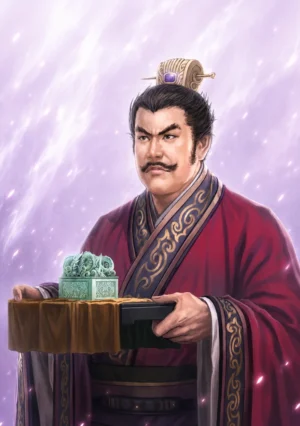
- After Cao Pi (曹丕, Tào Phi) forced Emperor Xian’s abdication and founded Cao Wei (220), Liu Bei proclaimed himself emperor at Chengdu (221), founding Shu Han as Han’s legitimate successor in Shu ideology, with Zhuge Liang as chancellor.
Year: 222–223 AD — Yiling & death
- To avenge Guan Yu’s death and reclaim Jing, Liu Bei launched a massive eastern expedition. Lu Xun (陆逊, Lục Tốn) burned the linked camps at Yiling/Xiaoting (222). Liu Bei retreated to Baidicheng (Yong’an), fell ill, entrusted heir Liu Shan (刘禅, Lưu Thiện) and state affairs to Zhuge Liang (and Li Yan), and died in 223 AD.
Historical Record
- Primary biography: Sanguozhi (Records of the Three Kingdoms) Shu Book 2 — Biography of the Former Lord (先主传), with Pei Songzhi’s annotations drawing on the Heroes’ Records, local gazetteers, and memorials. Distinguishes historical offices, Xu–Jing–Yi chronology, and Hanzhong/Yiling campaigns from novel idealizations (Peach Garden oath, Three Visits dramatics, Changban civilian throngs, Huarong Trail). Chen Shou’s appraisal and Pei’s notes remain the baseline for Liu Bei’s career as First Sovereign of Shu Han.
Appearance
Gallery
Appearance
Famous Allusion
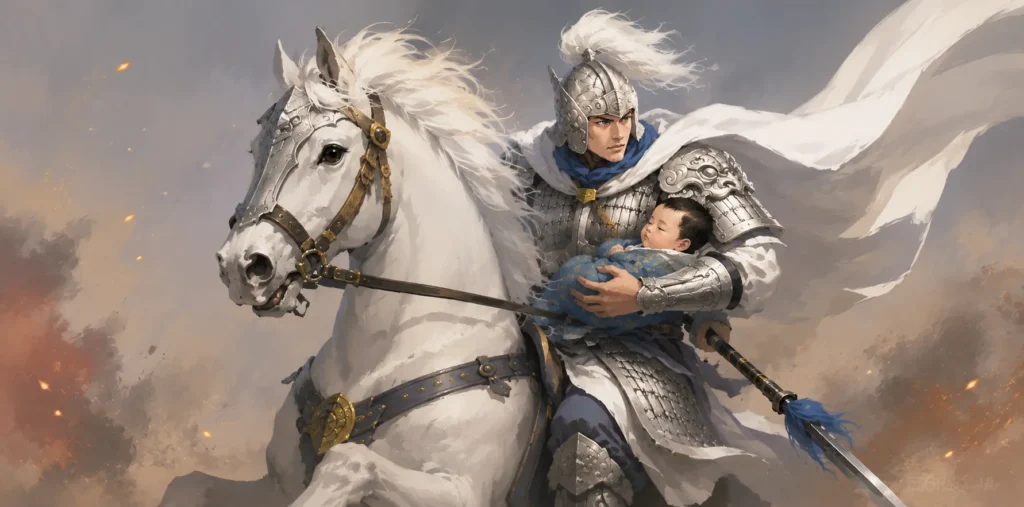
Zhao Yun Rescues A'Dou at Dangyang
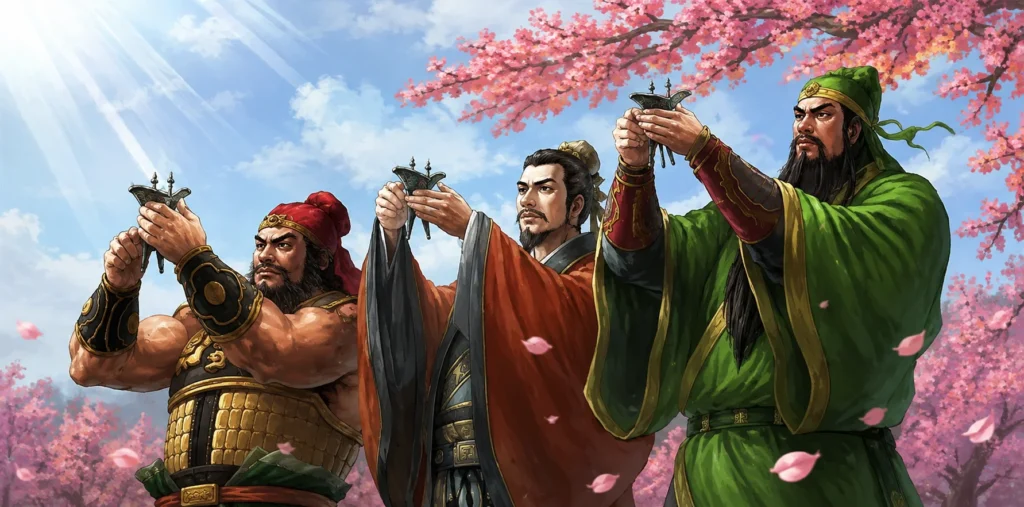
The Peach Garden Oath - 桃园结义 - Tao Yuan Jie Yi
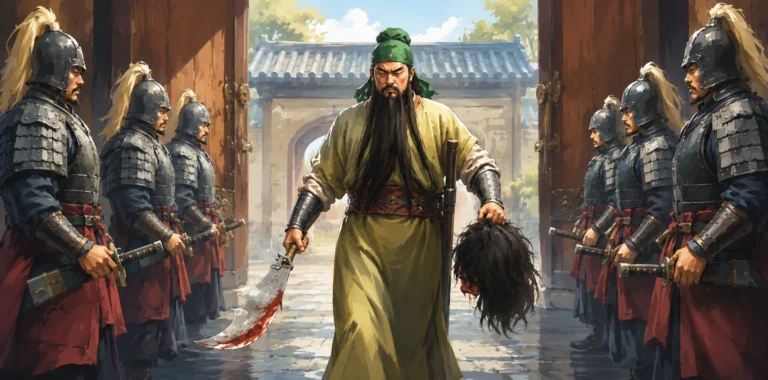
温酒斩华雄, Wēn Jiǔ Zhǎn Huá Xióng, Ôn Tửu Trảm Hoa Hùng
2 comments
[…] Xinyu) and Book of Jin (Jin Shu), when Ruan Ji visited the ancient battlefields of Guangling where Liu Bei, Xiang Yu, and Liu Bang once fought, he looked across the desolate landscape and lamented bitterly: […]
[…] Yuan (夏侯渊, Hạ Hầu Uyên) at Mount Dingjun (定军山) in 219 AD — the victory that let Liu Bei (刘备, Lưu Bị) hold Hanzhong and declare himself King of Hanzhong. Chen Shou ranks him among […]