







Contents
Biography & Historical Record
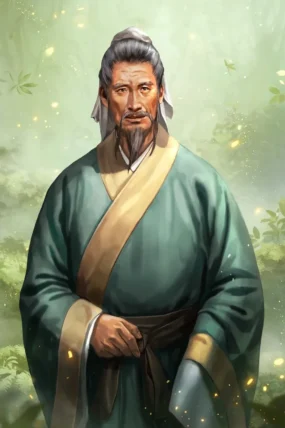
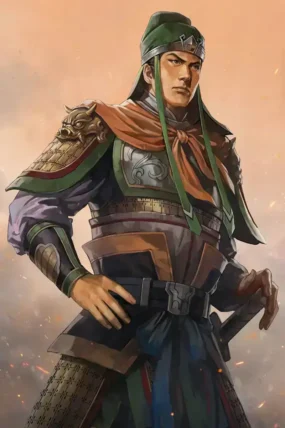
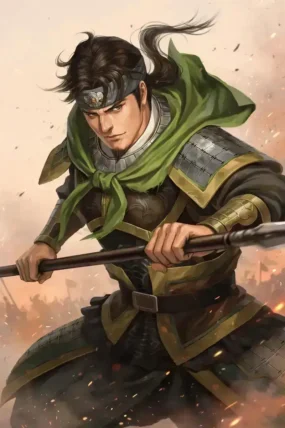
Guan Yu (160–220 AD), courtesy name Yunchang, was a legendary military general serving under the warlord Liu Bei during the late Eastern Han dynasty and early Three Kingdoms period. Hailing from Xiezhou in Hedong Commandery (present-day Yuncheng, Shanxi), Guan Yu played a foundational role in the civil wars that led to the collapse of the Han dynasty and the establishment of the state of Shu Han.
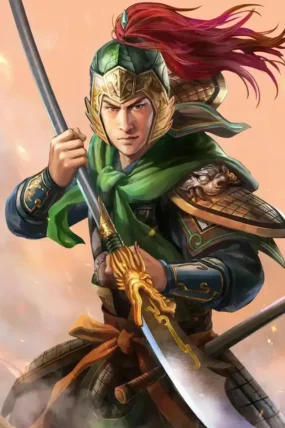
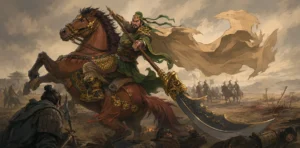
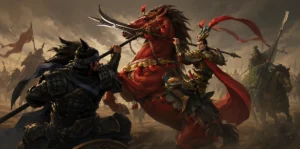
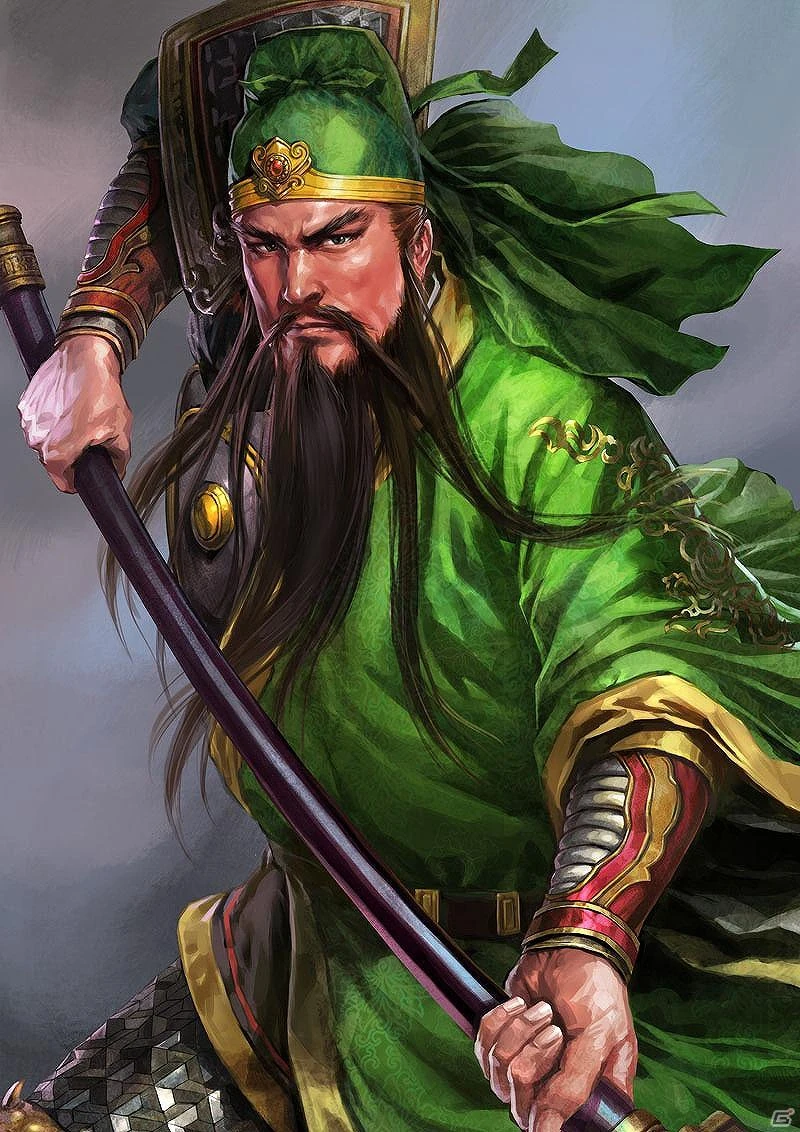
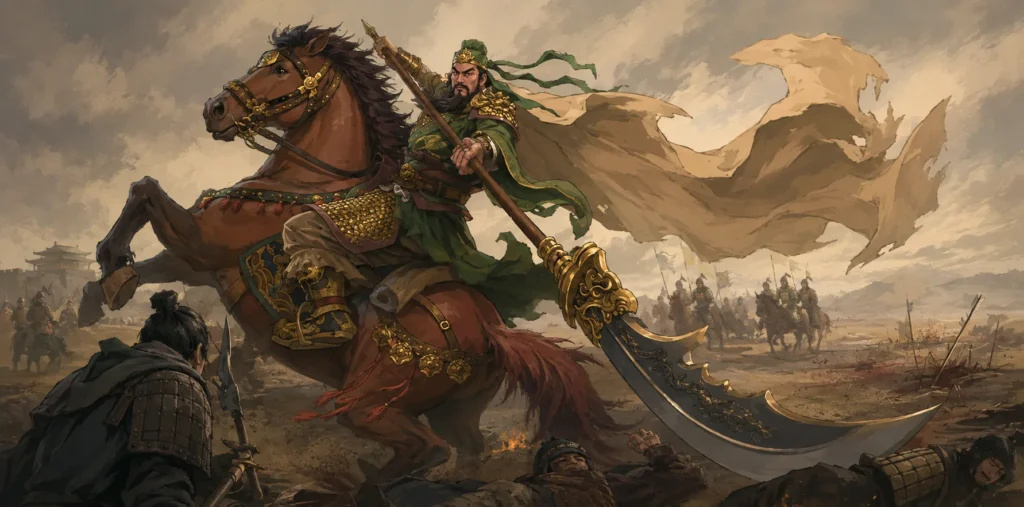
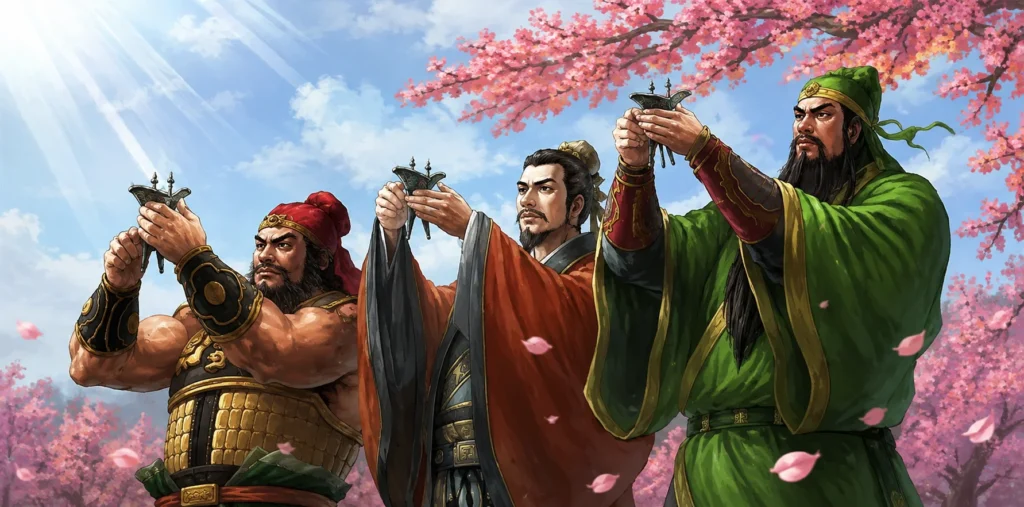
Renowned for his towering physical stature, formidable martial prowess, and magnificent long beard—which earned him the revered moniker “Beautiful Beard Lord”—Guan Yu was equally celebrated for his absolute loyalty, righteousness, and unyielding adherence to moral principles. Alongside Zhang Fei, he formed a lifelong bond with Liu Bei, famously swearing the Oath of the Peach Garden in a small orchard to protect the realm and restore the Han dynasty. Throughout his storied military career, Guan Yu achieved countless legendary feats, including slaying powerful enemy champions such as Hua Xiong, Yan Liang, and Wen Chou, crossing five enemy passes and slaying six blocking generals to escort Liu Bei’s wives safely, and successfully governing and defending Jing Province as its grand governor.
In 219 AD, Guan Yu launched the ambitious Campaign against Fan Castle, flooding the enemy fortress with the waters of the Han River, capturing the Wei general Yu Jin, and slaying the fierce warrior Pang De. However, following a surprise strategic betrayal by Eastern Wu orchestrated by Lü Meng and Sun Quan, Jing Province fell. Guan Yu was encircled, trapped at Maicheng (Mai Castle), and ultimately captured and executed by Wu forces at the age of 60 alongside his eldest son Guan Ping. Following his death, Guan Yu’s historical legacy transcended generations, eventually leading to his deification as the Chinese God of War, martial patron, and the universal symbol of supreme loyalty and righteousness (Emperor Guan / Guandi).
Role in Romance of the Three Kingdoms
In Luo Guanzhong’s epic historical novel Romance of the Three Kingdoms, Guan Yu is depicted as the ultimate paragon of martial honor, loyalty, and brotherhood. From the opening Oath of the Peach Garden in Chapter 1 to his tragic martyrdom at Maicheng in Chapter 77, Guan Yu’s narrative stands at the very beating heart of the saga. Key highlights include his heroic duel at Sishui Pass, his temporary surrender and honorable departure from Cao Cao’s camp after fully repaying his debts, his miraculous escape across five passes, and his fateful defense of Jing Province.
Notable Quotes & Famous Sayings
- “Though we are born on different days, we die together on the same.” — Guan Yu reciting the Oath of the Peach Garden with Liu Bei and Zhang Fei.
- “Better to die standing upright than live on bended knees!” — Guan Yu displaying his indomitable pride and righteousness before his execution at Maicheng.
- “I know Cao Cao treats me well, but I have received great favors from my lord Liu Bei, and I cannot stay here forever.” — Guan Yu explaining his unwavering loyalty to Zhang Liao.
Guan Yu (关羽) — Historical & Literary Timeline
184 AD
Oath of the Peach Garden
Meets Liu Bei and Zhang Fei in Zhuozhou, swearing a solemn brotherhood in a peach garden to suppress the Yellow Turban Rebellion and restore the Han dynasty.
190 AD
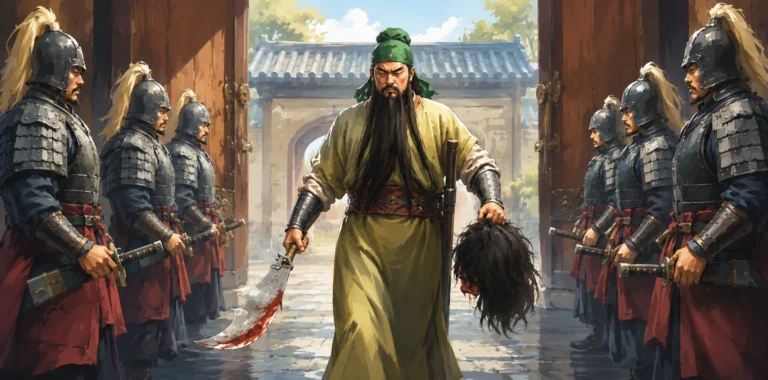
Slaying Hua Xiong at Sishui Pass
Flashes his legendary martial prowess by volunteering to fight and slaying Dong Zhuo’s champion general Hua Xiong while the wine poured for him is still warm.
200 AD — Chapters 25–27
Three Conditions, Crossing Five Passes, and Slaying Six Generals
Temporarily surrenders to Cao Cao under three strict honorable conditions to protect Liu Bei’s wives; upon learning of Liu Bei’s whereabouts, Guan Yu declines all rewards, breaks through five enemy passes, slays six blocking commanders, and reunites with his sworn brothers.
208 AD — Chapters 41–50
Battle of Red Cliffs & Huarong Trail
Participates in the allied coalition victory at Red Cliffs; commands the strategic Huarong Trail where he honors past kindness by risking his life to release a defeated Cao Cao.
219 AD — Chapters 73–76
Campaign against Fan Castle
Invades northern territories, floods Fan Castle with Han River waters, defeats Yu Jin, captures and executes Pang De, and wounds Cao Ren.
219 AD
Tragic Fall at Maicheng
Betrayed by Eastern Wu and abandoned by Meng Da at Shangyong, Guan Yu is ambushed and executed at Maicheng by Sun Quan’s forces.
For detailed historical records, archives, and official chronicles, explore Guan Yu on Wikipedia.
Key Relationships
Family
- Father: Guan Yi (关毅, Quan Nghị) – courtesy name Dao Yuan (道远, Đạo Viễn): A modest and filial scholar from Xiezhou, Hedong Commandery; recorded in Eastern Han stone steles and local genealogies discovered during the Qing Dynasty, later posthumously elevated by the imperial court to Duke Guangzhao (光昭公).
- Mother: Lady Wang (王氏, Vương thị) – Duchess Consort Guangzhao (光昭公夫人, Quang Chiêu Công phu nhân): An upright and benevolent matriarch from Xiezhou who raised Guan Yu in their ancestral hometown; officially enshrined alongside Guan Yu in imperial temples and posthumously granted the title Duchess Consort Guangzhao.
- Wife:
- Wife 1 (Historical Primary Wife & Stele Genealogies): Lady Hu / Hu Yueying (胡氏 / 胡玥英, Hồ thị / Hồ Nguyệt Anh) – Lady of Dignified Virtue (威德夫人, Uy Đức phu nhân): Daughter of scholar Hu Bin (胡斌) and the legitimate primary wife of Guan Yu who shared his early hardships in Xiezhou and bore his heirs Guan Ping (in history) and Guan Xing; posthumously enfeoffed as Lady Weide during the Song Dynasty.
- Wife 2 (Folk Literature & Theatrical Tradition): Hu Jinding (胡金定, Hồ Kim Định): Guan Yu’s spouse in Ming Dynasty folklore and Southern plays (Hua Guan Suo Zhuan), recognized as the mother of Guan Suo who stayed behind in Hedong pregnant when Guan Yu fled from local authorities after slaying a corrupt village tyrant.
- Wife 3 (Historical Betrothal Request Anecdote): Lady Du (杜氏, Đỗ thị): Former wife of Lu Bu’s subordinate Qin Yilu (秦宜禄); Guan Yu repeatedly requested Cao Cao to award her to him as his wife following the Siege of Xiapi (198 AD), but Cao Cao broke his promise and took her as his personal concubine upon witnessing her exceptional beauty.
- Children:
- Guan Ping (关平, Quan Bình): Eldest son who served as his trusted lieutenant and was captured and executed alongside him at Maicheng in 219 AD.
- Guan Xing (关兴, Quan Hưng): Second son who survived him and later became a prominent official and general for the state of Shu Han.
- Guan Suo (关索, Quan Sách): Third son who appears prominently in folklore and later literary adaptations of the Three Kingdoms period.
- Guan Yinping (关银屏, Quan Ngân Bình): Daughter whose rejection of a marriage proposal from Sun Quan’s son served as a catalyst for diplomatic tensions between Shu and Wu.

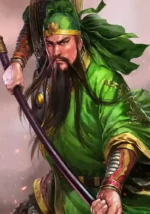





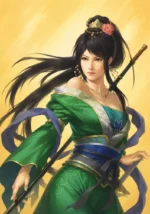

Friends
- Liu Bei (刘备, Lưu Bị): Sworn brother and sovereign; the two shared a lifelong bond cemented by the Oath of the Peach Garden in 184 AD.
- Zhang Fei (张飞, Trương Phi): Sworn brother and fellow warrior who joined Guan Yu and Liu Bei in their quest to restore the Han dynasty.
- Zhuge Liang (诸葛亮, Gia Cát Lượng): Prime Minister of Shu Han and chief strategist who coordinated military efforts with Guan Yu during the defense of Jing Province.
- Zhao Yun (赵云, Triệu Vân): Fellow member of the Five Tiger Generals who fought alongside Guan Yu in numerous campaigns for Liu Bei.
- Zhang Liao (张辽, Trương Liêu): A close friend from their youth who served Cao Cao; he famously acted as a mediator during Guan Yu’s temporary service to the Wei warlord.
- Liao Hua (廖化, Liêu Hóa): A loyal subordinate and commander who served under Guan Yu during his tenure as the governor of Jing Province.
Enemies
- Cao Cao (曹操, Tào Tháo): A rival warlord who deeply admired Guan Yu’s honor, though they stood on opposing sides for most of their careers.
- Sun Quan (孙权, Tôn Quyền): Ruler of Eastern Wu who orchestrated the betrayal of the alliance, leading to the invasion of Jing Province and Guan Yu’s execution in 219 AD.
- Lü Meng (吕蒙, Lã Mông): Wu Grand Viceroy who masterminded the strategic capture of Jing Province, directly leading to Guan Yu’s downfall.
- Hua Xiong (华雄, Hoa Hùng): Dong Zhuo’s champion whom Guan Yu famously slew at Sishui Pass in 190 AD.
- Yan Liang (颜良, Nhan Lương): Yuan Shao’s general whom Guan Yu killed during the Battle of Baima in 200 AD.
- Wen Chou (文丑, Văn Xú): Yuan Shao’s general whom Guan Yu defeated and killed shortly after the death of Yan Liang.
- Pang De (庞德, Bàng Đức): Wei general who fought Guan Yu at Fan Castle in 219 AD and was executed after refusing to surrender.
Other
- Emperor Xian (汉献帝, Hán Hiến Đế): The final emperor of the Eastern Han dynasty, whom Guan Yu remained loyal to throughout his service to Liu Bei.
Comrades

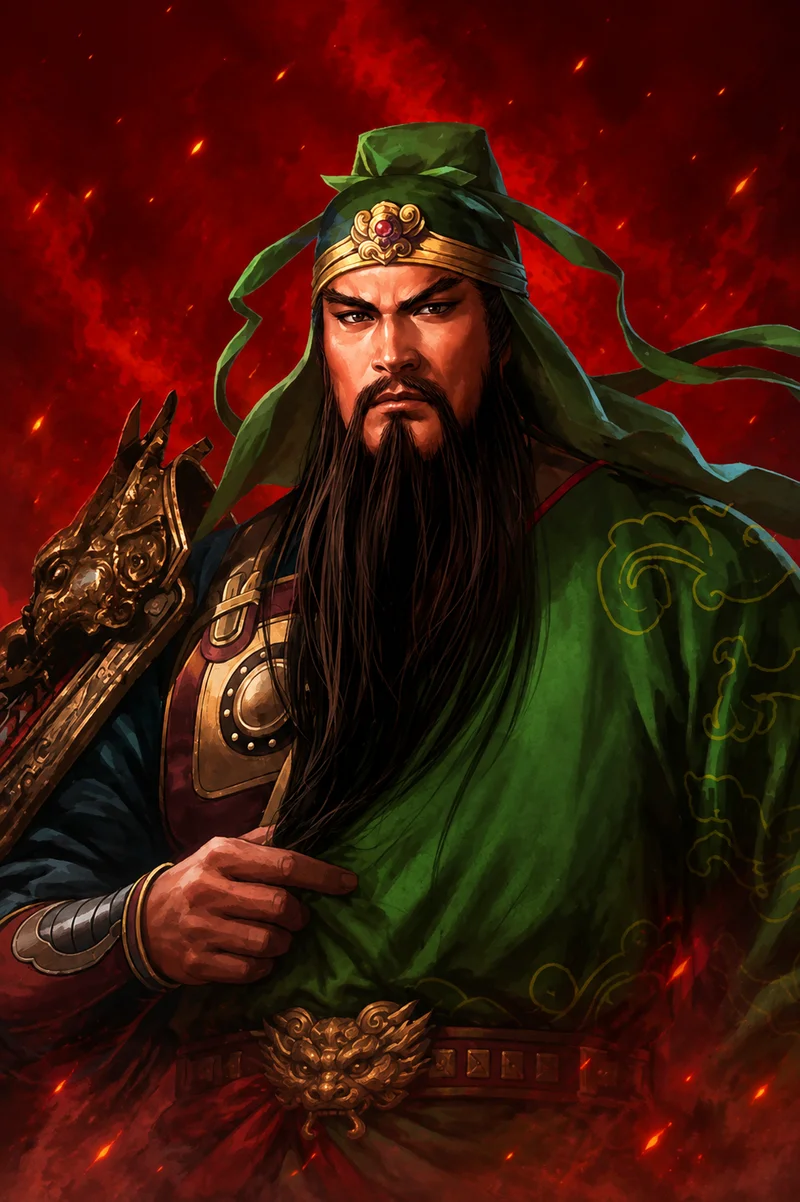

Appearance
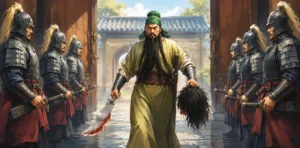

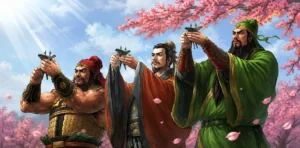
In Novel
Chapter 1
- Guan Yu (关羽, Quan Vũ): Warrior from Xiezhou, courtesy name Yunchang (云长), who formed the legendary Oath of the Peach Garden with Liu Bei (刘备, Lưu Bị) and Zhang Fei (张飞, Trương Phi) and slew Yellow Turban general Cheng Yuanzhi (程远志, Trình Viễn Chí) with his Green Dragon Crescent Blade.
Chapter 2
- Guan Yu (关羽, Quan Vũ): Assisted Liu Bei (刘备, Lưu Bị) in defeating Yellow Turban rebels at Yangcheng and Wancheng.
Chapter 5
- Guan Yu (关羽, Quan Vũ): Stepped forward from low rank at the allied coalition council to slay Hua Xiong (华雄, Hoa Hùng) before his wine grew cold, and participated in the three-hero duel against Lü Bu (吕布, Lã Bố) at Hulao Pass.
Chapter 11
- Guan Yu (关羽, Quan Vũ): Decapitated Yellow Turban chieftain Guan Hai (管亥, Quản Hợi) to lift the siege of Kong Rong (孔融, Khổng Dung) at Beihai, and aided Tao Qian (陶谦, Đào Khiêm) in Xuzhou.
Chapter 14
- Guan Yu (关羽, Quan Vũ): Fought Yuan Shu’s (袁术, Viên Thuật) commander Ji Ling (纪灵, Kỷ Linh) to a thirty-bout draw at Xiaopei.
Chapter 19
- Guan Yu (关羽, Quan Vũ): Participated in the water siege of Xiapi that captured Lü Bu (吕布, Lã Bố).
Chapter 21
- Guan Yu (关羽, Quan Vũ): Executed Cao Cao’s (曹操, Tào Tháo) general Che Zhou (车胄, Xa Trụ) to reclaim Xuzhou for Liu Bei (刘备, Lưu Bị).
Chapter 22
- Guan Yu (关羽, Quan Vũ): Defeated and captured Cao Cao’s (曹操, Tào Tháo) general Wang Zhong (王忠, Vương Trung) outside Xiapi.
Chapter 24
- Guan Yu (关羽, Quan Vũ): Besieged in Xiapi by Cao Cao (曹操, Tào Tháo) during the eastern campaign.
Chapter 25
- Guan Yu (关羽, Quan Vũ): Agreed to the ‘Three Conditions’ with Cao Cao (曹操, Tào Tháo) on Tushan to protect Liu Bei’s wives, and decapitated Yan Liang (颜良, Nhan Lương) in a single charge at Boma.
Chapter 26
- Guan Yu (关羽, Quan Vũ): Slew Wen Chou (文丑, Văn Sú) at Yanford, and sealed his gold and resigned his titles upon discovering Liu Bei’s (刘备, Lưu Bị) whereabouts in Hebei.
Chapter 27
- Guan Yu (关羽, Quan Vũ): Rode a thousand li on the Red Hare, breaking through Five Passes and slaying Six Generals to escort Liu Bei’s wives to safety.
Chapter 28
- Guan Yu (关羽, Quan Vũ): Slew Cai Yang (蔡阳, Sái Dương) at Gucheng to prove his fidelity to Zhang Fei (张飞, Trương Phi), reuniting the three brothers.
Chapter 31
- Guan Yu (关羽, Quan Vũ): Rescued Liu Bei (刘备, Lưu Bị) during the retreat from Runan and accompanied him to Jingzhou.
Chapter 39
- Guan Yu (关羽, Quan Vũ): Commanded river ambushes at the Battle of Bowang Slope under Zhuge Liang’s (诸葛亮, Gia Cát Lượng) inaugural strategic plan.
Chapter 40
- Guan Yu (关羽, Quan Vũ): Cut off Cao Ren’s (曹仁, Tào Nhân) retreat at the Battle of Xinye using river flood gates.
Chapter 42
- Guan Yu (关羽, Quan Vũ): Brought naval reinforcements from Jiangxia to rescue Liu Bei (刘备, Lưu Bị) following the disaster at Changban Slope.
Chapter 49
- Guan Yu (关羽, Quan Vũ): Stationed at Huarong Trail to intercept the fleeing Cao Cao (曹操, Tào Tháo) following the inferno at Red Cliffs.
Chapter 50
- Guan Yu (关羽, Quan Vũ): Spared Cao Cao’s (曹操, Tào Tháo) life at Huarong Trail out of personal honor and past gratitude, allowing the warlord to escape.
Chapter 51
- Guan Yu (关羽, Quan Vũ): Captured Changsha, engaging veteran warrior Huang Zhong (黄忠, Hoàng Trung) in single combat and sparing him before Wei Yan (魏延, Ngụy Diên) surrendered the city.
Chapter 65
- Guan Yu (关羽, Quan Vũ): Entrusted with supreme civil and military command of Jingzhou while Liu Bei (刘备, Lưu Bị) conquered the Riverlands.
Chapter 66
- Guan Yu (关羽, Quan Vũ): Attended Lu Su’s (鲁肃, Lỗ Túc) banquet at Lukou armed only with a single blade, outwitting Eastern Wu’s ambush.
Chapter 73
- Guan Yu (关羽, Quan Vũ): Enfeoffed as Senior General of the Front and head of the Five Tiger Generals, launching the northern offensive against Fan City.
Chapter 74
- Guan Yu (关羽, Quan Vũ): Drowned Yu Jin’s (于禁, Vu Cấm) seven divisions by breaching the Han River dikes, capturing Yu Jin and executing Pang De (庞德, Bàng Đức).
Chapter 75
- Guan Yu (关羽, Quan Vũ): Underwent bone-scraping surgery by physician Hua Tuo (华佗, Hoa Đà) for a poisoned arrow wound while calmly playing weiqi.
Chapter 76
- Guan Yu (关羽, Quan Vũ): Trapped in Maicheng after Lu Xun (陆逊, Lục Tốn) and Lü Meng (吕蒙, Lã Mông) seized Jingzhou through treachery.
Chapter 77
- Guan Yu (关羽, Quan Vũ): Captured in an ambush at Zhangxiang and executed by Sun Quan (孙权, Tôn Quyền) in 219 AD, manifesting as a protective deity at Mount Yuquan.
In History
Summary
- Guan Yu (关羽, Quan Vũ), courtesy name Yunchang, was a major military commander of Liu Bei (刘备, Lưu Bị) and one of the most prominent figures of the late Eastern Han period.
Year: 200 AD
- After being separated from Liu Bei, Guan Yu (关羽, Quan Vũ) temporarily served Cao Cao (曹操, Tào Tháo). He later killed Yan Liang (颜良, Nhan Lương) during the Guandu campaign and returned to Liu Bei.
Year: 219 AD
- Guan Yu (关羽, Quan Vũ) captured Xiangyang and Fancheng and defeated Cao Cao’s forces during the Fancheng campaign. His advance was later undermined by the Wu invasion of Jing Province.
Year: 220 AD
- Guan Yu (关羽, Quan Vũ) was captured and executed by forces of Sun Quan (孙权, Tôn Quyền) at Linju.
Historical Record
- Guan Yu (关羽, Quan Vũ) was a real historical commander. Later generations greatly expanded his reputation, eventually venerating him as a deity of loyalty and martial virtue.
Gallery





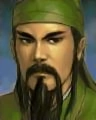

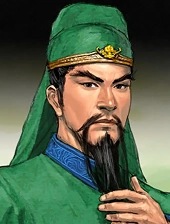
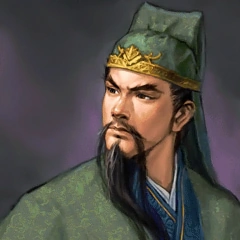




Appearance
Famous Allusion
Crossing Five Passes and Slaying Six Generals
The Peach Garden Oath - 桃园结义 - Tao Yuan Jie Yi
温酒斩华雄, Wēn Jiǔ Zhǎn Huá Xióng, Ôn Tửu Trảm Hoa Hùng