
Contents
The Eternal Bond of Brotherhood Among Liu Bei, Guan Yu, and Zhang Fei
Among all the legendary stories in Chinese culture and literature, few carry as much emotional weight, moral power, and cultural resonance as the Peach Garden Oath (Tao Yuan Jie Yi / 桃园结义). Recorded in Chapter 1 of Luo Guanzhong’s classic epic Romance of the Three Kingdoms (三国演义), this moment sets the entire narrative engine of the Three Kingdoms era into motion, serving as the supreme symbol of absolute loyalty, righteousness, and selfless brotherhood (Yi / 义).
Historical Context and Setting
(184 AD – The Dawn of the Yellow Turban Rebellion)
In the 6th year of Guanghe (184 AD), during the reign of Emperor Ling in the late Eastern Han Dynasty, imperial corruption and widespread famine pushed the peasantry to desperation. A mystic named Zhang Jue (张角) launched the massive Yellow Turban Rebellion (黄巾之乱), throwing the Chinese empire into chaos.
Overwhelmed by the uprising, the Han imperial court issued urgent decrees to local governors to recruit volunteer armies to suppress the rebels. One such decree was posted on the notice board in Zhuo County (涿县 / modern Zhuozhou, Hebei Province).
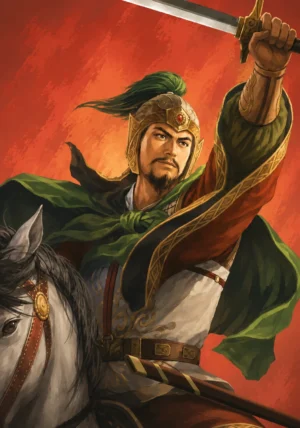
Watching the notice board was a young man named Liu Bei (title: Xuande / 玄德), a distant descendant of the Han royal family who lived in poverty, selling straw sandals and woven mats to support his mother. As Liu Bei stared at the recruitment poster and let out a deep, heavy sigh, a booming voice shouted from behind him:
“Why sigh, big man, if you do not offer your help to your country?”
The Fateful Encounter of Three Heroes
(The Meeting at the Inn)
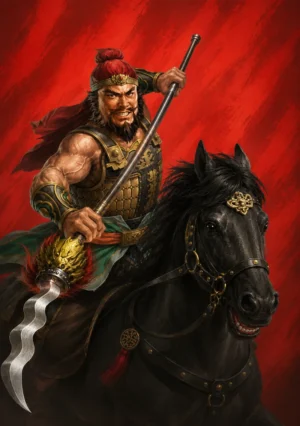
Turning around, Liu Bei saw a towering man standing eight chi tall, with a leopard-like head, round piercing eyes, a sharp swallow-like chin, and a tiger-like beard. This was Zhang Fei (title: Yide / 翼德), a wealthy local butcher and wine merchant known for his fiery temper and martial strength.
Impelled by a shared desire to restore peace to the realm, the two men hit it off immediately and retired to a local tavern to drink wine and discuss the country’s dire situation.
While drinking, another massive man entered the inn to rest, calling out to the waiter:
“Serve wine quickly! I must hurry to the city to join the volunteer army!”
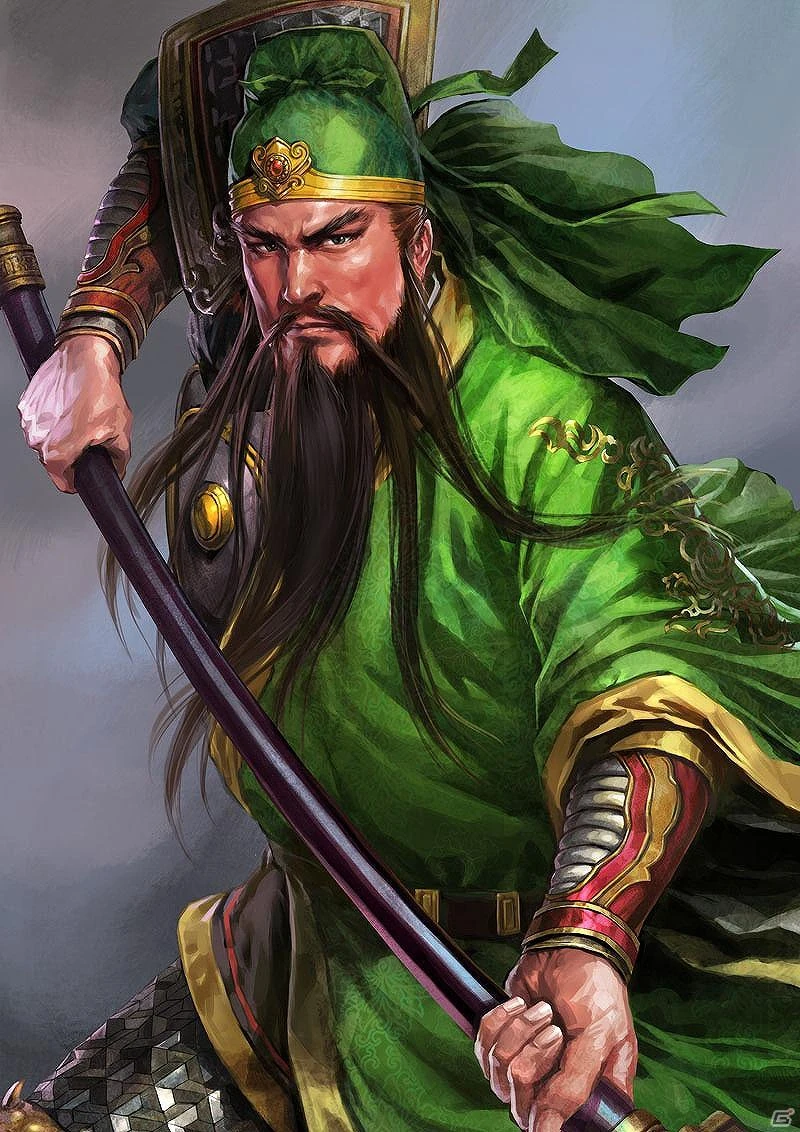
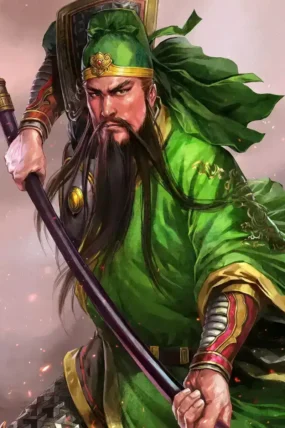
Liu Bei looked over and saw a magnificent warrior standing nine chi tall, with a two-foot-long flowing beard, cheeks red as ripe dates, lips full and crimson, eyes like a crimson phoenix, and eyebrows like sleeping silkworms. His posture radiated awe-inspiring majesty.
This was Guan Yu (title: Yunchang / 云长), a fugitive from Hedong who had been on the run for five years after slaying a corrupt local bully who preyed on the poor.
Recognizing each other’s noble spirits, Liu Bei and Zhang Fei invited Guan Yu to join their table. As they drank together, they discovered that all three shared the exact same burning ambition: to save the innocent people, defend the Han Dynasty, and bring order to a broken world.


The Oath in the Peach Garden
(Binding Three Souls into One)
Inspired by their shared vision, Zhang Fei made a generous proposal:
“Behind my farm, there is a peach garden in full bloom. Tomorrow, let us offer sacrifices to Heaven and Earth, swear an oath of brotherhood among the three of us, and unite our hearts and strength for the grand cause!”
Liu Bei and Guan Yu enthusiastically agreed.
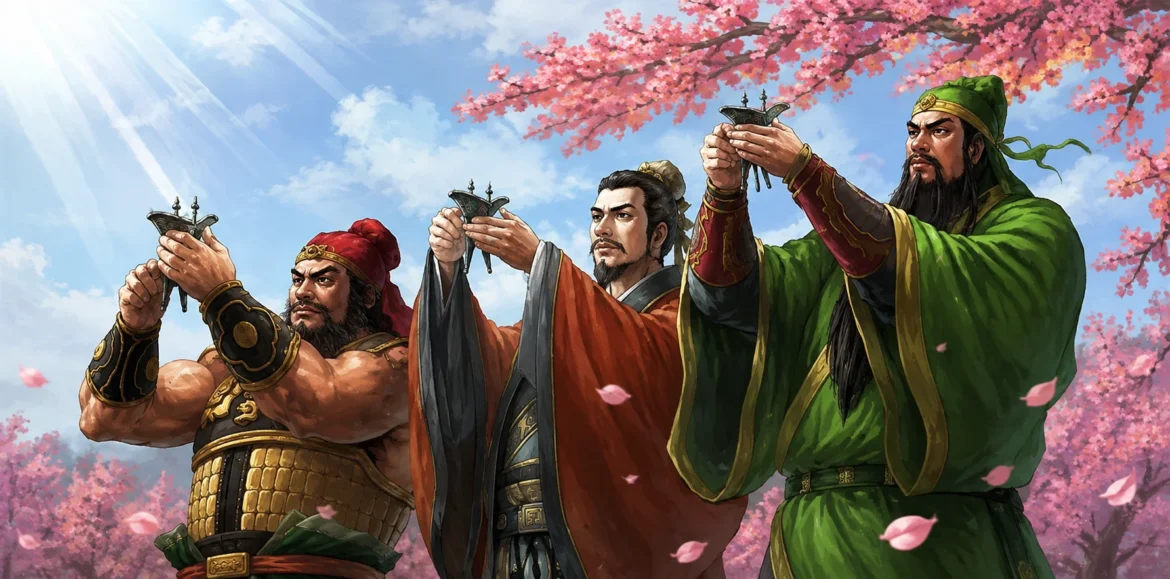
The following day, beneath a canopy of vibrant pink peach blossoms, the three men set up an altar. They slaughtered a black bull and a white horse as ceremonial offerings, lit incense burners, and knelt side-by-side in deep reverence.
Together, they recited the timeless, immortal oath:
The Sacred Text of the Oath:
“We three—Liu Bei, Guan Yu, and Zhang Fei—though born of different surnames, join together as brothers in a single heart and mind, to assist each other in times of danger, to rescue the nation, and to bring peace to the people.
We ask not to have been born on the same day, month, or year; we only ask to die on the same day, month, and year.
May Heaven above and Earth below witness our hearts! If any among us forgets this righteousness or turns his back on this vow, may Heaven and Earth strike him down!”
Following the oath, they bowed according to age:
-
Liu Bei (the eldest) became the First Brother (Big Brother / 大哥).
-
Guan Yu became the Second Brother (Second Brother / 二哥).
-
Zhang Fei (the youngest) became the Third Brother (Third Brother / 三弟).
The First Footsteps of the Brotherhood
(Forging Weapons and Raising the Army)
To fund their new army, Zhang Fei contributed his entire personal fortune, slaughtering livestock and donating his estate. Soon after, two wealthy horse merchants from Zhongshan named Zhang Shiping (张世平) and Su Shuang (苏双) passed through Zhuo County. Deeply moved by the three brothers’ lofty noble mission, the merchants gifted them 50 fine warhorses, 500 ounces of gold and silver, and 1,000 catties of refined steel.
Using this high-grade steel, the brothers forged their iconic signature weapons:
-
Liu Bei: The Dual Twin Swords (双股剑 / Shuāng Gǔ Jiàn).
-
Guan Yu: The legendary 82-catty Green Dragon Crescent Blade (青龙偃月刀 / Qīng Lóng Yǎn Yuè Dāo).
-
Zhang Fei: The terrifying eight-foot Viper Serpent Spear (丈八蛇矛 / Zhàng Bā Shé Máo).



They recruited 500 local brave men, built their volunteer unit, and marched out under the banner of Liu Bei to fight their first battles against the Yellow Turban rebels, embarking on a tumultuous journey that would shake the foundations of China for decades.
Summary of Key Details
| Reference / Aspect | Historical & Literary Facts |
| Novel Chapter | Romance of the Three Kingdoms, Chapter 1 |
| Year of Event | Spring of 184 AD (6th year of Guanghe / 光和七年) |
| Location | Zhang Fei’s Peach Garden, Zhuo County (涿县桃园) |
| Key Characters | Liu Bei (Xuande), Guan Yu (Yunchang), Zhang Fei (Yide) |
| Sacrificial Offerings | A black bull, a white horse, wine, and incense |
| Famous Quote | “Ask not to be born on the same day… only ask to die on the same day.” |
| First Weapons Forged | Twin Swords (Liu Bei), Green Dragon Blade (Guan Yu), Serpent Spear (Zhang Fei) |
Related

Cultural Significance and Modern Legacy
While historical records such as Chen Shou’s Records of the Three Kingdoms (三国志) confirm that Liu Bei, Guan Yu, and Zhang Fei were as close as brothers and “slept on the same bed,” the formal, ritualistic “Peach Garden Oath” itself was a masterstroke of literary romanticism by Luo Guanzhong.
Nevertheless, the Oath of the Peach Garden has left an indelible mark on East Asian society:
-
The Ultimate Code of Righteousness (Yi / 义):
It established the benchmark for loyalty in Chinese culture—a commitment that transcends blood relations, social status, wealth, and power.
-
Societal and Guild Traditions:
For centuries, brotherhoods, martial arts schools, merchant guilds, and organizations across China and East Asia have invoked the spirit of the Peach Garden Oath when swearing loyalty among partners or members.
-
Symbolism of the Peach Blossom:
The blooming peach garden symbolizes rebirth, purity of heart, and the fresh, untainted beginning of a life-long journey dedicated to a righteous cause.
1 comment
[…] of Heaven, Zhang Bao General of Earth, Zhang Liang General of the People. Novel Ch. 1 also frames the Peach Garden oath and Cheng Yuanzhi’s death at Guan Yu’s hands as the Youzhou answer to the […]