

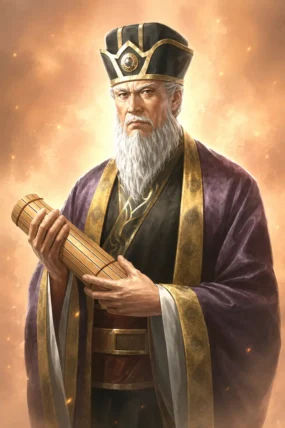


Hua Biao (华表, Hoa Biểu; 204–275 AD; courtesy name Weirong 伟容), native of Gaotang in Pingyuan, was a prominent high-ranking minister who served both the Cao Wei and Western Jin dynasties, son of Cao Wei Grand Commandant and Chancellor Hua Xin (华歆), and father of Hua Bo and Hua Zhou.
Inheriting the austere integrity, extensive Confucian erudition, and political prudence of his father Hua Xin, Hua Biao entered Cao Wei officialdom during the reign of Cao Rui (Cao Rui). He rose through the ministerial ranks, serving as Gentleman of the Yellow Gate (*Huangmen Shilang*), Palace Attendant (*Shizhong*), and Minister of Finance (*Dasi nong*). Throughout the vicious political purges between the Sima clan and the Cao imperial house, Hua Biao maintained a dignified, upright neutrality, refusing bribery, living in modest quarters, and managing state treasuries with scrupulous honesty.
Following the establishment of the Western Jin Dynasty by Sima Yan (Emperor Wu of Jin) in 265 AD, Hua Biao was treated with the highest veneration as an elder statesman of the empire. He was appointed Minister of Ceremonies (*Taichang* 太常), overseeing imperial ancestral rituals, Confucian academies, and statutory court rites. Praised in the Book of Jin for his unyielding decorum and incorruptibility, Hua Biao retired with the rank of Guangluxun (Minister of the Household), passing away peacefully in 275 AD at the age of seventy-one.
Contents
Role in History (Jin Shu)
Book of Jin (Jin Shu, vol. 44, Biography of Hua Biao): “Hua Biao was dignified, calm, and devoted to classical learning. He served across the Wei and Jin courts without staining his name. As Minister of Ceremonies, he reformed rites and promoted worthy scholars. Even after rising to the highest three ministers, his family lived simply in a thatched pavilion, possessing no luxurious carriages.”
Hua Biao — Historical & Literary Timeline
204 AD
Birth in Gaotang
Born into the prestigious Hua family of Pingyuan, son of Chancellor Hua Xin.
c. 235 AD
Service in Cao Wei
Enters imperial service as Gentleman of the Yellow Gate under Emperor Ming (Cao Rui).
250–265 AD
Palace Attendant & Dasi nong
Manages state finance and palace counsel during the regent rule of Sima Shi and Sima Zhao.
265 AD
Minister of Ceremonies (Taichang)
Appointed by Jin Emperor Wu (Sima Yan) to oversee imperial rites and ancestral protocols.
275 AD
Passing at Age 71
Passes away in Luoyang with full state honors and posthumous elevation.
Key Relationships
Family
- Father Hua Xin (华歆, Hoa Hâm): Grand Commandant and Chancellor of Cao Wei, famed for austere virtue.
- Sons Hua Bo (华博), Hua Zhou (华周 / 华廙): High-ranking Western Jin ministers and Confucian scholars.
- Grandson Hua Jiao (华峤): Celebrated Jin historian and author of the Book of Later Han (Han Hou Shu).
Friends
- Jin Sovereign Sima Yan (司马炎 – Emperor Wu): Founding emperor of Jin who revered Hua Biao as a pillar of court rites.
- Sima Regent Sima Zhao (司马昭): Wei regent under whom Hua Biao served as trusted financial administrator.
Enemies
- Extravagant Nobles Corrupt Oligarchs of Luoyang: Shamed by Hua Biao’s lifelong poverty and frugal lifestyle.
Other
- Preceding Sovereign Cao Rui (Emperor Ming of Wei): First emperor whom Hua Biao served in the palace.
In Jin Shu
Biography of Hua Biao
“Though holding the golden seals of high state office, his gates were plain wood and his robes bore patches. He was the living standard of court rectitude.”
Historical Significance
Hua Biao preserved the moral and intellectual continuity of the Pingyuan Hua clan across the Wei-Jin dynastic change, providing Sima Yan’s new empire with institutional legitimacy and ceremonial refinement.