


Here is the exhaustive biography, ancestral background, historical records, and Romance of the Three Kingdoms narrative for Ding Yuan (丁原), courtesy name Jianyang (建陽) (died 189 AD), incorporating all detailed accounts of his provincial administration, military prowess, adoption of Lu Bu, and fatal clash with Dong Zhuo in the capital Luoyang.
Contents
Ancestry, Family Background & Early Life
Born into a humble family of obscure lineage, Ding Yuan (丁原), courtesy name Jianyang (建陽), was a native of northern China. In his youth, despite his poor background and limited scholarly literacy, he possessed bold courage, physical strength, and exceptional skill in martial arts, equestrianism, and archery. Recognized for his decisive nature and willingness to confront danger, he entered local government service as an administrative official (Li) and was assigned hazardous police duties, often pursuing brigands and bandits through difficult terrain. Whenever a crisis or armed robbery arose, Ding Yuan personally led the charge against criminals, earning a reputation for bravery and military effectiveness.
Rise as Inspector of Bing Province & Imperial Defense
Through his distinguished service, Ding Yuan steadily advanced in rank within the Eastern Han administration. He was eventually appointed Inspector of Bing Province (幷州刺史, Bingzhou Cishi). To secure the northern frontier against nomadic incursions and maintain internal order, he recruited and trained elite regional warriors. During this period, he encountered Lu Bu (呂布), a formidable warrior from Wuyuan Commandery renowned for his unrivaled martial ability. Recognizing Lu Bu’s immense talent, Ding Yuan appointed him as Chief Secretary (Master of Records / Zhubu) and treated him with extraordinary affection and generosity, bonding with him like a father to a son.
In 188–189 AD, as the Eastern Han Empire collapsed into widespread unrest following the Yellow Turban Rebellion and Liang Province uprisings, Emperor Ling of Han established the Western Garden Army. Ding Yuan was ordered to march his provincial troops to the capital region to bolster military presence. Following the death of Emperor Ling in 189 AD, the Commander-in-Chief He Jin (何進) secretly summoned regional warlords—including Ding Yuan and Dong Zhuo—to march their armies toward Luoyang to pressure the powerful court eunuchs (the Ten Attendants). Ding Yuan led his forces to Mengford (Mengjin) outside Luoyang and burnt the city outskirts to intimidate the eunuchs, receiving the appointment of Colonel of Cavalry (Jiqidowei) and Imperial Capital Administrator.
Clash with Dong Zhuo & Death
When He Jin was assassinated by the eunuchs and the capital erupted in chaos, Dong Zhuo arrived first in Luoyang and seized control of the young Emperor Shaodi (Liu Bian) and the imperial court. Seeking absolute authority, Dong Zhuo proposed deposing Emperor Shaodi in favor of his younger brother, Liu Xie (Emperor Xian). Ding Yuan fiercely opposed Dong Zhuo’s tyrannical ambition, asserting that the emperor had committed no wrongdoing and that a provincial general had no legal right to alter the succession.
Recognizing that Ding Yuan’s formidable troops and his fierce foster son Lu Bu posed the primary obstacle to his dictatorship, Dong Zhuo plotted to eliminate him. Dong Zhuo sent an emissary, Li Su (李肅), a fellow townsman of Lu Bu, to secretly visit Lu Bu. Li Su bribed Lu Bu with immense treasures, gold, pearls, and the legendary steed Red Hare (Chìtùmǎ). Tempted by greed and ambition, Lu Bu betrayed his benefactor. In the late hours of the night in 189 AD, Lu Bu entered Ding Yuan’s private tent, decapitated him, and presented his head to Dong Zhuo. Ding Yuan’s troops, leaderless and demoralized, were subsequently absorbed by Dong Zhuo, solidifying Dong Zhuo’s tyrannical grip over Luoyang and the Han imperial court.
Ding Yuan (丁原) — Historical & Literary Timeline
Late 180s AD — Inspector of Bing Province
Appointment & Recruitment of Lu Bu
Rises from humble origins through martial courage. Appointed Inspector of Bing Province (Bingzhou). Recruits Lu Bu as Chief Secretary (Master of Records) and treats him like his own son.
189 AD — Summoned to Luoyang
Response to He Jin’s Decree & Arrival at Mengford
Summoned by Regent General He Jin to march on the capital to eliminate the Ten Attendants. Burns Mengjin and positions his army near Luoyang, appointed Cavalry Commander.
189 AD — Confrontation with Dong Zhuo
Denouncing Deposition of Emperor Shaodi
At a royal banquet, Dong Zhuo proposes deposing Emperor Shaodi. Ding Yuan slams his table in fury, openly denouncing Dong Zhuo as a traitor. Lu Bu stands behind Ding Yuan with spear in hand, forcing Dong Zhuo to back down temporarily.
189 AD — Defeating Dong Zhuo in Battle
Victory Outside Luoyang City Walls
The next day, Ding Yuan leads his forces outside Luoyang. Championed by Lu Bu on the battlefield, Ding Yuan routes Dong Zhuo’s army, forcing Dong Zhuo to retreat over thirty li and erect defensive stockades.
189 AD — Betrayal & Assassination
Assassinated by Lu Bu for Red Hare
Dong Zhuo sends Li Su with the Red Hare horse and gold to bribe Lu Bu. Lu Bu slays Ding Yuan in his tent at night, presents his head to Dong Zhuo, and surrenders Ding Yuan’s army, leaving Dong Zhuo in absolute control of the capital.
Romance of the Three Kingdoms Narrative
In Luo Guanzhong’s historical novel Romance of the Three Kingdoms, Ding Yuan is portrayed as a loyal Han patriot and righteous official who courageously stands up against Dong Zhuo’s imperial usurpation. When Dong Zhuo hosts a grand banquet for high officials at Wenming Garden and proposes dethroning Emperor Shaodi in favor of the Prince of Chenliu (Liu Xie), Ding Yuan overturns his table in outrage, shouting: “Who are you to dare speak such treason? The Emperor is the legitimate ruler, wise and without fault!” As Dong Zhuo draws his sword to execute Ding Yuan, he notices the towering figure of Lu Bu standing behind Ding Yuan, brandishing a heavy spear and staring with murderous eyes, causing Dong Zhuo to hesitate. The next day, Ding Yuan leads his Army of Bing Province against Dong Zhuo outside the city gates. Led by Lu Bu, Ding Yuan’s forces smash through Dong Zhuo’s ranks, driving Dong Zhuo back thirty miles. Desperate, Dong Zhuo accepts Li Su’s counsel to bribe Lu Bu with the prized Red Hare, gold, and fine silk. Later that night, while Ding Yuan is reading by candlelight in his tent, Lu Bu enters armed with a sword. When Ding Yuan asks his foster son why he enters late, Lu Bu coldly declares, “I am a real man, how can I be your son?” and decapitates Ding Yuan. Lu Bu then surrenders Ding Yuan’s troops to Dong Zhuo, removing the sole military barrier to Dong Zhuo’s tyrannical regime.
For detailed historical records, archives, and official chronicles, explore Ding Yuan on Wikipedia.
Key Relationships
Family
- Lu Bu (吕布, Lã Bố): Adopted son in the novel. Highly favored and armed by Ding Yuan, but seduced by Dong Zhuo with gifts (Red Hare) and turned against Ding Yuan.
Friends
- He Jin (何进, Hà Tiến): General-in-Chief who summoned Ding Yuan and his elite Bingzhou cavalry to the capital Luoyang in 189 AD to intimidate the eunuchs.
- Zhang Liao (张辽, Trương Liêu): Subordinate commander originally serving under Ding Yuan in Bingzhou before transferring to Dong Zhuo and Lu Bu.
- Zhang Yang (张杨, Trương Dương): Fellow Bingzhou officer under Ding Yuan’s provincial command.
Enemies
- Dong Zhuo (董卓, Đổng Trác): Tyrant of Liangzhou who sought to depose Emperor Shao; Ding Yuan vehemently opposed him in the imperial court, leading Dong Zhuo to bribe Lu Bu to assassinate Ding Yuan in 189 AD.
- Li Ru (李儒, Lý Nho): Chief advisor to Dong Zhuo who devised the plot to bribe Lu Bu with the Red Hare steed to murder Ding Yuan.
Others
- No information
In Novel
Chapter 3
- Ding Yuan (丁原, Đinh Nguyên): Governor of Jingzhou and adoptive father of Lu Bu (吕布, Lã Bố), courtesy name Jianyang (建阳), who brought his provincial army to Luoyang and vehemently denounced Dong Zhuo’s (董卓, Đổng Trác) despotic plan to depose Emperor Shao (少帝, Thiếu Đế) at the Wenming Garden banquet; he defeated Dong Zhuo in battle the following day, but was subsequently betrayed and decapitated in his tent by Lu Bu, who was bribed by Dong Zhuo with the Red Hare steed and gold.
In History
Year: 188 AD
-
- Ding Yuan (丁原, Đinh Nguyên), styled Jianyang, became Inspector of Bing Province after the previous inspector Zhang Yi was killed during a rebellion. He was a capable military commander and recruited Lu Bu (吕布, Lã Bố), whom he appointed as a close subordinate.
Year: 189 AD
-
- Ding Yuan (丁原, Đinh Nguyên) was summoned to Luoyang with his troops during the political crisis following the death of Emperor Ling. He opposed Dong Zhuo (董卓, Đổng Trác) and refused to support Dong Zhuo’s seizure of political power. Dong Zhuo won Lu Bu over to his side, and Lu Bu killed Ding Yuan. Ding Yuan was therefore eliminated in the political struggle that followed Dong Zhuo’s entry into the capital.
Historical Status
-
- Ding Yuan (丁原, Đinh Nguyên) was a real historical figure. His courtesy name was Jianyang (建阳), but the dramatic details of his relationship with Lu Bu in later literature should be distinguished from the more limited historical record.
Gallery


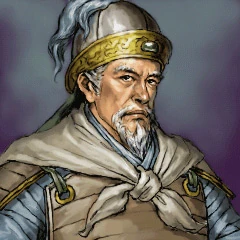
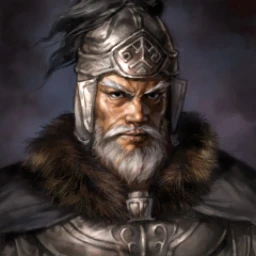
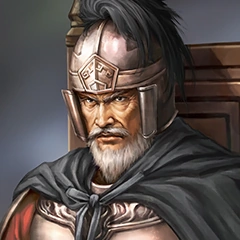
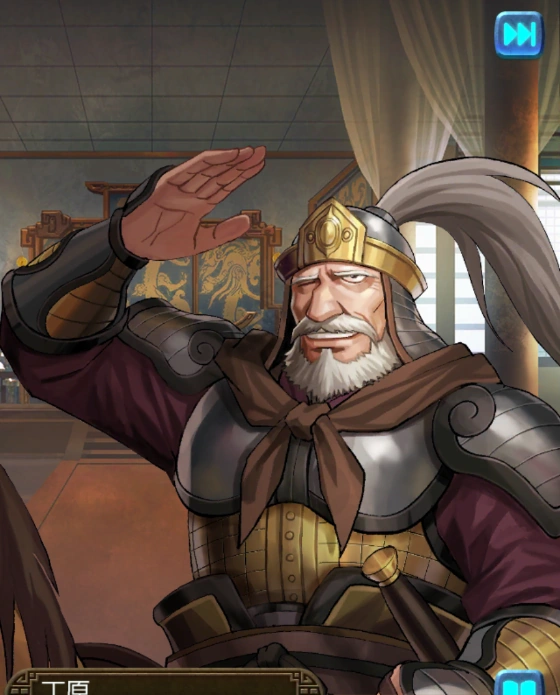

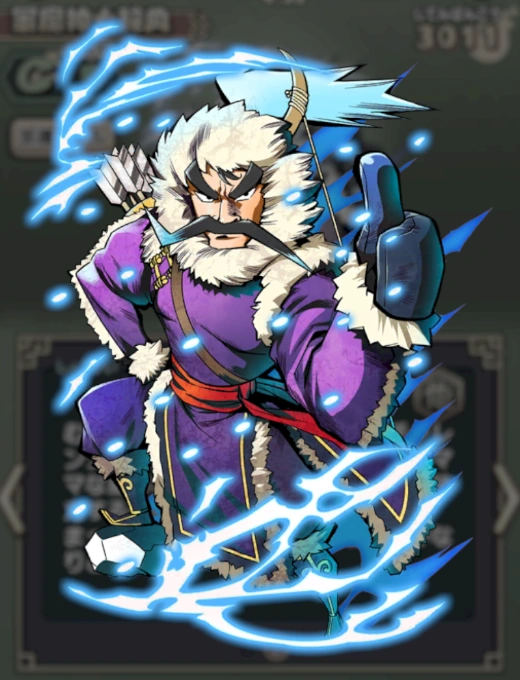
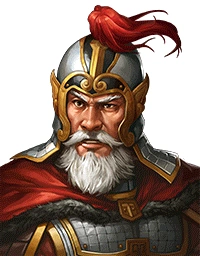
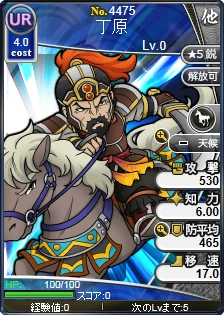
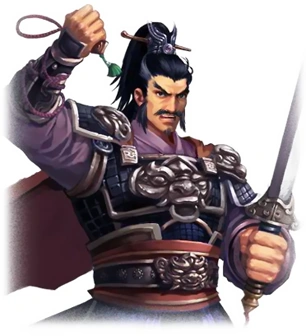
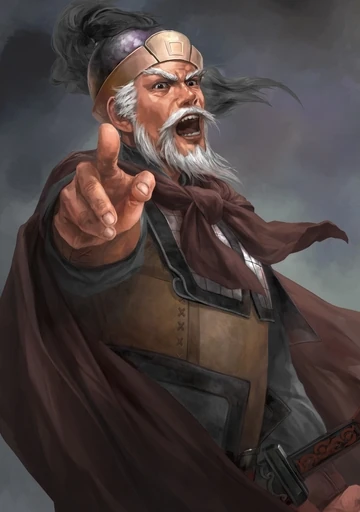
3 comments
Ding Yuan (onyomi: Tei Gen) is the Governor of Bing Province during the Eastern Han Dynasty. In the novel, he is the first adoptive father of Lu Bu.
Historical Information
Ding Yuan came from a poor family in Nanyang Commandery of Jing Province. In his youth, he was known to be a rough man, who was brave and skilled in archery and horsemanship. When he served as a county magistrate in Nan County, he would never deem a task too difficult and was always on the forefront when pursuing bandits. He eventually became Inspector of Bing Province and met Lu Bu, by whom he was so impressed that he made him his chief secretary and kept him by his side. Ding Yuan was further promoted to Chief Commandant Who is Martial and Brave and stationed at Henei in Si Province.
After the death of Emperor Ling, Ding Yuan led his forces to the capital at Luoyang and plotted with He Jin to slay the eunuchs. At He Jin’s instigation, Ding Yuan, along with Dong Zhuo, Wang Kuang, and Qiao Mao, staged a false rebellion to coerce Empress Dowager He into agreeing to kill the eunuchs. Ding Yuan set fire to Mengjin, near Luoyang, so that the flames spread into the city. Subsequently, Ding Yuan was promoted to the position of Bearer of the Gilded Mace. In desperation, the eunuchs assassinated He Jin, which led to the anti-eunuch faction easily eliminating them, but the eunuchs’ act of abducting the emperor allowed Dong Zhuo to seize the opportunity to ensure his “protection” of the emperor. To ensure his rule, Dong Zhuo targeted Ding Yuan. He incited Lu Bu to kill Ding Yuan, who took his head and presented it to Dong Zhuo. Ding Yuan’s forces in the capital were then absorbed into Dong Zhuo’s army.
Romance of the Three Kingdoms
Ding Yuan is presented as a rival to Dong Zhuo in the novel. He objected Dong Zhuo’s plan to depose Emperor Shao and enthrone Emperor Xian, making Dong Zhuo his enemy. Dong Zhuo, however, did not dare to kill Ding Yuan as he was afraid of his trusted general and foster son, Lu Bu. He later defeated Dong Zhuo in a small battle. Dong Zhuo’s general Li Su then volunteered to buy Lu Bu over as he was from the same hometown. Dong Zhuo gave Li Su some gifts, including his steed Red Hare, and sent him to persuade Lu Bu to join him. Lu Bu was convinced and entered Ding Yuan’s tent. When Lu Bu told him that he wouldn’t be his son forever and Ding Yuan asked why he changed his mind so suddenly, Lu Bu beheaded Ding Yuan with one cut.
Ding Yuan (pronunciationⓘ) (died c.26 September 189[2]), courtesy name Jianyang, was a Chinese politician and warlord who lived during the late Eastern Han dynasty of China.[1] In 189, both he and Dong Zhuo were summoned into the capital Luoyang with their individual troops to assist in the struggle against the powerful eunuch faction. However, Ding Yuan was eventually killed by his trusted aide Lü Bu, who had been bought over by Dong Zhuo.
Life
According to the Records of Heroes (英雄記) by Wang Can, Ding Yuan was born in a poor family. Uncouth but brave, he was adept in horse riding and archery. During his early career as a county magistrate, he never turned away from his responsibility no matter the adversity or risk. He always pitched himself in front during confrontations with fugitive criminals and bandits.
In early 188, the northern frontiers in Bing province (并州; present-day Shanxi and the Hetao region in Inner Mongolia) fell into disorder when the Xiuchuge and Southern Xiongnu vassal tribes rose in rebellion, killing the provincial inspector, Zhang Yi (張懿) and the chanyu, Qiangqu. To quell the unrest, the Han court appointed Ding Yuan as the new Inspector of Bing province, later promoting him to Cavalry Commandant (騎都尉) and ordering him to garrison at Henei Commandery. Ding Yuan recruited several renowned warriors in the province, namely Zhang Yang, Zhang Liao and Lü Bu. Lü’s martial prowess in particular greatly impressed Ding Yuan, who made him Chief Secretary and kept him close at side.
In May 189, Emperor Ling died. The General-in-Chief He Jin then summoned Ding Yuan into the capital Luoyang with his regional troops to assist in the power struggle against the eunuch faction. Before Ding Yuan arrived, however, the eunuchs assassinated He Jin. Dong Zhuo, a warlord from Liang Province (涼州; present-day western Gansu) who was also summoned by He Jin, arrived in Luoyang ahead of Ding Yuan and defeated the eunuchs, grasping military control of the capital.
After Ding Yuan arrived, Dong Zhuo managed to buy over Lü Bu, who killed Ding Yuan and presented the latter’s head to Dong Zhuo.
In Romance of the Three Kingdomshttps://upload.wikimedia.org/wikipedia/commons/thumb/e/ee/Lu_Bu_murders_Ding_Yuan.jpg/250px-Lu_Bu_murders_Ding_Yuan.jpg
A Qing dynasty illustration of Lü Bu murdering Ding Yuan.
The 14th-century historical novel Romance of the Three Kingdoms is a romanticisation of the events that occurred before and during the Three Kingdoms period of China. In Chapter 3, Ding Yuan becomes a rival of Dong Zhuo after he opposes the latter’s plan to depose Emperor Shao in favour of Emperor Xian. However, Dong Zhuo refrains from killing Ding Yuan on the spot because Ding Yuan’s foster son, the formidable warrior Lü Bu, is protecting him.
Li Su, an official under Dong Zhuo who is from the same commandery as Lü Bu, then volunteers to persuade Lü Bu to defect to Dong Zhuo’s side. Bringing along a famous steed named Red Hare and other extravagant gifts, he meets Lü Bu at his camp outside the city. Attracted by the gifts and feeling convinced by Li Su, Lü Bu agrees to betray his foster father and defect to Dong Zhuo’s side. That very night, Lü Bu barges into Ding Yuan’s tent, decapitates him and brings his head as a present to Dong Zhuo the following day.
Đinh Nguyên (chữ Hán: 丁原; 140-190), tự Kiến Dương (建陽), là tướng nhà Đông Hán trong lịch sử Trung Quốc. Ông tham gia cuộc chiến quân phiệt đầu thời Tam Quốc và thất bại dưới tay Đổng Trác.
Xuất thân
Đinh Nguyên xuất thân nhà nghèo, tuy vụng về nhưng rất gan dạ. Ông theo học cưỡi ngựa bắn cung. Ông được cất nhắc làm quan ở địa phương, đi trấn áp quân cướp, thường không ngại khó khăn nguy hiểm.
Dần dần ông được thăng tiến làm Thứ sử Tinh châu. Thủ hạ dưới trướng ông có hai người nổi tiếng là Lã Bố và Trương Dương.
Trong tiểu thuyết Tam Quốc diễn nghĩa, La Quán Trung kể rằng Đinh Nguyên nhận Lã Bố làm con nuôi
Chống Đổng Trác
Đầu năm 189, Hán Linh Đế mất, thái tử Biện lên nối ngôi, tức là Hán Thiếu Đế. Ngoại thích Đại tướng quân Hà Tiến nắm quyền phụ chính, mâu thuẫn với các hoạn quan. Do không thuyết phục được em gái là Hà thái hậu trừ bỏ hoạn quan, Hà Tiến sai người ra nói với Đinh Nguyên và tướng Đổng Trác đang đóng quân ở Hà Đông hãy mang quân vào Lạc Dương “giả làm phản đòi dẹp hoạn quan”, với mục đích là dọa thái hậu phải bằng lòng bãi chức các hoạn quan.[1]
Đinh Nguyên nhận lệnh, mang quân đến Lạc Dương trước, mang theo Lã Bố và Trương Dương. Hà Tiến điều động Trương Dương lên Thượng Đảng[2] dẹp quân khởi nghĩa tại đây.
Tháng 8 năm 189, Hà Tiến theo ý kiến của thủ hạ là Viên Thiệu, vào cung Trường Lạc gặp Hà thái hậu đề nghị giết hết các hoạn quan. Tin lộ ra, hoạn quan Trương Nhượng cùng Đoàn Khuê vội huy động vài mươi quân lính cầm binh khí phục sẵn, đợi lúc Hà Tiến ra cửa cung bèn đổ ra bắt sống và giết chết.[3]
Viên Thiệu mang quân đánh vào cung diệt từ các hoạn quan.[4] Không lâu sau Đổng Trác kéo quân vào Lạc Dương, dùng vũ lực thao túng triều đình. Viên Thiệu phải bỏ chạy lên Bột Hải.
Đổng Trác thu luôn quân đội của Hà Tiến. Đinh Nguyên bất bình với Đổng Trác bèn mang quân bản bộ chống lại. Hai bên giao chiến, Đổng Trác gặp bất lợi, bèn dùng vàng bạc mua chuộc Lã Bố, xui Bố phản lại ông. Lã Bố nghe theo Đổng Trác, liền nhân lúc Đinh Nguyên không phòng bị, bất ngờ sát hại ông rồi mang quân về hàng Đổng Trác.
Sau này bộ tướng của ông là Trương Dương làm Thái thú quận Hà Nội, còn Lã Bố lại theo Vương Doãn, trở mặt giết Đổng Trác.
Trong Tam Quốc diễn nghĩa
Trong tiểu thuyết Tam Quốc diễn nghĩa của La Quán Trung, Đinh Nguyên xuất hiện trong hồi thứ 3 trong cuộc đối địch với Đổng Trác. Ông bị Lã Bố sát hại khi đang xem sách ban đêm.