
Contents
The Twin Weapons of the Imperial Descendant
In Luo Guanzhong’s (罗贯中, La Quán Trung) epic novel Romance of the Three Kingdoms (三国演义, Sān Guó Yǎn Yì, Tam Quốc Diễn Nghĩa), each of the three sworn brothers of the Peach Garden (桃园, Đào Viên) wielded a signature weapon that perfectly mirrored their personality and combat style.
While Guan Yu (关羽, Quan Vũ) carried the heavy, devastating Green Dragon Crescent Blade (青龙偃月刀, Thanh Long Yển Nguyệt Đao) representing righteousness, and Zhang Fei (张飞, Trương Phi) wielded the wild Serpent Spear (丈八蛇矛, Trượng Bát Xà Mâu) reflecting fierce bravery, Liu Bei (刘备, Lưu Bị) fought with the Dual Swords (双股剑, Shuāng Gǔ Jiàn, Song Cổ Kiếm). Also known as the Twin Swords or Mandarin Duck Swords (鸳鸯剑, Yuān Yāng Jiàn, Uyên Ương Kiếm), these weapons symbolized balance, leadership, and regal authority.



Origin and Forging in the Peach Garden
According to Chapter 1 of Romance of the Three Kingdoms, the Dual Swords were forged in 184 AD immediately following the Oath of the Peach Garden (桃园三结义, Đào Viên Tam Kết Nghĩa).
Two wealthy horse merchants from Zhongshan (中山, Trung Sơn) named Zhang Shiping (张世平, Trương Thế Bình) and Su Shuang (苏双, Tô Sảng) presented the three brothers with 50 warhorses, gold, and 1,000 catties of refined steel.
Liu Bei commissioned a local master blacksmith to forge a pair of twin straight swords (Jiàn / 剑) from this high-grade steel, tailored specifically to his double-handed fencing style (Shuāng Jiàn / 双剑).
Physical Design and Symbolism
Unlike single long swords worn on one side of the hip, the Dual Swords were designed as a paired set carried together in a single custom scabbard or twin scabbards on Liu Bei’s left hip.
-
The Male and Female Swords (Yīn Yáng Jiàn):
Ancient lore describes the set as a “Mandarin Duck” pair (Yuan Yang):
-
The Male Blade (Yang): Slightly longer and heavier, crafted for offensive strikes, thrusts, and parrying heavy enemy weapons.
-
The Female Blade (Yin): Slightly shorter and lighter, designed for swift counter-attacks, defensive guards, and close-quarters maneuvers.
-
-
Symbolism of the Dual Nature:
The paired swords represented Liu Bei’s political philosophy: The balance of Kindness (Rén / 仁) and Authority (Yí / 仪). Just as one blade protects while the other strikes, Liu Bei governed by balancing soft benevolence with firm imperial resolve.
Legendary Exploits in Battle
Although Liu Bei is remembered primarily as a political leader and strategist rather than a frontline champion, he was a skilled swordsman trained in double-sword techniques (Shuāng Jiàn Fǎ). His most famous military engagement featuring the Dual Swords occurs in Chapter 5.
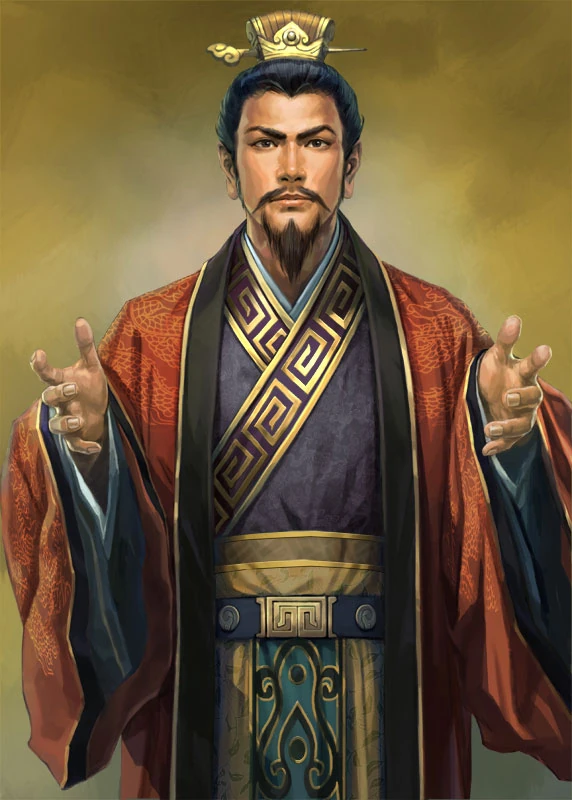
Liu Bei – 刘备 – Lưu Bị
The Battle of Hulao Pass (虎牢关之战, 190 AD)
(The Three Brothers Battle Lu Bu / 三英战吕布)
When the invincible warlord Lu Bu (吕布, Lữ Bố) defeated coalition commanders at Hulao Pass, Zhang Fei charged out first, fighting Lu Bu for 50 bouts without a victor. Guan Yu rode out to assist, and the two fought Lu Bu for another 30 bouts in a deadlocked duel.
Seeing his brothers unable to subdue Lu Bu, Liu Bei drew his Dual Swords, spurred his horse forward, and joined the fray:
-
The Tactical Contribution: While Guan Yu and Zhang Fei engaged Lu Bu’s Sky-Piercing Ji (方天画戟, Phương Thiên Họa Kích) with heavy attacks, Liu Bei used the agility of his twin blades to weave through Lu Bu’s guard, targeting open flanks and forcing Lu Bu to split his defensive focus three ways.
-
The Outcome: Overwhelmed by the synchronized assault of the three brothers, Lu Bu feinted a strike toward Liu Bei’s face, broke out of the circle, and retreated into Hulao Pass.
Summary of Profile Details
| Aspect | Historical & Literary Details |
| Chinese Name | 双股剑 (Shuāng Gǔ Jiàn) / 鸳鸯剑 (Yuān Yāng Jiàn) |
| Vietnamese Name | Song Cổ Kiếm / Uyên Ương Kiếm |
| English Name | Dual Swords / Twin Swords / Pair-of-Swords |
| Weapon Type | Paired Double-Edged Straight Swords (Shuāng Jiàn) |
| Owner | Liu Bei (刘备, Lưu Bị) |
| Key Combat Style | Dual-wielding fencing, high agility, balanced parrying |
| Famous Battle | Three Heroes Battle Lu Bu at Hulao Pass (190 AD) |
| Core Symbolism | Benevolence (Ren), Harmony (Yin-Yang), Imperial Leadership |
Historical Reality vs. Literary Fiction
-
Dual Sword Technique in History:
In Chen Shou’s historical Records of the Three Kingdoms (三国志), there are no specific mentions of Liu Bei wielding a pair of swords called “Shuāng Gǔ Jiàn.” However, dual-sword fencing (Shuāng Jiàn) was indeed a recognized martial arts discipline during the Han Dynasty, often favored by officers for self-defense and horseback combat.
-
Literary Function in the Novel:
Luo Guanzhong assigned the Dual Swords to Liu Bei to complete the visual trilogy of the three brothers:
-
Guan Yu: Heavy Polearm (Supreme Strength)
-
Zhang Fei: Long Thrusting Spear (Fierce Courage)
-
Liu Bei: Dual Swords (Agility, Grace, and Leadership)
-
By wielding two swords that acted as one, Liu Bei’s weapon served as a visual metaphor for his ability to unite disparate people—such as Guan Yu, Zhang Fei, and Zhuge Liang—into a single, harmonious force.
For detailed historical records, archives, and official chronicles, explore Dual Swords on Wikipedia.