
Contents
Biography & Historical Record
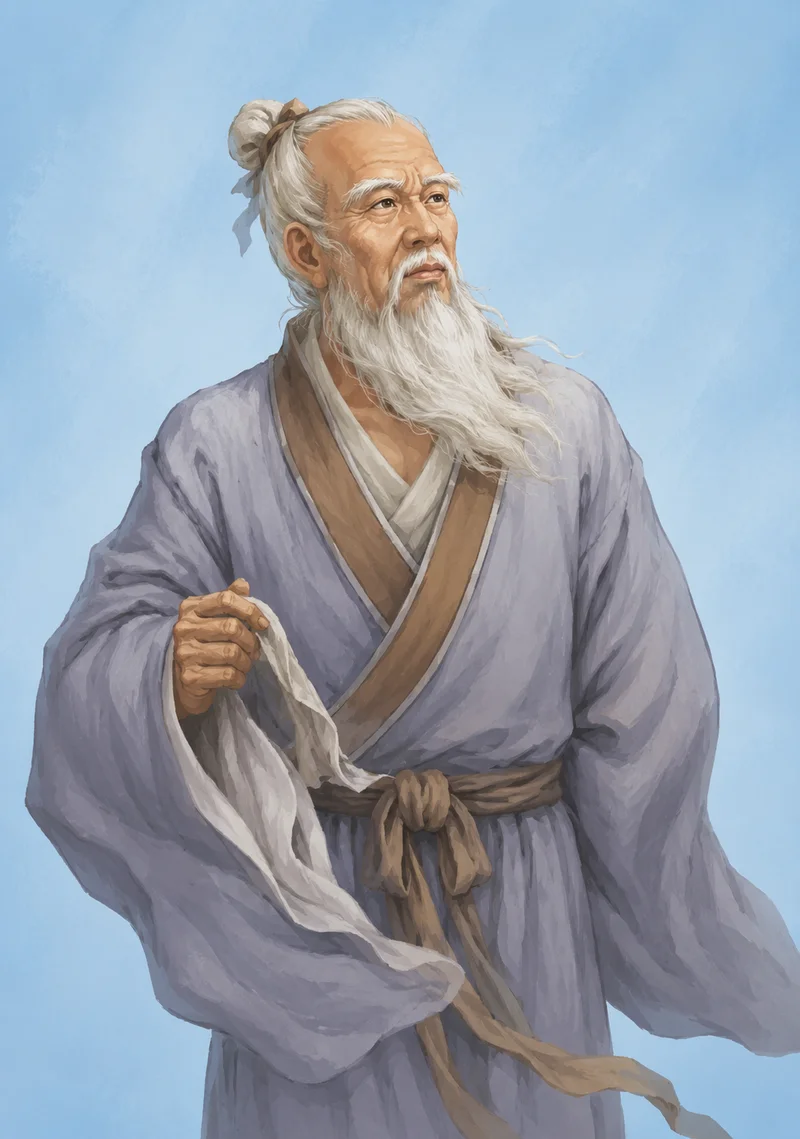
Zi Xu Shang Ren is a legendary Taoist hermit and reclusive immortal portrayed in Luo Guanzhong’s classic 14th-century historical novel Romance of the Three Kingdoms. Residing in a secluded thatched hermitage atop the precipitous Jinping Mountain in Yizhou (Sichuan), Zi Xu Shang Ren is revered by local inhabitants and regional officers as a living immortal possessed of divine foresight, capable of predicting human destiny, life, death, fortune, and misfortune with absolute accuracy. In strict historical reality, Zi Xu Shang Ren does not appear in Chen Shou’s Records of the Three Kingdoms (Sanguozhi) or any authentic Han dynasty imperial records. He is an entirely literary creation invented by Luo Guanzhong to embody the overarching Taoist philosophy of divine decree and the inescapable nature of preordained destiny during Liu Bei’s military campaign to conquer Yizhou.
During the invasion of Yizhou in 213 AD, as Liu Bei’s forces advanced toward Luo County, the defending Yi Province generals—Liu Kui, Zhang Ren, Ling Bao, and Deng Xian—grew desperate amidst impending military collapse. Seeking divine counsel regarding the outcome of the campaign, Liu Kui and his fellow officers climbed Jinping Mountain carrying rich gifts of gold and silk to solicit a prophecy from Zi Xu Shang Ren. The Taoist hermit brushed aside their material offerings, remarking that a mountain recluse had no concern for worldly rise and fall. However, moved by Liu Kui’s earnest entreaties, Zi Xu Shang Ren written an eight-line prophetic verse upon paper: “A dragon and a phoenix shall enter Yi Province together. The phoenix shall fall upon its wings, while the dragon soars above. Deprived of one wing, the land of Shu shall still achieve balance; the mandate of heaven is preordained, abstain from rash defiance.”
When Liu Kui pressed the Taoist for explicit predictions regarding their personal fates, Zi Xu Shang Ren coldly replied that heavenly fate was immutable and that those who harmonized with heaven would survive while those who resisted would perish. Shortly thereafter, the verse proved completely accurate: the “phoenix” Pang Tong was ambushed and slain by Zhang Ren at Phoenix Slope (Luofeng Slope), while the “dragon” Liu Bei ultimately secured Yizhou with the arrival of Zhuge Liang.
Role in Romance of the Three Kingdoms
In Chapter 62 of Romance of the Three Kingdoms, Zi Xu Shang Ren serves as the ultimate literary harbinger of fate prior to the tragic fall of Pang Tong. When Yi Province officers circulated Zi Xu Shang Ren’s prophecy, scouts from the Jing Province army overheard the verse and reported it directly to Pang Tong. Upon hearing the prophecy, Pang Tong burst into loud, mocking laughter, dismissing Zi Xu Shang Ren as a rustic quack merchant who exploited supernatural riddles to frighten weak-minded fools. Adhering to a fierce belief in human agency, Pang Tong declared that military success depended entirely upon strategy and popular support rather than baseless omens. Driven by intellectual pride and eager to prove the Taoist wrong, Pang Tong disregarded Zhuge Liang’s cautionary letters and warning signs, insisting on leading the vanguard directly into Luo County.
In Chapter 62 of Luo Guanzhong’s Romance of the Three Kingdoms, Zi Xu Shang Ren delivers the iconic eight-line prophetic verse foretelling Pang Tong’s death at Phoenix Slope and Liu Bei’s eventual triumph in Yizhou. His cold dismissal of human resistance reinforces the novel’s core philosophical motif that human wisdom cannot override the preordained Mandate of Heaven.
Zi Xu Shang Ren (紫虛上人) — Literary Timeline
Consultation at Jinping Mountain
Receives Yizhou generals Liu Kui, Zhang Ren, Ling Bao, and Deng Xian at his hermitage on Jinping Mountain; refuses gifts of gold and composes the eight-line prophecy foretelling the fates of Liu Bei and Pang Tong.
Delivery of the Prophecy to Liu Kui
Warns the Yizhou generals that the Mandate of Heaven cannot be averted and retreats into his mountain cave, prompting Liu Kui to circulate the prophetic verse across the region.
Fulfillment of the Prophecy at Phoenix Slope
Pang Tong hears the prophecy, mocks Zi Xu Shang Ren as a fraud, and rashly advances into an ambush at Phoenix Slope, where he is slain by Zhang Ren’s archers, exactly fulfilling the Taoist’s prophecy.
Key Relationships
- Family:
- Comrades / Allies:
- Enemies / Opponents:
- Pang Tong — Brilliant strategist of Liu Bei who openly mocked Zi Xu Shang Ren’s prophecy as fraudulent before perishing at Phoenix Slope.
- Liu Kui — Yizhou general who climbed Jinping Mountain to seek Zi Xu Shang Ren’s divine prophecy regarding the defense of Luo County.
- Zhang Ren — Valiant Yizhou commander who accompanied Liu Kui to consult Zi Xu Shang Ren and later ambushed Pang Tong at Phoenix Slope.
- Ling Bao & Deng Xian — Yizhou generals who accompanied Liu Kui to Jinping Mountain to solicit the prophetic verse.
- Liu Bei — Warlord represented as the ‘dragon’ in Zi Xu Shang Ren’s prophecy who was destined to conquer Yizhou.
For detailed historical records, archives, and official chronicles, explore Zi Xu Shang Ren on Wikipedia.
In Novel
Chapter 62
- Zi Xu Shang Ren (紫虚上人, Tử Hư Thượng Nhân): Zi Xu Shang Ren is a mysterious recluse living on Jinping Mountain in Yizhou. Liu Zhang’s generals Liu Kui, Zhang Ren, Leng Bao and Deng Xian stop at his mountain while marching toward Luoxian and ask him to foretell their fortunes. He writes eight lines warning that the “young phoenix” will fall and the “crouching dragon” will rise, a prophecy pointing to Pang Tong’s death and Zhuge Liang’s eventual role in conquering Yizhou. When Liu Kui asks about his own fate, Zi Xu Shang Ren simply tells him that destiny cannot be escaped. The four generals leave without receiving the favorable future they hoped for.
In History
Summary
- Zi Xu Shang Ren (紫虚上人, Tử Hư thượng nhân) is a legendary Taoist-style immortal or diviner in the literary tradition surrounding Romance of the Three Kingdoms.
Folklore and Literary Tradition
- The title 上人 is an honorific rather than a normal personal name. Zi Xu Shang Ren is presented through supernatural and prophetic traditions rather than as a securely documented Eastern Han official.
- His characterization belongs to the novel’s broader use of prophecy, divination and supernatural lore.
Historical Record
- Classification: Fictional / Legendary. No sufficiently secure historical biography has been established for an independent Three Kingdoms figure under the exact name 紫虚上人.