


Contents
Biography & Historical Record
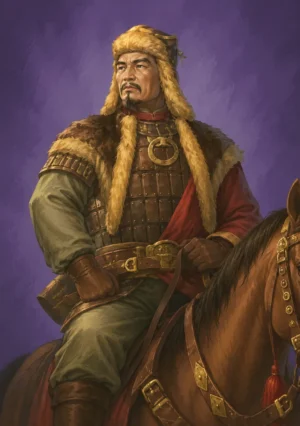
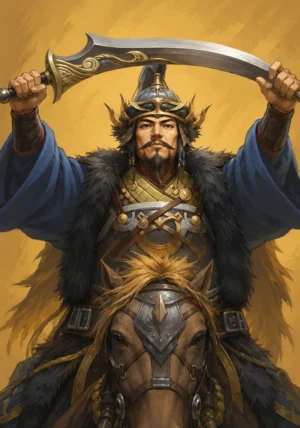
Qubei was the Right Worthy Prince (You Xianwang) of the Southern Xiongnu, a distinguished nomadic military commander, and a key strategic ally of the Eastern Han dynasty and the Cao Wei state. As the younger brother of Chanyu Yufuluo and uncle of Chanyu Huchuwen, Qubei held immense influence within the Xiongnu royal lineage. Historically, he is celebrated for leading elite Xiongnu cavalry across the Yellow River in 184 AD and 195 AD to rescue Emperor Xian of Han from the warlords Li Jue and Guo Si, and later for serving as the Imperial Director (Jianguo) overseeing all five divisions of the Southern Xiongnu under Cao Cao’s administration.
In 195 AD (the second year of the Xingping era), Emperor Xian escaped from Chang’an in a desperate flight east toward the ancient capital of Luoyang. The imperial entourage was relentlessly pursued by the combined armies of Li Jue and Guo Si, facing total annihilation near Hongnong. Imperial officer Yang Feng, a former White Wave insurgent officer, dispatched urgent emissaries to Hedong Commandery to summon the White Wave chiefs and Qubei. Recognizing the historical opportunity to cement a noble alliance with the Han court, Qubei personally commanded thousands of elite Southern Xiongnu cavalry, crossing the Yellow River to join forces with Yang Feng, Han Xian, Li Yue, and Hu Cai.
In the fierce confrontation at Dongjian, Qubei’s nomadic cavalry launched devastating flank charges against Li Jue’s pursuers, decisively shattering the Liangzhou cavalry lines. Qubei and the joint coalition escorted Emperor Xian safely across the river, protecting the royal entourage from capture. For his vital military salvation of the throne, Qubei received high honors, royal gifts, and deep respect from the Han court.
Following the relocation of Emperor Xian to Xuchang under Cao Cao’s political protection, Qubei led his cavalry forces back to the northern tribal territories. Throughout the turbulent years from 196 to 215 AD, as rival warlords vied for supremacy across China, Qubei maintained a steadfast, loyal alliance with Cao Cao’s central government in Xuchang. He actively guarded the northern frontier against hostile steppe factions and rival rebel tribes, ensuring stability along Cao Cao’s northern flank.
In 216 AD (the twenty-first year of the Jian’an era), Cao Cao executed a comprehensive structural reorganization of the Southern Xiongnu to eliminate the risk of tribal rebellions. Cao Cao detained Chanyu Huchuwen in Ye City under comfortable house arrest and divided the Southern Xiongnu population into five autonomous divisions (Front, Rear, Left, Right, and Center) centered in Taiyuan Commandery. Cao Cao appointed Qubei as the Imperial Director (Jianguo), placing him in direct administrative and military command over all five Xiongnu divisions. In this capacity, Qubei served as the paramount administrative leader of the Xiongnu people residing within imperial territory.
Following Cao Pi’s usurpation of the throne and establishment of the Cao Wei dynasty in 220 AD, Qubei reaffirmed his allegiance to the Wei state. In 220 AD (first year of Huangchu) and 223 AD (fourth year of Huangchu), when hostile Xianbei tribes and rebellious Xiongnu nobles launched border raids in the north, Qubei personally led imperial armies on campaigns to crush the insurgents, securing the northern borders. He passed away from old age around 223 AD.
Historically, Qubei’s lineage exerted a profound influence on Chinese history. His son, Liu Gaorenfu, served as the Left Division Commander under Cao Wei. Furthermore, Qubei was the direct great-grandfather of Liu Yuan, the Xiongnu leader who later founded the Han-Zhao dynasty in 304 AD, initiating the Sixteen Kingdoms era and the Five Barbarians invasion that brought down the Western Jin dynasty.
Role in Romance of the Three Kingdoms
In Luo Guanzhong’s novel Romance of the Three Kingdoms, Qubei appears as the Right Worthy Prince of the Southern Xiongnu. When Emperor Xian flees Chang’an while under relentless pursuit by Li Jue and Guo Si, General Yang Feng joyfully announces Qubei’s arrival with thousands of Xiongnu cavalry. Joining forces with Yang Feng, Han Xian, Li Yue, and Hu Cai, Qubei leads his nomadic horsemen into a grand battle against Li Jue’s forces. Their timely intervention repels the pursuers and allows Emperor Xian to safely cross the river toward Luoyang.
Qubei (去卑) — Literary & Historical Timeline
195 AD
Imperial Summons and Rescue at Dongjian
Responds to Yang Feng’s urgent summons, leading thousands of Southern Xiongnu cavalry across the Yellow River to defeat Li Jue and Guo Si at Dongjian, protecting Emperor Xian’s flight to Luoyang.
196–215 AD — Historical Record
Northern Border Defense and Alliance with Cao Cao
Maintains a steadfast strategic alliance with Cao Cao’s administration, guarding the northern frontier against hostile steppe tribes.
216 AD — Historical Record
Appointment as Imperial Director over Five Xiongnu Divisions
Appointed Imperial Director (Jianguo) by Cao Cao to govern all five restructured divisions of the Southern Xiongnu based in Taiyuan Commandery.
220–223 AD — Historical Record
Campaigns Against Xianbei and Death
Pledges allegiance to the Cao Wei dynasty under Cao Pi; personally commands imperial forces to pacify Xianbei border incursions in 220 and 223 AD before dying of old age.
Key Relationships
- Family:
- Yufuluo — Elder brother and former Chanyu of the Southern Xiongnu.
- Huchuwen — Nephew and Chanyu of the Southern Xiongnu who was detained at Ye City by Cao Cao.
- Liu Gaorenfu — Son who served as Left Division Commander under the Cao Wei dynasty.
- Liu Yuan — Great-grandson who founded the Han-Zhao dynasty during the Sixteen Kingdoms period.
- Comrades / Allies:
- Emperor Xian of Han — Han monarch rescued from Li Jue and Guo Si by Qubei’s cavalry forces.
- Cao Cao — Imperial Chancellor and Prince of Wei who appointed Qubei as Imperial Director of the Five Xiongnu Divisions.
- Cao Pi — First Emperor of Cao Wei to whom Qubei pledged continued loyalty and service.
- Yang Feng — Imperial officer and former White Wave general who summoned Qubei to rescue Emperor Xian.
- Han Xian, Li Yue & Hu Cai — White Wave leaders who co-commanded the coalition with Qubei at Dongjian.
- Enemies / Opponents:
- Li Jue — Warlord and former Liangzhou commander defeated by Qubei’s cavalry at Dongjian.
- Guo Si — Warlord who co-commanded the pursuit of Emperor Xian alongside Li Jue.
For detailed historical records, archives, and official chronicles, explore Qubei on Wikipedia.
In Novel
Chapter 13
- Qubei (去卑, Khứ Ty): Qubei is the leader of a Xiongnu force that becomes involved in the struggle surrounding Emperor Xian. He is connected with the northern tribal forces assisting the imperial side and is mentioned among the commanders who bring cavalry into the fighting during the emperor’s escape from Chang’an.
In History
Summary
- Qubei (去卑, Khứ Ty) was a historical leader of the Southern Xiongnu and an important intermediary between the Xiongnu and the Han court.
Period I — Southern Xiongnu Leadership
- Qubei belonged to the ruling Luandi lineage of the Southern Xiongnu and held the title of Worthy Prince of the Right (右賢王), although some sources use the title Worthy Prince of the Left.
- He was an uncle of Huchuquan and belonged to the generation that maintained Xiongnu political authority while the Han dynasty was collapsing.
Period II — Emperor Xian’s Escape
- In 195, Qubei joined Yang Feng, Dong Cheng and the White Wave leaders in supporting Emperor Xian during the emperor’s escape from Chang’an toward Luoyang.
- His participation gave the imperial party additional cavalry and military protection during its confrontation with Li Jue and Guo Si.
Period III — Reorganization under Cao Cao
- After Huchuquan was detained at Ye in 216, Qubei was placed in charge of supervising the Southern Xiongnu’s Five Divisions.
- His descendants later became ancestors of important non-Chinese political lineages, including the Helian and Dugu traditions.
Historical Record
- Qubei was historical. His career is documented across the Hou Han Shu, Sanguozhi, Zizhi Tongjian and later dynastic histories.