

Contents
Biography & Historical Record
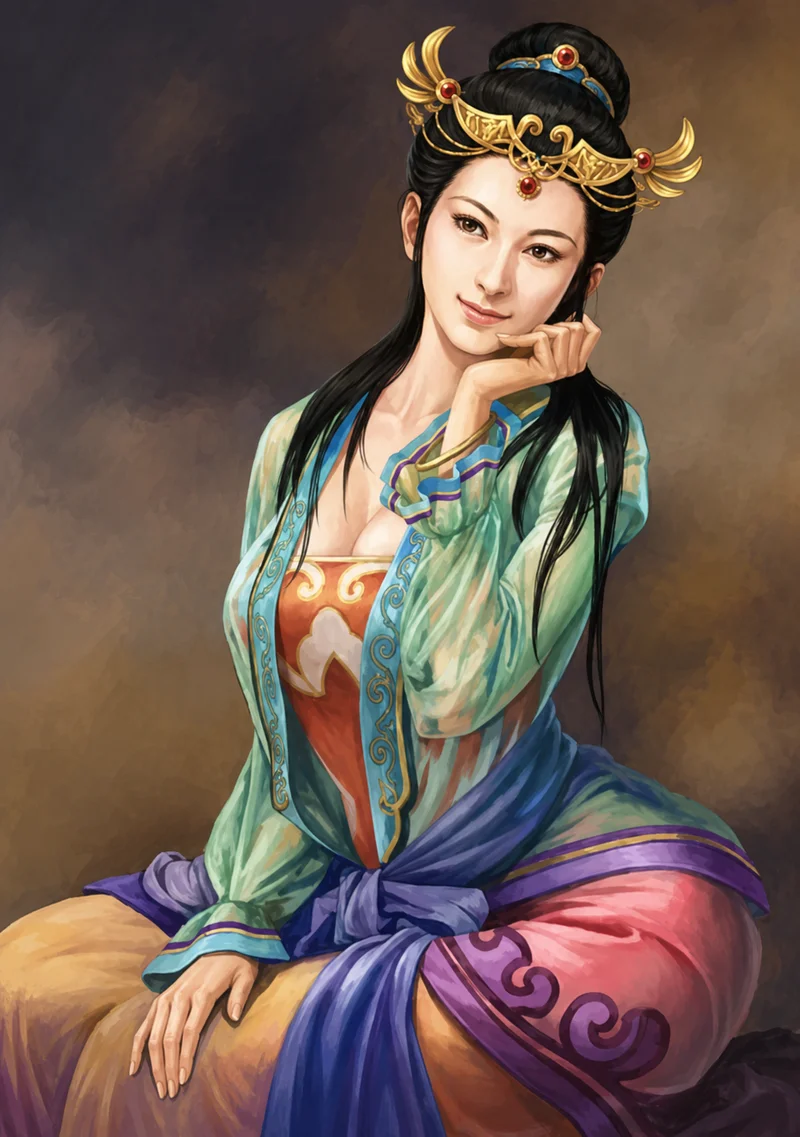
Lady Bian (159–230 AD), officially posthumously honored as Empress Wuxuan, was the primary wife and consort of the grand warlord Cao Cao, as well as the mother of Emperor Wen of Cao Wei (Cao Pi), Prince of Rencheng (Cao Zhang), Prince of Chensi (Cao Zhi), and Cao Xiong. Born in Qiangyang, Lu Commandery (present-day Yanzhou, Shandong Province), she originated from a humble family of itinerant entertainers. In her youth, she became a courtesan and entertainer before being taken by Cao Cao as a secondary concubine around 179 AD at Qiao County.
During Dong Zhuo’s usurpation in 189 AD, when Cao Cao fled Luoyang under an assumed name to raise troops, rumors spread that he had been killed. While Cao Cao’s household panicked and prepared to scatter, the young Lady Bian displayed remarkable political composure, persuading his followers and servants to remain united and guard Cao Cao’s estate. Following the tragic death of Cao Cao’s eldest son Cao Ang at Wancheng and the subsequent departure of Cao Cao’s first wife Lady Ding, Lady Bian was elevated to be Cao Cao’s primary official wife. Renowned for her wisdom, extreme frugality, humility, and lack of ostentation, she steadfastly avoided luxury, wore simple garments, and treated all of Cao Cao’s children born to deceased concubines with equal maternal warmth and devotion.
In 219 AD, following Cao Pi’s formal designation as Crown Prince of Wei, palace courtiers congratulated Lady Bian and suggested she distribute lavish gifts. Lady Bian calmly declined, stating that as a mother, her only responsibility was to ensure Cao Pi was educated without fault. Following Cao Cao’s death in 220 AD, she was honored as Empress Dowager when Cao Pi founded the Cao Wei dynasty, and later as Grand Empress Dowager under her grandson Cao Rui (Emperor Ming). She frequently intervened to preserve clan harmony, successfully dissuading Cao Pi from executing Cao Zhi and saving Cao Hong from execution. Empress Wuxuan died in 230 AD at the age of 71 and was buried alongside Cao Cao in the Gaoling Mausoleum.
Role in Romance of the Three Kingdoms
In Luo Guanzhong’s Romance of the Three Kingdoms, Lady Bian appears in Chapters 79 and 80 as a paragon of maternal compassion, family loyalty, and moral dignity. Following Cao Cao’s death, when Cao Pi seizes control and seeks to eliminate his younger brother Cao Zhi out of political jealousy, Lady Bian weeping intervention halts the execution. She confronts Cao Pi directly, reminding him that Cao Zhi shares the exact same blood and womb, forcing Cao Pi to relent and demand the Seven Steps Verse instead of ordering an immediate death sentence. Later, during Cao Pi’s political maneuvering to depose Emperor Xian of Han, Lady Bian maintains her quiet, stoic dignity, serving as a moral anchor within the imperial palace and repeatedly restraining internal clan persecution among Cao Cao’s surviving sons.
Lady Bian (卞氏) — Literary Timeline
Guarding the Household
Maintains total composure and preserves Cao Cao’s household in Luoyang when false rumors spread of Cao Cao’s death following his flight from Dong Zhuo.
Intervention for Cao Zhi
Confronts Cao Pi with tears and righteous indignation to stop him from executing Cao Zhi, saving Cao Zhi’s life and prompting the creation of the Seven Steps Verse.
Elevation as Empress Dowager
Honored as Empress Dowager of Cao Wei following Cao Pi’s usurpation of the Han throne and the establishment of the Wei dynasty.
For detailed historical records, archives, and official chronicles, explore Bianshi on Wikipedia.
Key Relationships
Family
- Cao Cao (曹操, Tào Tháo) — Husband and primary warlord; she became his official wife after the departure of Lady Ding and remained his loyal consort until his death in 220 AD.
- Cao Pi (曹丕, Tào Phi) — Eldest biological son and first Emperor of Cao Wei; she served as his Empress Dowager and frequently moderated his political impulses.
- Cao Zhang (曹彰, Tào Chương) — Biological son and prominent military commander known as the Prince of Rencheng.
- Cao Zhi (曹植, Tào Thực) — Biological son and renowned poet; she famously intervened to save him from execution by Cao Pi in 220 AD.
- Cao Xiong (曹熊, Tào Hùng) — Biological son and Prince of Huaiyang.
- Cao Rui (曹叡, Tào Duệ) — Grandson and Emperor Ming of Cao Wei; she served as Grand Empress Dowager during his reign.
- Bian Yuan (卞远, Biện Viễn) — Father, who was posthumously honored as the Marquis of Kaiyang.
- Bian Bing (卞秉, Biện Bỉnh) — Younger brother and general who served the Cao Wei state.
- Lady Ding (丁氏, Đinh Thị) — Cao Cao’s first wife; Lady Bian maintained a respectful relationship with her even after Lady Ding was divorced from Cao Cao.
Friends
- Cao Hong (曹洪, Tào Hồng) — A cousin of Cao Cao whose life was spared from execution by Cao Pi due to Lady Bian’s direct intercession.
- Jia Xu (贾诩, Giả Hủ) — A senior advisor to Cao Cao and Cao Pi who maintained a stable political relationship with Lady Bian during the succession transition.
Enemies
- Dong Zhuo (董卓, Đổng Trác) — Tyrannical warlord whose 189 AD coup forced Cao Cao to flee, placing Lady Bian and the household in immediate danger.
Other
- Emperor Xian of Han (汉献帝, Hán Hiến Đế) — The final emperor of the Han Dynasty whose abdication in 220 AD facilitated the elevation of Lady Bian’s son, Cao Pi, to the throne.
In Novel
Chapter 68
In History
Summary
- Bian Shi (卞夫人, Biện Thị), also known as Lady Bian, was the wife of Cao Cao and mother of Cao Pi, Cao Zhang, Cao Zhi and Cao Xiong.
Period I — Family of Cao Cao
- Lady Bian came from a relatively modest background and became Cao Cao’s principal wife.
- She was respected for restraint and conduct and played an important role within the Cao household.
Period II — Cao Wei
- After Cao Pi established Wei, Lady Bian was honored as Empress Dowager and later Grand Empress Dowager.
- Her sons occupied the highest levels of the new dynasty, making her a central maternal figure of the Cao Wei ruling house.
Historical Record
- Lady Bian was historical. Her biography is preserved in the Wei imperial family records.
1 comment
[…] Lady Bian (卞氏, Biện Thị) — Principal wife; mother of Cao Pi, Cao Zhang, Cao Zhi, and Cao Xiong. […]