
Contents
The Sky-Piercing Ji: Lu Bu’s Invincible Halberd
The Devastating Weapon of the Number One Warrior
In Luo Guanzhong’s (罗贯中, La Quán Trung) epic novel Romance of the Three Kingdoms (三国演义, Sān Guó Yǎn Yì, Tam Quốc Diễn Nghĩa), Lu Bu (吕布, Lữ Bố / courtesy name: Fengxian, 奉先, Phụng Tiên) is universally recognized as the single most powerful warrior of the era. Immortalized by the famous ancient adage:
“Among men, Lu Bu; among horses, Red Hare.”
(人中吕布,马中赤兔, Rén zhōng Lǚ Bù, mǎ zhōng Chì Tù, Nhân trung Lữ Bố, mã trung Xích Thố)
Just as Guan Yu (关羽, Quan Vũ) was defined by his heavy Green Dragon Crescent Blade (青龙偃月刀, Thanh Long Yển Nguyệt Đao) and Zhang Fei (张飞, Trương Phi) by his wild Serpent Spear (丈八蛇矛, Trượng Bát Xà Mâu), Lu Bu was inseparable from his signature weapon: the Sky-Piercing Ji (方天画戟, Fāng Tiān Huà Jǐ, Phương Thiên Họa Kích).
Also localized in English as the Sky-Piercing Halberd, Fangtian Ji, or Sky-Scraper Trident, this complex, lethal polearm remains an eternal icon of unstoppable martial dominance.

Lu Bu – 吕布- Lữ Bố
1. Etymology and Name Significance
The weapon’s full Chinese title carries deep poetic and ceremonial majesty:
-
Fāng Tiān (方天): Literally translates to “Square Heaven,” “Symmetrical Sky,” or “Paralleling the Heavens.” It conveys the idea of a weapon whose design mirrors heavenly order and whose reach extends to the sky.
-
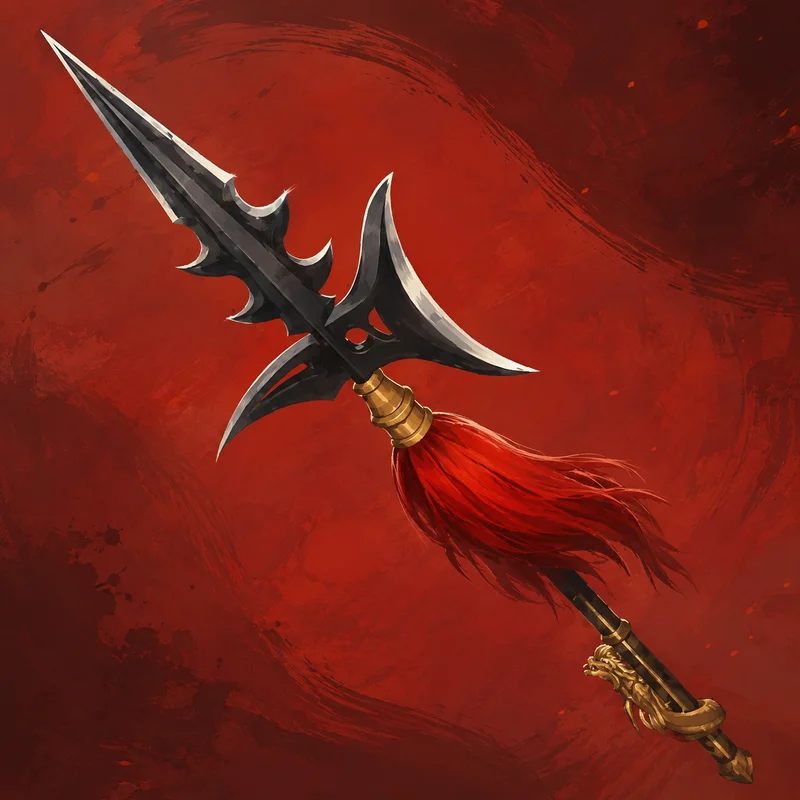
Huà (画): Translates to “Painted,” “Engraved,” or “Ornate.” It refers to the intricate golden dragon patterns and red tassels carved onto the shaft and metal guards.
-
Jǐ (戟): A traditional Chinese polearm that combines the stabbing tip of a spear (Qiāng / 枪) with the cleaving crescent blade of an axe (Yè / 钺).
Taken together, Fāng Tiān Huà Jǐ signifies “The Ornate Sky-Piercing Halberd”—a weapon so complex that only a warrior with divine martial talent could master it.

2. Physical Design and Anatomy
Unlike basic single-crescent halberds (Qīng Lóng Jǐ / 青龙戟), Lu Bu’s Sky-Piercing Ji was a Double-Crescent Halberd (Shuāng Chǐ Jǐ / 双翅戟), featuring crescent blades attached to both sides of the central spearhead.

Sky-Piercing Ji, 方天画戟, Fāng Tiān Huà Jǐ, Phương Thiên Họa Kích
-
The Stabbing Tip (Qiāng Tóu): A long, double-edged straight spear blade at the top, designed for high-speed thrusting to penetrate heavy iron plate and lamellar armor.
-
Dual Crescent Blades (Huà Ér): Two crescent-shaped side blades attached to the shaft via steel struts. These sharp, curved edges allowed Lu Bu to chop downward like a battleaxe, sweep sideways like a broadsword, or hook enemy weapons and reins during horseback duels.
-
The Shaft and Tassels: The heavy shaft was forged from iron-reinforced wood, decorated with red horsehair tassels (Hóng Yīng / 红缨) below the guard. These tassels served a practical purpose in combat: they absorbed blood running down the blade, keeping the grip dry and non-slip.
3. Combat Mechanics and Versatility
The Sky-Piercing Ji is widely regarded as one of the most difficult weapons to master in Chinese martial arts history because it combines the techniques of four separate weapon classes:
-
Spear Techniques (Thrusting): Straightforward, long-range lunges.
-
Axe Techniques (Cleaving): Overhead downward chops capable of splitting helmets and shields.
-
Broadsword Techniques (Slashing): Wide, circular horizontal sweeps on horseback.
-
Hook/Dagger Techniques (Parrying & Disarming): Using the inner crescent gaps to trap enemy spearheads or pull riders off their saddles.
In the hands of an average soldier, the weapon was clumsy and top-heavy. However, Lu Bu’s physical strength and agility allowed him to wield the Sky-Piercing Ji fluidly from the saddle of Red Hare (赤兔马), turning the halberd into a whirlwind of offense and defense.
4. Legendary Exploits Under Lu Bu
The Sky-Piercing Ji served as Lu Bu’s weapon in his most famous literary triumphs throughout Romance of the Three Kingdoms:
The Massacre at Hulao Pass (190 AD)
In Chapter 5, during the campaign of the Eighteen Warlords against Dong Zhuo (董卓, Đổng Trác), Lu Bu rode out before Hulao Pass (虎牢关, Hổ Lao Quan). Wielding his Sky-Piercing Ji:
-
He killed Fang Yue (方悦, Phương Duệ) in under 5 bouts.
-
He killed Mu Shun (穆顺, Mục Thuận) in a single thrust through his helmet.
-
He severed the wrist of Wu Anguo (武安国, Võ An Quốc) with a side sweep of his crescent blade.



Three Heroes Battle Lu Bu (190 AD)
In the same chapter, Lu Bu fought Zhang Fei (张飞), Guan Yu (关羽), and Liu Bei (刘备) simultaneously. For over 80 combined bouts, Lu Bu used the double crescents of his Sky-Piercing Ji to parry Zhang Fei’s Serpent Spear, Guan Yu’s Green Dragon Blade, and Liu Bei’s Dual Swords all at once before breaking out of the circle unharmed.
Shooting the Halberd at Yuanmen (196 AD)
(Yán Mén Shè Jǐ / 辕门射戟 – Bắn kích cửa trại)
In Chapter 16, to prevent a war between Yuan Shu’s (袁术) general Ji Ling (纪灵, Kỷ Linh) and Liu Bei, Lu Bu hosted a banquet. He had his Sky-Piercing Ji set up at the main gate of his camp, a distance of over 150 paces (approx. 200 meters) away.



Lu Bu declared a wager:
“If I hit the small side blade of my halberd with an arrow, both sides must truce. If I miss, you may fight!”
Drawing his bow, Lu Bu released a single arrow that flew straight through the air and struck the narrow side crescent of the Crescent Halberd dead center, awing both armies into signing a peace treaty without shedding a drop of blood.
Summary of Profile Details
| Aspect | Historical, Literary & Gaming Details |
| Chinese Name | 方天画戟 (Fāng Tiān Huà Jǐ) |
| Vietnamese Name | Phương Thiên Họa Kích |
| English Names | Sky-Piercing Ji / Sky-Piercing Halberd / Fangtian Ji |
| Primary Owner | Lu Bu (吕布 / courtesy name: Fengxian, 奉先) |
| Weapon Category | Double-Crescent Polearm (Ji / 戟) |
| Primary Mount | Red Hare (赤兔马, Ngựa Xích Thố) |
| Famous Feats | Fought Liu, Guan, and Zhang at Hulao Pass; struck at 150 paces by arrow (196 AD) |
| Core Symbolism | Absolute Martial Superiority, Unbeatable Power, Unpredictable Ferocity |
Historical Reality vs. Literary Myth
-
In History (Records of the Three Kingdoms / 三国志): Chen Shou’s (陈寿, Trần Thọ) historical texts record that Lu Bu was indeed a skilled horseman and archer referred to as the “Flying General” (Fēi Jiāngjūn / 飞将军). However, in actual Han Dynasty combat, Lu Bu primarily used standard cavalry spears (Mao / 矛) and side swords. He did use a Ji (halberd) as a ceremonial or defensive weapon, most notably when he used one to stab Dong Zhuo during the palace coup in 192 AD.
-
The Evolution of the Fangtian Ji: Double-crescent painted halberds (Fāng Tiān Huà Jǐ) were not used on ancient battlefields. They emerged much later during the Song Dynasty (960–1279 AD) as ceremonial weapons carried by imperial honor guards or used in military strength exams due to their elaborate appearance.
-
Literary Triumph: Luo Guanzhong retroactively assigned this grand, complex weapon to Lu Bu in Romance of the Three Kingdoms. By equipping the realm’s strongest warrior with the realm’s most complex weapon, the author created an indelible visual symbol of martial perfection that remains iconic across modern literature, drama, and gaming worldwide.
For detailed historical records, archives, and official chronicles, explore Crescent Halberd on Wikipedia.