

Contents
Biography & Historical Record
Ma Su, courtesy name幼常 (Youchang), was a brilliant military strategist and official of the state of Shu Han during the Three Kingdoms period. A native of Yicheng in Xiangyang Commandery, he was the youngest of the five exceptionally talented Ma brothers. Possessing a deep understanding of military tactics and strategy, Ma Su was greatly favored and trusted by Imperial Chancellor Zhuge Liang, who frequently engaged him in deep discussions on state affairs and military deployment. However, despite his immense theoretical knowledge, senior statesmen such as Liu Bei famously warned Zhuge Liang on his deathbed that Ma Su was prone to exaggeration and overconfidence, advising that he should never be assigned major responsibilities or entrusted with critical military commands.
In 228 AD, during Zhuge Liang’s First Northern Expedition against Cao Wei, Ma Su was chosen over veteran generals to command the vanguard forces and defend the vital strategic stronghold of Jieting against the veteran Wei general Zhang He. Disregarding Zhuge Liang’s explicit deployment orders and tactical instructions to camp at a defensible water source, Ma Su stubbornly chose to position his troops atop a barren, waterless mountain, arrogantly claiming that taking high ground would provide an overwhelming psychological advantage. The Wei army under Zhang He swiftly surrounded the mountain, cut off their water supply, and inflicted a crushing defeat on the Shu forces, resulting in the loss of Jieting and ruining the entire northern expedition. Following this catastrophic failure, Ma Su attempted to flee but was captured. To uphold military discipline and appease the disgruntled populace and allied factions, Zhuge Liang wept as he ordered the execution of Ma Su, an event famously recorded as ‘shedding tears while executing Ma Su’ (揮淚斬馬謖).
Role in Romance of the Three Kingdoms
In Luo Guanzhong’s epic novel Romance of the Three Kingdoms, Ma Su is prominently featured as a gifted yet fatally arrogant tactician. He first gains widespread renown in Chapter 87 during the Southern Campaign against Meng Huo, where he proposes the brilliant psychological strategy of ‘attacking the heart is best, attacking the fortress is secondary’ (攻心為上, 攻城為下), advising Zhuge Liang to capture and release Meng Huo seven times to secure the permanent loyalty of the southern tribes. Later in Chapter 92, Ma Su uses a clever ruse to defeat and capture the Wei general Sima Zhi.
The defining and tragic climax of Ma Su’s literary arc occurs in Chapter 95 during the First Northern Expedition. Appointed to defend Jieting against Zhang He, Ma Su arrogantly dismisses the advice of his deputy Wang Ping, opting to camp on top of a barren mountain instead of blocking the roads below. Predictably, Zhang He surrounds the mountain and cuts off their water supply, causing a total rout. Ma Su returns in chains to the Shu camp, and in Chapter 96, despite his deep personal affection for him, Zhuge Liang sorrowfully orders his execution to enforce military law before the entire grieving army.
Notable Quotes & Famous Sayings
- “In military strategy, attacking the heart is best, attacking the fortress is secondary; psychological warfare is best, tactical warfare is secondary.” — Ma Su advising Zhuge Liang on how to permanently subdue the southern tribes.
- “Placing troops on top of a desperate height is a classic maneuver; what danger could there possibly be?” — Ma Su arrogantly dismissing Wang Ping’s warnings at Jieting.
Ma Su (馬謖) — Historical & Literary Timeline
225 AD
The Strategy of Capturing Meng Huo
During the Southern Campaign, Ma Su advises Zhuge Liang to win over the hearts of the southern people by capturing and releasing Meng Huo seven times, successfully pacifying the region.
228 AD
Countering Sima Yi’s Disinformation
Ma Su employs a counter-espionage stratagem to spread rumors in Cao Wei’s court, successfully leading Sima Yi to be stripped of his military command.
228 AD
The Defeat at Jieting
Given command of the vanguard at Jieting, Ma Su disobeys orders by camping on a barren mountain, where he is decisively routed by Zhang He.
228 AD
The Execution at Jieting
Following his capture, Ma Su is publicly executed by Zhuge Liang to uphold military discipline, prompting the Chancellor’s famous tears.
For detailed historical records, archives, and official chronicles, explore Ma Su on Wikipedia.
Key Relationships
Family
- Ma Liang (马良, Mã Lương) — The eldest of the five Ma brothers, he was a highly respected official and strategist for Liu Bei who died during the Battle of Yiling.
Friends
- Wang Ping (王平, Vương Bình) — Served as Ma Su’s deputy during the defense of Jieting in 228 AD; he famously warned Ma Su against camping on the mountain, though his advice was ignored.
Enemies
- Zhang He (张郃, Trương Cáp) — A veteran Wei general who exploited Ma Su’s tactical failure at Jieting in 228 AD, surrounding his position and inflicting a decisive defeat that ruined the Northern Expedition.
- Sima Yi (司马懿, Tư Mã Ý) — The supreme commander of the Cao Wei forces who served as a strategic adversary during the northern campaigns; Ma Su notably used a ruse to temporarily discredit him in the novel.
Other
- Zhuge Liang (诸葛亮, Gia Cát Lượng) — The Imperial Chancellor of Shu Han who acted as Ma Su’s mentor and close confidant; despite his deep personal affection for Ma Su, he ordered his execution in 228 AD to uphold military law after the loss of Jieting.
- Liu Bei (刘备, Lưu Bị) — The founding emperor of Shu Han who, on his deathbed, warned Zhuge Liang that Ma Su was prone to overconfidence and should not be entrusted with major responsibilities.
- Meng Huo (孟获, Mạnh Hoạch) — The leader of the southern tribes whom Ma Su advised Zhuge Liang to capture and release seven times to secure his permanent loyalty during the 225 AD Southern Campaign.
Appearance
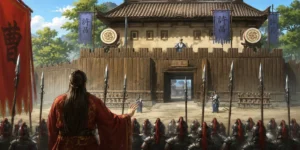
In Novel
Chapter 87
- Ma Su (马谡, Mã Tốc): After Zhuge Liang enters the Southern Campaign, Ma Su comes to the Shu camp wearing mourning clothes for his recently deceased elder brother Ma Liang. Zhuge Liang asks for his advice on how to pacify the Southern tribes permanently. Ma Su argues that military conquest alone will only produce repeated rebellions and gives the principle “attacking the heart is best, attacking the fortress is secondary; psychological warfare is best, tactical warfare is secondary”. Zhuge Liang accepts the advice and appoints Ma Su as a staff officer. The strategy becomes the foundation for Zhuge Liang’s policy of repeatedly capturing and releasing Meng Huo until the Southern ruler submits willingly.
Chapter 91
- Ma Su (马谡, Mã Tốc): After the Southern Campaign, Zhuge Liang learns that Sima Yi has been appointed to command the forces of Yong and Liang. Ma Su advises against immediately exhausting the Shu army in another campaign and proposes an indirect strategy: secretly spread rumors in Wei territory that Sima Yi intends to rebel, and circulate forged proclamations supposedly issued by Sima Yi. Zhuge Liang adopts the plan. Cao Rui becomes suspicious of Sima Yi, investigates him, and ultimately removes him from military command. This is Ma Su’s second major strategic contribution in the novel.
Chapter 95
- Ma Su (马谡, Mã Tốc): During Zhuge Liang’s First Northern Expedition, Ma Su volunteers to defend the vital strategic position of Jieting against Sima Yi and Zhang He. Zhuge Liang warns him repeatedly that the position has no strong fortification and that losing it will cut the Shu army’s retreat. Ma Su nevertheless insists that his knowledge of military theory is sufficient and accepts command. At Jieting, Wang Ping advises him to place the main force on the road and build a fortified position. Ma Su rejects the advice and camps on a mountain, arguing that high ground gives overwhelming advantage and that troops cut off from water will fight with greater determination. He gives Wang Ping 5,000 soldiers to establish a separate supporting camp. Sima Yi surrounds Ma Su’s mountain, while Zhang He blocks Wang Ping. The Wei army cuts the Shu troops’ water supply; the soldiers become thirsty, hungry and disorganized. Ma Su kills two of his own officers when his troops refuse to attack, but the army still collapses. He finally abandons the mountain and flees westward as Zhang He pursues him.
Chapter 96
- Ma Su (马谡, Mã Tốc): After the loss of Jieting, Ma Su returns to Zhuge Liang’s camp and accepts responsibility for the defeat. Zhuge Liang orders him arrested and sentenced to death under military law. Ma Su pleads that his crime is undeniable and asks Zhuge Liang to remember their close relationship, but Zhuge Liang refuses to sacrifice military discipline for personal affection. Ma Su is taken outside the commander’s gate and executed. Zhuge Liang then has his head displayed to the army, orders his burial, writes a memorial, and arranges continuing provisions for Ma Su’s family. Zhuge Liang later explains that his tears are also for having ignored Liu Bei’s earlier warning that Ma Su’s words exceeded his actual ability and that he should not be entrusted with major responsibilities.
Appearance
In History
- Ma Su (马谡, Mã Tốc), courtesy name Youchang, was a Shu Han military officer and adviser who was highly regarded by Zhuge Liang (诸葛亮, Gia Cát Lượng).
Year: 228 AD
- Ma Su (马谡, Mã Tốc) was given command at Jieting during Zhuge Liang’s first northern expedition. He disregarded the recommended deployment and was defeated by Zhang He (张郃, Trương Cáp).
Year: 228 AD
- Ma Su (马谡, Mã Tốc) was executed after the defeat. Zhuge Liang accepted responsibility and demoted himself.
Historical Record
- Ma Su (马谡, Mã Tốc) was a real historical Shu officer. The historical sources support his defeat at Jieting and execution, while later literature expands his characterization.