
Contents
Biography & Historical Record
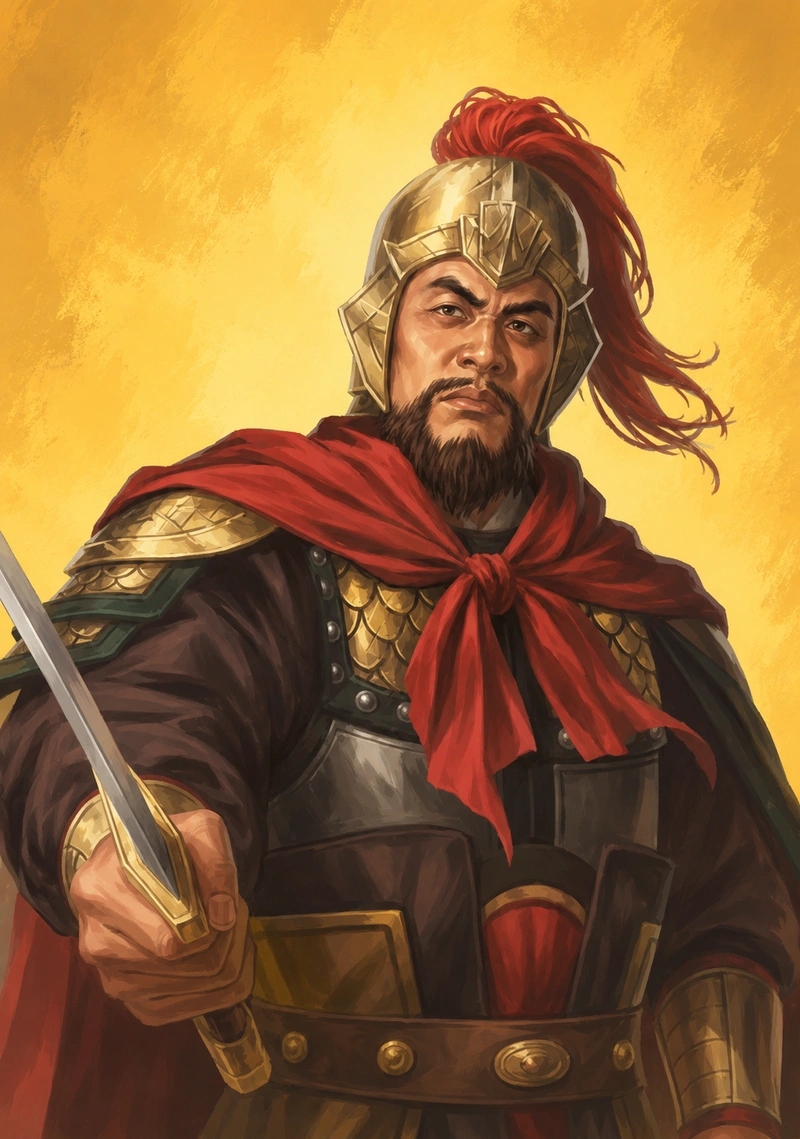
Tao Huang, courtesy name Shiying, was a distinguished military commander, governor, and statesman who served as Inspector of Jiao Province (Jiaozhou Cishi), General Who Pacifies the South (Annan Jiangjun), and was ennobled as the Marquis of Wanling. Hailing from Moling County in Danyang Commandery (modern-day Nanjing, Jiangsu Province), he was the son of Tao Dan, a renowned Eastern Wu general. Documented in Chen Shou’s official dynastic history Records of the Three Kingdoms (Sanguozhi – Book of Wu, Biography of Tao Huang, Volume 48) and the Book of Jin (Jin Shu), Tao Huang is historically celebrated as one of the most brilliant and virtuous military commanders of the late Eastern Wu period. He is best known for his decisive reconquest of the Jiao Province (modern-day Vietnam) in 271 AD and his exceptionally benevolent and stable thirty-year governance that brought prosperity and security to the southern frontier, earning him deep veneration from both the imperial court and the local populace.
In 268 AD, the Jiao Province—a strategic region covering parts of modern-day Vietnam and southern China—erupted in revolt. Local chieftains and clans, discontent with Eastern Wu administration, opened their gates to Western Jin forces, who dispatched General Yang Ze to fortify the region. After two successive Eastern Wu expeditionary forces were crushed by the Jin defenders, the embattled Wu emperor Sun Hao appointed Tao Huang as the Front-Column Commander (Qianbu Du) to launch a final, decisive counter-offensive. Displaying mastery of battlefield maneuvering, Tao Huang led a formidable army south. During a critical engagement along the river, he deployed a secret elite unit carrying massive incendiary torches under the cover of darkness, outflanking the Jin defensive perimeter. When the battle erupted, his surprise nocturnal assault created utter chaos within the Jin ranks, resulting in the death of the Jin commander Feng Fei and a total rout of the defending army.
Following this victory, Tao Huang employed a sophisticated blend of military pressure and strategic bribery, utilizing gold and silks to detach local tribes from the Western Jin’s influence. He systematically besieged and reduced the fortress of Hepu, shattering the Jin defensive network and forcing the surrender of the regional commander Yang Ze. With the Jiao Province fully secured, Sun Hao rewarded Tao Huang with the title of Inspector of Jiao Province. Over the next thirty years, Tao Huang implemented a policy of enlightened governance; he starkly refused to impose the excessive, unjust taxes demanded by the corrupt central court, reduced corvée labor for the impoverished peasantry, reformed corrupt local bureaucracy, and personally mediated disputes among the diverse indigenous tribes to foster regional peace. His administration is heralded as the “Golden Age” of late Eastern Wu governance in the south.
In 280 AD, as the Western Jin forces swept south and annihilated Eastern Wu, Emperor Sun Hao surrendered. Despite the collapse of his state, Tao Huang remained at his post to prevent chaos and safeguard the welfare of the people of Jiao Province. Upon receiving the official imperial surrender order, Tao Huang wept bitterly for the fall of the dynasty he served, yet ultimately opened the gates to the Jin army to spare the region from unnecessary slaughter. Greatly impressed by his unwavering loyalty and exceptional administrative record, the Jin Emperor Sima Yan confirmed him as Inspector of Jiao Province, maintaining his authority over the region. Tao Huang continued his benevolent governance for another decade before passing away in 290 AD. Upon news of his death, the populace and scholar-gentry of Jiao Province reportedly grieved collectively, constructing shrines to honor his legacy as the most virtuous guardian of the southern border.
Famous Quotes & Historical Sayings
In the historical records of the Records of the Three Kingdoms (Sanguozhi – Book of Wu), historian Chen Shou and the Jin Shu recorded the paramount tribute to Tao Huang’s legacy: ‘Tao Huang Shiying served with upright virtue, standing as a tranquil pillar amidst the falling dynasty. For thirty years, he governed the southern frontier, transforming the volatile marches into a bastion of stability and prosperity. When the Wu state collapsed, he shielded the people from fire and blade, earning the respect of the Jin conquerors and the eternal love of the southern populace. He was indeed the greatest guardian of the southern seas in the late era.’
Tao Huang (陶璜) — Historical & Literary Timeline
Reconquest of Jiao Province
Dispatched by Sun Hao to suppress the Jin-backed rebellion in Jiao Province; utilizes night-time incendiary maneuvers and strategic bribery to defeat General Yang Ze and secure the region for Eastern Wu.
Thirty Years of Benevolent Governance
Serves as Inspector of Jiao Province; enacts tax relief, reforms the bureaucracy, and integrates local tribal groups, fostering stability throughout the southern commanderies.
Submission to Western Jin & Continued Service
Surrenders the province to Western Jin forces following Sun Hao’s capitulation to preserve the peace; retained by Sima Yan as Inspector due to his high moral prestige and administrative excellence.
Passing Away in Old Age & Public Mourning
Passes away peacefully in office; widespread public mourning across Jiao Province leads to the construction of shrines to commemorate his rule.
Key Relationships
Family
- Tao Dan (陶诞, Đào Đản): Father and Eastern Wu general who preceded Tao Huang in military service.
- Tao Zun (陶浚, Đào Tuấn): Son and Eastern Wu officer who helped maintain the family lineage and military standing in the late Wu period.
Friends
- Xue Xu (薛珝, Tiết Hủ): Eastern Wu senior general who served as a chief commander alongside Tao Huang during the joint expedition to reconquer Jiao Province between 269 and 271 AD.
- Yu Si (虞汜, Ngu Tự): Eastern Wu general and campaign colleague who coordinated with Tao Huang to pacify regional insurgencies and restore Wu authority in the south.
Enemies
- Yang Ze (杨稷, Dương Tắc): Western Jin general and regional commander who led the Jin-backed forces in Jiao Province; forced to surrender after Tao Huang isolated and besieged his stronghold in 271 AD.
- Feng Fei (冯斐, Phùng Phỉ): Western Jin officer killed in action during Tao Huang’s decisive nighttime incendiary river assault during the Jiao Province campaign.
Other
- Sun Hao (孙皓, Tôn Hạo): The final Emperor of Eastern Wu who appointed Tao Huang as Front-Column Commander in 268 AD to recover Jiao Province and later promoted him to Inspector of Jiao Province.
- Sima Yan (司马炎, Tư Mã Viêm): Emperor Wu of Jin who received Tao Huang’s formal surrender in 280 AD, highly praised his integrity, and reappointed him as Inspector of Jiao Province under the Jin dynasty.
In Novel
Tao Huang (陶璜, Đào Hoàng) does not have a securely verified named appearance in the supplied edition under the exact Chinese name 陶璜. He is a historical Wu/Jin-era commander, but no chapter is assigned without exact textual support.
In History
- Tao Huang (陶璜, Đào Hoảng) was a prominent Eastern Wu military commander and administrator, especially active in the south.
Military Career
- Tao Huang became particularly important in Wu’s campaigns in Jiaozhou and against the Jin dynasty.
- He helped preserve Wu influence in the far south during a period when the region was contested by local forces and the northern Jin state.
Defense of Jiaozhou
- He was associated with prolonged military operations in the region and demonstrated considerable knowledge of local conditions.
- His service helped maintain the political and military position of the Wu government in southern territories.
Legacy
- Tao Huang is remembered as one of Wu’s important southern commanders and administrators during its later period.
- Classification: Historical.