
Contents
Biography & Historical Record
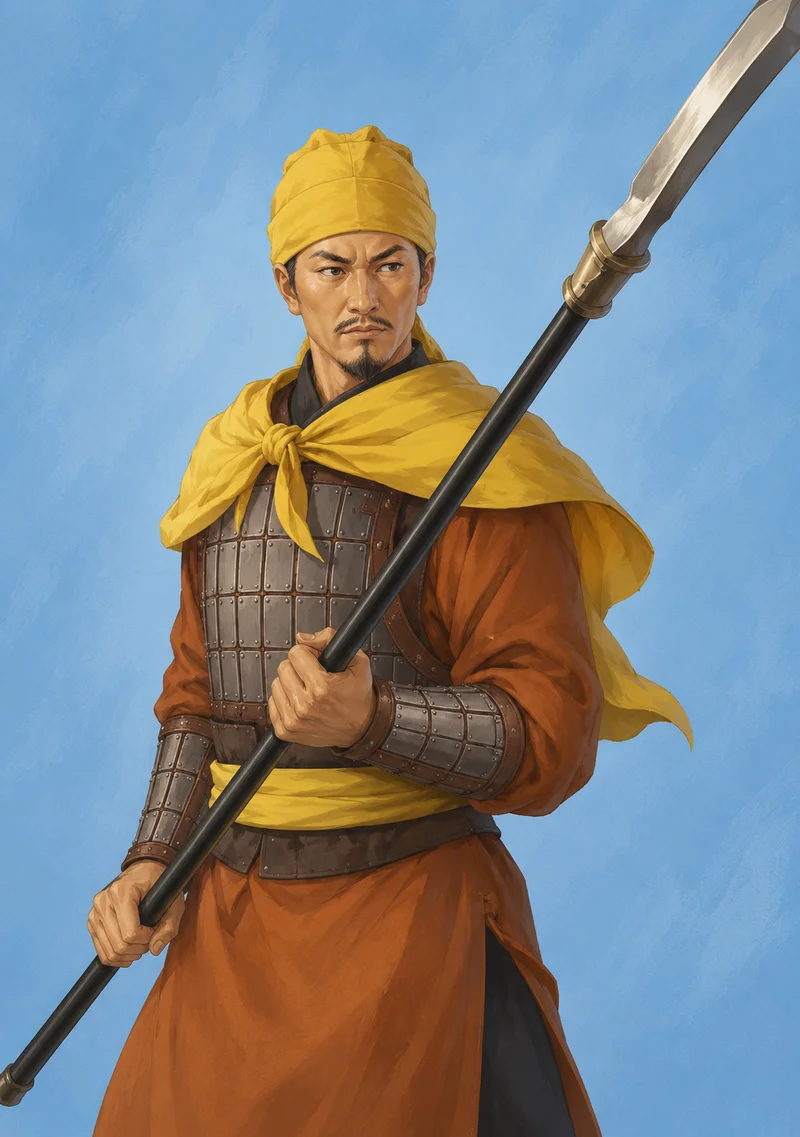
Wang Du was an Eastern Han dynasty local official turned insurgent leader who served as the County Magistrate’s Assistant (Xiancheng) of Dong’a County in Dong Commandery, Yan Province. In 184 AD, during the explosive outbreak of the Yellow Turban Rebellion, Wang Du betrayed the Han imperial government, defected to the Yellow Turban movement, and led a major local armed uprising in Dong’a. His rebellion caused significant regional chaos but ultimately served as the catalyst that brought the famous strategist Cheng Yu into historical prominence.
In the spring of 184 AD (the first year of the Zhongping era under Emperor Ling), Zhang Jiao ignited the nationwide Yellow Turban Rebellion under the banner ‘The Azure Sky is dead, the Yellow Sky shall arise’. Recognizing the systemic corruption and instability of the Han imperial court, Wang Du made a bold political decision to defect. Mobilizing thousands of disaffected local residents and religious adherents, Wang Du raised the Yellow Turban banner in Dong’a County, launching a violent uprising against imperial authority.
In March 184 AD, Wang Du commanded his rebel forces to set fire to the imperial granaries, armories, and strategic government storehouses in Dong’a to induce panic. Overwhelmed by the destruction, the reigning County Magistrate panicked and fled the city by scaling the fortress walls. The terrified local population and lower-ranking officials fled eastward, escorting their elderly and children to seek refuge at Mount Quqiu (also recorded as Mount Qiushan). Having captured Dong’a, Wang Du realized that holding an empty city with an unorganized force was unsustainable. He led his army out of the fortress and established a fortified military camp five to six li west of Dong’a to wait for opportunities to plunder the surrounding countryside.
Cheng Yu, a prominent local scholar hiding on Mount Quqiu with the fleeing populace, recognized Wang Du’s strategic vulnerability. Cheng Yu persuaded local gentry leaders such as Xue Fang and former officials to launch a counter-offensive. Cheng Yu covertly dispatched several mounted scouts bearing imperial banners to the eastern mountain peaks, shouting and feigning the arrival of imperial relief forces. Deceived into believing imperial reinforcements had arrived, the refugee populace and former officials rushed back to reoccupy and secure the walls of Dong’a.
Enraged upon discovering the deception, Wang Du led his entire army back to storm Dong’a, but met fierce and unyielding resistance from the fortified defenders. As Wang Du’s troops grew exhausted and began a disorganized withdrawal, Cheng Yu personally threw open the city gates and led a sudden, decisive counter-attack. Wang Du’s army was completely shattered, suffering heavy casualties, and Wang Du was forced to flee with his remaining shattered forces. Dong’a County was preserved intact. Wang Du died or was eliminated in subsequent pacification sweeps across Yan Province later in 184 AD.
Historically, Wang Du’s rebellion served as a fateful turning point in the history of the Three Kingdoms era. Although his uprising was quickly crushed, it established Cheng Yu’s reputation as a brilliant military strategist. When Cao Cao took control of Yan Province years later, he sought out Cheng Yu based on his fame from defeating Wang Du, bringing Cheng Yu into his inner council to become one of the five pillar advisors of the Cao Wei state.
Role in Romance of the Three Kingdoms
In Luo Guanzhong’s novel Romance of the Three Kingdoms, Wang Du does not appear as a named character nor is he featured in any chapter. Luo Guanzhong omitted many localized administrative uprisings during the 184 AD Yellow Turban campaign to focus the literary drama on the primary battlefields involving Zhang Jiao, Huangfu Song, Lu Zhi, Zhu Jun, Liu Bei, Cao Cao, and Sun Jian. However, Wang Du is an authentic historical figure documented in official historical texts, most notably Chen Shou’s Records of the Three Kingdoms (Sanguozhi – Book of Wei, Biography of Cheng Yu) and Sima Guang’s Zizhi Tongjian, as the rebellious County Assistant of Dong’a whose defeat marked the rise of Cheng Yu.
Wang Du (王度) — Historical & Literary Timeline
184 AD — Historical Record
Defection and Outbreak of Rebellion in Dong’a
Serves as County Assistant in Dong’a County; defecting to the Yellow Turban Rebellion in spring 184 AD, he sets fire to government granaries and forces the County Magistrate and populace to flee.
184 AD — Historical Record
Encamping West of Dong’a and Imperial Deception
Encamps west of Dong’a County to plunder the region; deceived by Cheng Yu’s false signals of imperial relief, allowing the refugees to reoccupy the city walls.
184 AD — Historical Record
Defeat by Cheng Yu and Collapse
Launches a failed assault on Dong’a; routed in a decisive sortie led by Cheng Yu, resulting in the total destruction of his rebel army and his eventual death.
Key Relationships
- Family:
- ? — Unknown family lineage.
- Comrades / Allies:
- Zhang Jiao — Supreme Master of Taiping Dao and supreme leader of the Yellow Turban Rebellion whose nationwide uprising Wang Du supported.
- Sun Xian — Fellow remnant Yellow Turban leader mentioned alongside Wang Du in regional historical surveys.
- Enemies / Opponents:
- Cheng Yu — Prominent scholar of Dong’a who devised the plan to trick Wang Du, organized the city’s defense, and led the counter-offensive that destroyed Wang Du’s army.
- Xue Fang — Local gentry leader who partnered with Cheng Yu to resist Wang Du’s rebellion.
- Emperor Ling of Han — Han monarch against whose imperial administration Wang Du revolted.
In Novel
Chapter 13
- Wang Du (王度, Vương Độ): Wang Du is associated with the local unrest surrounding the struggle for control of the Han territories. His appearance is brief and belongs to the period when the imperial government is attempting to restore order after the collapse of the Yellow Turban rebellion.
In History
Summary
- Wang Du (王度, Vương Độ) is a rebel leader associated with the late Eastern Han disturbances.
Historical Record
- Wang Du appears in the historical-literary tradition of the late Han as a local rebel figure rather than a major state commander.
- The available record is brief, and his exact relationship to the larger Yellow Turban and post-Yellow Turban movements requires careful source distinction.
- Classification: Historical / Minor Rebel Leader.