
Contents
Biography & Historical Record
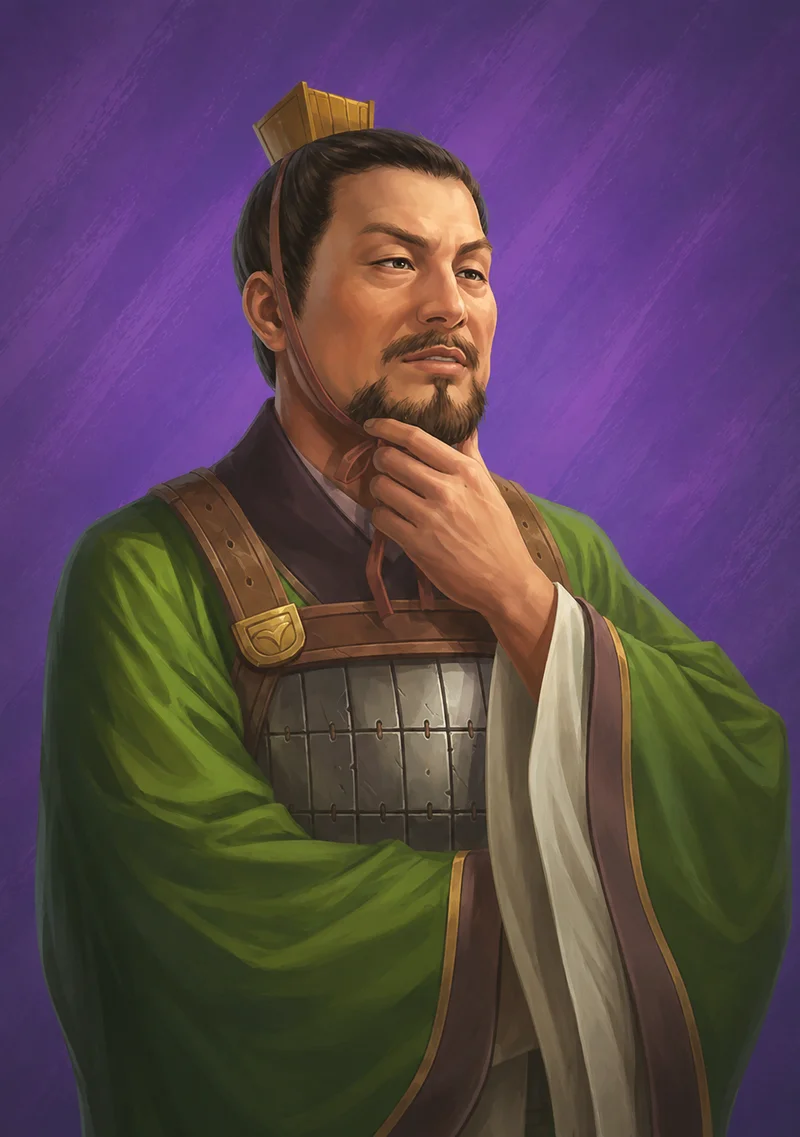
Ding Fei, courtesy name Wenhou, was an Eastern Han dynasty military commander, strategic advisor, and Colonel of Imperial Guards (Dianjun Xiaowei) under Cao Cao during the late second and early third centuries. Hailing from Qiao County in Pei Commandery (modern-day Bozhou, Anhui Province), he was a close personal friend and fellow townsman of Cao Cao. Documented in Chen Shou’s Records of the Three Kingdoms (Sanguozhi – Book of Wei, Biography of Cao Hong, citing Wei Lue), Ding Fei was celebrated for his brilliant tactical resourcefulness, his swift crisis management, and his unwavering loyalty, though he was equally notorious for his extreme avarice, bribery, and petty corruption. Despite his moral flaws, Cao Cao treasured Ding Fei’s tactical genius and repeatedly shielded him from capital punishment, famously comparing him to an elite hunting dog that occasionally steals meat but catches the grandest game.
During Cao Cao’s early rise to power, Ding Fei accompanied him across various campaigns in northern China, serving as Magistrate of Weinan and later as Colonel of Imperial Guards. In 211 AD, Cao Cao launched his western expedition against the Xiliang coalition led by Ma Chao and Han Sui, culminating in the Battle of Tong Pass along the Wei River. As Cao Cao attempted to transport his army across the Wei River, Ma Chao launched a sudden, devastating surprise attack with elite Xiliang cavalry. Pinned against the riverbank with his bodyguard routed, Cao Cao was forced to cut his beard and discard his robes to escape recognition, coming within hair’s breadth of death. Observing Cao Cao’s peril from the southern slopes of Mount Nanshan, Ding Fei executed a masterclass in psychological distraction: he ordered his troops to throw open all army livestock enclosures, releasing thousands of horses, cattle, and sheep onto the battlefield. The greedy Xiliang cavalry immediately broke ranks to capture the fleeing livestock, creating total chaos and halting their pursuit, which allowed Cao Cao and his inner guard to board boats and escape across the Wei River unharmed.
Following this miraculous rescue, Cao Cao praised Ding Fei’s quick wit, laughing that without his ingenuity, he would have perished at the hands of Ma Chao. However, Ding Fei’s insatiable greed frequently got him into legal trouble. On one occasion during a military march, Ding Fei secretly exchanged his own emaciated, elderly ox for a fat, healthy government ox. When the fraud was discovered, Minister of Justice Mao Jie arrested Ding Fei and stripped him of his official seals. The next day, Cao Cao playfully teased him, asking where his official seals had gone. Ding Fei casually replied that he had traded them for pastries. Amused by his unblushing honesty, Cao Cao immediately restored his rank. When upright ministers such as Mao Jie repeatedly petitioned for Ding Fei’s execution for corruption, Cao Cao firmly refused, maintaining his high patronage. Ding Fei served the Wei court honorably until passing away peacefully of natural causes, leaving his son Ding Mi (courtesy name Yanjing), who later inherited his noble lineage and served Cao Shuang.
Role in Romance of the Three Kingdoms
In Luo Guanzhong’s novel Romance of the Three Kingdoms, Ding Fei appears in Chapter 58 as a clever and resourceful advisor to Cao Cao during the Battle of Tong Pass in 211 AD. As Cao Cao attempts to lead his army across the Wei River, Xiliang warrior Ma Chao leads a terrifying cavalry charge that shatters Cao Cao’s lines, forcing Cao Cao to cut his beard and throw off his red robe to evade capture. Trapped along the riverbank under a hail of arrows, Cao Cao’s life hangs by a thread. Standing atop a nearby hill, Ding Fei realizes that the Xiliang cavalry soldiers are greedy for loot and livestock. Ding Fei immediately orders his men to release all the army’s cattle and horses onto the open field. Seeing thousands of animals running wild, Ma Chao’s troops break formation and fight among themselves to round up the cattle, completely abandoning the pursuit of Cao Cao. This brilliant tactical distraction allows Cao Cao and his bodyguards to board the ferry and cross the river safely. After reaching safety, Cao Cao praises Ding Fei lavishly, remarking: ‘If not for Wenhou’s sudden stroke of genius today, I would have been trapped and killed by that young thief Ma Chao!’ Ding Fei’s timely intervention stands as one of the most famous tactical saves in the novel.
Ding Fei (丁斐) — Historical & Literary Timeline
Releasing Livestock to Save Cao Cao from Ma Chao
Releases thousands of army cattle and horses onto the field as Ma Chao pursues Cao Cao along the Wei River; distracts the Xiliang cavalry, allowing Cao Cao to escape across the river safely.
Receiving Praise for Crisis Ingenuity
Praised by Cao Cao following his rescue, who laughs and acknowledges that Ding Fei’s quick thinking saved his life from Ma Chao’s pursuit.
Corruption Anecdotes & Protection by Cao Cao
Arrested for exchanging his private ox for a state ox; witty response to Cao Cao leads to immediate restoration of rank as Cao Cao shields him from Mao Jie’s impeachment.
Passing of Natural Causes
Passes away peacefully of natural causes in Wei; succeeded by his son Ding Mi, who continues family service under Cao Wei.
For detailed historical records, archives, and official chronicles, explore Ding Fei on Wikipedia.
Key Relationships
Family
- Ding Mi (丁谧, Đinh Mật): His son, who inherited the family line and rose to prominence as a powerful minister and core advisor to Regent Cao Shuang in Cao Wei.
Friends
- Cao Cao (曹操, Tào Tháo): His fellow townsman from Qiao County and longtime companion, who valued Ding Fei’s tactical resourcefulness, celebrated his timely rescue at the Wei River, and repeatedly shielded him from severe punishments for bribery and corruption.
Enemies
- Ma Chao (马超, Mã Siêu): Western warlord at the Battle of Tong Pass (211 AD) whose fierce cavalry charge nearly killed Cao Cao along the Wei River, until Ding Fei diverted the pursuit by unleashing cattle and horses onto the battlefield.
- Han Sui (韩遂, Hàn Toại): Allied commander of the Western Liang coalition facing Cao Cao’s forces during the Tong Pass and Wei River campaign in 211 AD.
Other
- Mao Jie (毛玠, Mao Giới): Upright Han and Wei judicial official who strictly enforced discipline, arresting Ding Fei after he swapped a private ox for a state ox and repeatedly demanding his execution for corruption.
In Novel
Chapter 22
- Ding Fei (丁斐, Dīng Fěi): Ding Fei serves Cao Cao as an officer during the conflict with Lü Bu. When Lü Bu’s forces capture Cao Cao’s horses and livestock, Ding Fei proposes a psychological trick: he releases prisoners and spreads the impression that Cao Cao is abandoning the campaign and destroying his own supplies. Lü Bu’s men rush to seize the apparent spoils, allowing Cao Cao to regroup and escape the immediate danger. Ding Fei’s quick thinking prevents a potentially disastrous defeat.
In History
Summary
- Ding Fei (丁斐, Đinh Phỉ), courtesy name Wuhou (文侯), was a Cao Wei official and trusted associate of Cao Cao.
Service under Cao Cao
- Ding Fei served in Cao Cao’s administration and was known for his ability to handle practical affairs.
- Historical anecdotes describe his quick wit and his willingness to use unconventional methods in dealing with military and administrative problems.
Historical Reputation
- His biography is associated with the tradition of capable but sometimes overly opportunistic officials surrounding Cao Cao.
- Although he was not one of Cao Cao’s principal generals, he belonged to the ruler’s wider circle of trusted administrators.
Historical Record
- Classification: Historical. The surviving record is brief and should not be expanded with novel episodes as if they were historical.