

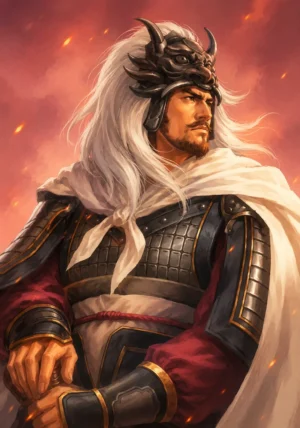
Here is the exhaustive biography of Han Sui (韓遂 / 韩遂), originally named Han Yue (韓約), courtesy name Wenyue (文約) (? – 215), a long-lived warlord of Liang Province, sworn brother and later rival of Ma Teng, ally and then enemy of Ma Chao, whose defection (or forced surrender) at Tong Pass became one of the decisive moments of Cao Cao’s western campaign, incorporating historical records and the detailed narrative of Romance of the Three Kingdoms.
Contents
Early Career and the Liang Province Rebellion
Han Sui was originally named Han Yue. A native of Jincheng in Liang Province, he was a well-known scholar who once served as Prefect of Jincheng. In 186 he became entangled in the great Liang Province Rebellion led by Beigong Boyu and the Qiang and other non-Han forces. According to tradition he was coerced into joining; thereafter he changed his name to Han Sui. Over the following decades he emerged as one of the dominant military figures of the north-west, controlling large stretches of Liang Province alongside Ma Teng. The two men were at times sworn brothers and allies, at other times bitter enemies who fought over the same territory and even saw members of each other’s families killed.
Relations with Dong Zhuo, Li Jue and Cao Cao
When Dong Zhuo seized power, Han Sui and Ma Teng initially aligned themselves with him. After Dong Zhuo’s assassination they joined Liu Yan of Yi Province in an advance on Chang’an, only to be heavily defeated by Li Jue, Guo Si and the other remnant Dong officers and forced to withdraw. In 200, after Cao Cao’s victory at Guandu, the envoy Zhong Yao successfully mediated a truce between Han Sui and Ma Teng; both submitted nominally to Cao Cao and later assisted him against the remnants of the Yuan clan. Cao Cao eventually summoned Ma Teng to the capital as a hostage-official; Han Sui remained in the west and treated Ma Chao as a successor figure.
The Tong Pass Campaign and the Letter Ruse (211)
In 211 Cao Cao moved west against Zhang Lu of Hanzhong. The Liang warlords, led by Ma Chao and including Han Sui, suspected that the true target was themselves. They rose in arms and blocked the passes. Han Sui, though older and more cautious, found himself drawn into the leadership of the coalition; Ma Chao even asked to be treated as his adopted son. Cao Cao advanced to Tong Pass. After a period of inconclusive fighting, Cao Cao employed a classic stratagem against the elderly Han Sui. He first arranged a public, apparently cordial conversation with Han Sui within sight of Ma Chao’s army, speaking of old times and shared acquaintances while giving the younger generals the impression of secret understanding. A few days later he sent Han Sui a letter in which certain passages had been deliberately blotted, altered or left incomplete, so that it appeared Han Sui himself had erased sensitive content. When Ma Chao demanded to see the letter and saw the suspicious marks, his distrust of Han Sui hardened into open hostility. The coalition fractured. In the novel the ruse is described in vivid detail: the messenger is beheaded, Ma Chao confronts Han Sui over the altered letter, and the alliance collapses amid mutual accusation. Cao Cao then struck, defeating the divided Liang forces. Han Sui was forced to submit or flee; historically he survived a few more years before dying in 215.
Han Sui (韓遂) — Historical & Literary Timeline
186 AD — Liang Province Rebellion
From Han Yue to Han Sui
Caught up in the great rebellion of Beigong Boyu and the north-western peoples. Changed his name from Han Yue to Han Sui and emerged as a major military leader in Liang Province alongside Ma Teng.
c. 192 AD — Alliance and Defeat at Chang’an
With Liu Yan against Li Jue
After Dong Zhuo’s death, Han Sui and Ma Teng joined Liu Yan in an expedition against Chang’an. They were defeated by Li Jue, Guo Si and the other remnant officers and withdrew to Liang Province, where they later fought each other for dominance.
200 AD — Truce with Ma Teng and Submission to Cao Cao
Zhong Yao’s Mediation
After Guandu, Cao Cao’s envoy Zhong Yao reconciled Han Sui and Ma Teng. Both offered nominal submission and later aided Cao Cao against the Yuan remnants. Ma Teng was eventually summoned to court; Han Sui remained in the west.
211 AD — Battle of Tong Pass and the Altered Letter
Cao Cao’s Stratagem and the Collapse of the Coalition
Ma Chao and the Liang warlords rose against Cao Cao’s western advance. Han Sui became nominal leader of the coalition. Cao Cao first conversed publicly with the aged Han Sui in view of Ma Chao’s army, then sent a deliberately altered letter. Ma Chao, seeing the blotted passages, accused Han Sui of secret dealing. The alliance broke; Cao Cao defeated the divided forces. In the novel the messenger is beheaded and the confrontation between Ma Chao and Han Sui is staged in full dramatic detail.
215 AD — Death
End of the Liang Warlord
Han Sui died in 215, a few years after the disaster at Tong Pass. The novel treats his effective elimination as part of the settlement of the north-west following Cao Cao’s victory over Ma Chao and the later campaigns in the region.
Historical Note
Han Sui was one of the longest-surviving independent warlords of the late Han, a man who navigated the Liang Province rebellions, the Dong Zhuo interregnum, intermittent war and alliance with Ma Teng, and finally the overwhelming pressure of Cao Cao’s expanding power. The famous “altered letter” episode at Tong Pass—whether strictly historical in every detail or heightened by the novel—perfectly illustrates Cao Cao’s preference for political dislocation over pure force. By destroying trust between the elderly Han Sui and the fiery Ma Chao, Cao Cao shattered a dangerous western coalition without a single decisive field engagement against its full strength. The novel turns the stratagem into one of the classic illustrations of Cao Cao’s cunning, while history records that Han Sui himself lived only a few years longer, dying in 215 as the independent power of Liang Province finally passed away.
For detailed historical records, archives, and official chronicles, explore Han Sui on Wikipedia.
Key Relationships
Family
- Unnamed daughter of Han Sui — Historical wife of Yan Xing (阎行, Diêm Hành) (son-in-law). Yan Xing later turns against Han Sui and surrenders toward Cao Cao’s side—kinship used as political leverage, not a novel invention.
- Ma Chao (马超, Mã Siêu) — Novel: treated as sworn nephew / adoptive son during the 211 anti-Cao coalition. History: coalition ally and fellow Liang commander, not a formal adoptive son; no SGZ father–son bond.
- No mother, spouse name, or sons are securely attested in the primary biographies beyond the Yan Xing marriage link.
Friends
- Ma Teng (马腾, Mã Đằng) — Long-term Liang Province partner. Novel: sworn brother who co-attacks Chang’an to relieve Emperor Xian (Ch. 10). History: repeated ally and rival for northwest dominance; neither is simply the other’s subordinate.
- Ma Chao (马超, Mã Siêu) — Co-leader of the 211 Tong Pass / Wei River rising against Cao Cao (曹操, Tào Tháo). Novel: after Cao Cao’s smeared-letter ruse, Ma Chao severs Han Sui’s left arm and the alliance collapses into surrender. History: Cao Cao divides the coalition by talks and gifts; Han Sui is not recorded as losing an arm to Ma Chao, and he dies later (215) of illness amid the Liang collapse.
- Chenggong Ying (成公英, Thành Công Anh) — Most steadfast staff officer through Han Sui’s final northwest resistance.
- Bian Zhang (边章, Biên Chương) — Early Liang rebellion co-leader (184–185) in the same provincial rising that launches Han Sui’s career (as Han Yue).
Enemies
- Cao Cao (曹操, Tào Tháo) — Principal opponent at Tong Pass (211); alienation stratagem (novel letter episode / historical negotiation-and-division) shatters the western front.
- Dong Zhuo (董卓, Đổng Trác) — Imperial general who fought the early Liang rebels, including Han Sui’s circle.
- Huangfu Song (皇甫嵩, Hoàng Phủ Tung) — Han commander who defeated Liang forces (e.g. Chencang theater) during the rebellion years.
- Xiahou Yuan (夏侯渊, Hạ Hầu Uyên) — Wei western expedition (214–215) that finishes Liang independence and precedes Han Sui’s death.
- Yan Xing (阎行, Diêm Hành) — Son-in-law turned opponent when he defects toward Cao Cao (historical betrayal of the family alliance).
Other
- Emperor Xian (刘协, Hán Hiến Đế) — Nominal sovereign whose rescue from Li Jue (李傕, Lý Thôi) motivates the novel’s Ch. 10 Chang’an march with Ma Teng; historically Han Sui holds titles such as General Who Pacifies the Qiang while remaining a de facto independent Liang lord.
- Tong Pass coalition peers (Cheng Yi, Li Kan, Zhang Heng, Ma Wan, Yang Qiu, Hou Xuan, and related western captains) — Co-appear with Han Sui and Ma Chao against Cao Cao in 211; military colleagues rather than sworn friends, and several peel away under Cao Cao’s division tactics.
- Qiang and Liang provincial forces — The demographic and military base of Han Sui’s power from the 184 rebellion through 215; not personal “friends,” but the constituency that makes him a durable northwest warlord.


In Novel
Chapter 10
- Han Sui (韩遂, Hàn Toại), courtesy name Wenyue (文约, Văn Ước): Liangzhou warlord who joins Ma Teng (马腾, Mã Đằng) to march on Chang’an and relieve Emperor Xian (刘协, Hán Hiến Đế) from Li Jue (李傕, Lý Thôi).
Chapter 58
- Han Sui (韩遂, Hàn Toại): Forms a sworn coalition with Ma Chao (马超, Mã Siêu) to avenge Ma Teng, seizes Tong Pass (潼关; Đồng Quan), and drives Cao Cao (曹操, Tào Tháo) into desperate fighting along the Wei River.
Chapter 59
- Han Sui (韩遂, Hàn Toại): Falls for Cao Cao’s alienation ruse (forged / smudged letters). Suspicious Ma Chao (马超, Mã Siêu) attacks him and severs his left arm; Han Sui surrenders to Cao Cao and is enfeoffed Marquis of Xiping. (History differs: no arm-severing; he dies of illness in 215 amid Liang’s collapse under Xiahou Yuan (夏侯渊, Hạ Hầu Uyên).)
In History
Year: 184 AD
- Han Sui (韩遂, Hàn Toại), originally named Han Yue, became involved in the Liang Province rebellion. He emerged as one of the most important military leaders in the region and maintained influence among the local Qiang and Han forces.
Year: 192 AD
- Han Sui (韩遂, Hàn Toại) continued as a major Liang Province warlord after the fall of Dong Zhuo (董卓, Đổng Trác). He operated independently and was not simply a subordinate of Ma Teng (马腾, Mã Đằng), despite their close association in later literature.
Year: 195 AD
- Han Sui (韩遂, Hàn Toại) received the title General Who Pacifies the Qiang and continued to exercise military authority in the northwest. His alliance with Ma Teng remained important to the balance of power in Liang Province.
Year: 211 AD
- Han Sui (韩遂, Hàn Toại) joined Ma Chao (马超, Mã Siêu) and other western commanders in opposing Cao Cao (曹操, Tào Tháo). Their forces fought Cao Cao at Tong Pass and in the Wei River region. Cao Cao used negotiations and division within the coalition to weaken the western alliance before defeating it.
Year: 214 AD
- Han Sui (韩遂, Hàn Toại) continued fighting in the northwest after the defeat of the Ma Chao coalition. His position weakened as Cao Cao’s commanders consolidated control over Liang Province.
Year: 215 AD
- Han Sui (韩遂, Hàn Toại) died in the fifth month of the twentieth year of the Jian’an era. His subordinates surrendered and sent his head to Cao Cao. He was more than seventy years old according to the Dianlüe tradition.
Historical Status
- Han Sui (韩遂, Hàn Toại) was a real historical warlord. The novel depicts him as Ma Teng’s sworn brother and includes dramatic episodes that are not supported by the historical record.
Novel vs History
- Alliance with Ma Teng / Ma Chao: Novel casts Han Sui as Ma Teng’s sworn brother and Ma Chao’s adoptive uncle/father-figure at Tong Pass. History treats him as an independent Liang warlord who allied with—but was not subordinate to—the Ma family.
- Tong Pass outcome: Novel: Cao Cao’s smeared letters make Ma Chao sever Han Sui’s left arm; Han Sui then surrenders and is enfeoffed Marquis of Xiping. History: Cao Cao divides the coalition by talks and gifts; Han Sui is not recorded as losing an arm to Ma Chao, continues northwest resistance, and dies of illness in 215 (Dianlüe age tradition 70+); subordinates later send his head to Cao Cao.
Gallery
1 comment
[…] the Guanzhong warlords grew suspicious and formed a massive confederation led by Ma Chao and Han Sui to resist Cao Cao’s western advance. Outraged by Ma Chao’s open rebellion at Tong Pass, Cao Cao […]