


Contents
Biography & Historical Record
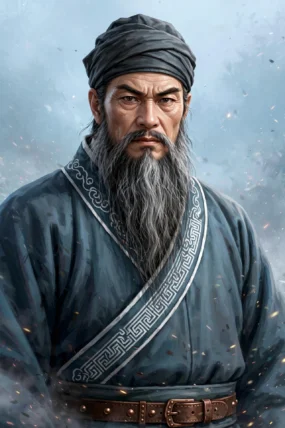
Pang Yu, courtesy name Ziyi, was a renowned Cao Wei senior imperial minister, high-ranking military advisor, and heroic scholar-gentry leader who served as Palace Attendant (Zhongsan Daifu), Commandant of Imperial Consorts (Fuma Douwei), Grand Administrator of Xihai Commandery, and Magistrate of Poqiang, being ennobled as the Marquis of Guannei. Hailing from Biaoshi County in Jiuquan Commandery (modern-day Gaotai County, Gansu Province), Pang Yu belonged to a family celebrated for supreme moral integrity and martial martyrdom across the northwestern frontier of Liang Province. He was the son of Lady Zhao E (Zhao E of Jiuquan), the most celebrated heroine of the Eastern Han dynasty who famously avenged her father by slaying his assassin in broad daylight before turning herself in to local magistrates. Documented in Chen Shou’s Records of the Three Kingdoms (Sanguozhi – Book of Wei, Biography of Pang Yu, Volume 18) and Sima Guang’s Zizhi Tongjian, Pang Yu was historically celebrated across ancient China as an uncompromising pillar of righteousness, loyalty, and filial piety, renowned for hiding a concealed dagger to assassinate the rebel general Zhang Meng and attempting self-immolation/suicide at city gates to compel relief armies to save his besieged lord.
In 209 AD, a catastrophic rebellion erupted in Wuwei Commandery when the rebel military officer Zhang Meng launched a bloody coup, assassinating Han Tanshang, the Inspector of Yong Province. To suppress dissent, Zhang Meng issued a tyrannical decree throughout Liang Province, declaring: ‘Anyone who dares to weep at the coffin of Han Tanshang shall be executed alongside three generations of their family without pardon!’ Hearing of the outrage, Pang Yu, who was then serving as a low-ranking officer, immediately resigned his official post. Braving immediate execution, he galloped day and night directly to the funeral hall of his former superior, throwing himself upon Han Tanshang’s coffin and weeping bitterly before the shocked populace. Having performed his rites of loyalty, Pang Yu concealed a razor-sharp dagger inside his sleeve and marched directly into Zhang Meng’s headquarters, intending to assassinate the rebel leader and avenge the Han inspector. Though Zhang Meng’s guards intercepted and bound him before he could strike, Zhang Meng stared into Pang Yu’s fearless eyes and sighed in profound admiration, declaring before his officers: ‘I have committed a grave crime by slaying the inspector. This man is a supreme martyr of righteousness; if I slay him, no honorable man in Liang Province will ever follow me!’ Zhang Meng personally untied Pang Yu and released him, earning Pang Yu national renown for his unyielding moral courage.
Sometime later, during local insurrections in Western Liang, the local rebel chieftain Huang Ang mobilized thousands of insurgent horsemen to besiege the provincial city of Jiuquan, trapping the Grand Administrator of Western Liang, Xu Yi. With the city on the brink of total annihilation and food supplies exhausted, Pang Yu, who had married into a local family, made the agonizing decision to abandon his wife and young children. Slipping over the city walls under cover of a torrential rainstorm, he braved dense rebel patrols to seek emergency military aid from the neighboring garrisons of Zhangye and Dunhuang. However, upon arriving at the gates of Zhangye and Dunhuang, the local commanders suspected a rebel trick and refused to deploy their troops. Enraged by their cowardice and desperate to save his lord, Pang Yu drew his sword and attempted to slit his own throat at the city gate to prove his absolute sincerity. Moved to tears by his willingness to die for his lord, the commanders opened the gates and dispatched their entire cavalry force to Jiuquan. Though the city fell and Xu Yi perished before the relief force arrived, Pang Yu personally recovered his lord’s remains, arranged a dignified burial, and observed three full years of mourning in deep solitude.
Word of Pang Yu’s heroic exploits reached the northern court, and Cao Cao immediately summoned him to Xuchang, appointing him as a trusted advisor in his central military administration. When Cao Pi proclaimed himself Emperor of Cao Wei in 220 AD, he honored Pang Yu’s supreme loyalty by appointing him Commandant of Imperial Consorts (Fuma Douwei) and promoting him to Grand Administrator of Xihai Commandery to secure the northwestern frontier. In his final years, Pang Yu was summoned back to the imperial capital at Luoyang to serve as Palace Attendant (Zhongsan Daifu) and awarded the honorific title Marquis of Guannei. He passed away peacefully of old age in office, and his title was inherited by his son, Pang Zeng.
Famous Quotes & Historical Sayings
In the historical records of Records of the Three Kingdoms (Sanguozhi – Book of Wei), historian Chen Shou recorded the immortal praise bestowed upon Pang Yu and his heroic mother, Lady Zhao E: ‘Pang Yu thought nothing of drawing his sword to slit his throat at city gates, using his absolute sincerity to move neighboring armies to rescue his lord. His mother, Zhao E, fearlessly wielded a blade to avenge her father and uphold moral righteousness, while her son, Pang Yu, sacrificed his life for the supreme loyalty of the state. A single family united in unblemished heroism and martyrdom, their names shall radiate glory through a thousand generations!’ Furthermore, when Zhang Meng captured Pang Yu with a concealed dagger, he lamented: ‘He is a supreme martyr of righteousness; to slay him would alienate all under Heaven!’
Pang Yu (龐淯) — Historical & Literary Timeline
Concealing Dagger to Assassinate Rebel Zhang Meng
Resigns office to mourn murdered Inspector Han Tanshang despite Zhang Meng’s death penalty decree; conceals a dagger in his sleeve to assassinate Zhang Meng, earning release due to his immense moral prestige.
Attempted Self-Sacrifice at City Gate to Save Xu Yi
Escapes Huang Ang’s siege at Jiuquan to seek relief armies from Zhangye and Dunhuang; attempts suicide at the city gates to prove his sincerity, moving commanders to dispatch relief forces.
Imperial Enfeoffment Under Cao Wei Dynasty
Appointed Commandant of Imperial Consorts and Grand Administrator of Xihai by Emperor Wen (Cao Pi), ennobled as Marquis of Guannei to secure the northwestern frontier.
Passing Away in Luoyang & Succession of Pang Zeng
Serves as Palace Attendant (Zhongsan Daifu) in Luoyang, passing away peacefully in old age while his son Pang Zeng inherits his noble title.
For detailed historical records, archives, and official chronicles, explore Pang Yu on Wikipedia.
Key Relationships
Family
- Pang Zixia (庞子夏, Bàng Tử Hạ): Pang Yu’s father, who served as a local official in Jiuquan Commandery.
- Zhao E (赵娥, Triệu Nga): Pang Yu’s mother, a celebrated Eastern Han heroine from Jiuquan renowned across China for avenging her father by slaying his murderer in broad daylight, instilling in Pang Yu a lifelong devotion to moral integrity and righteousness.
- Pang Zeng (庞曾, Bàng Tăng): Pang Yu’s son, who inherited his father’s noble title as the Marquis of Guannei under the Cao Wei dynasty.
Friends
- Han Tanshang (邯郸商, Hám Đan Thương): Inspector of Yong Province and Pang Yu’s superior; after Han Tanshang was murdered in 209 AD, Pang Yu openly wept over his coffin in defiance of death threats and attempted to assassinate the killer to fulfill his duty of loyalty.
- Xu Yi (徐揖, Từ Ấp): Grand Administrator of Jiuquan and Pang Yu’s superior; when Xu Yi was besieged by rebels, Pang Yu escaped the city and attempted to take his own life at the gates of neighboring commanderies to secure relief troops, later observing three full years of mourning following Xu Yi’s death.
Enemies
- Zhang Meng (张猛, Trương Mãnh): Rebel military officer who staged a bloody coup in Wuwei Commandery and murdered Han Tanshang in 209 AD; Pang Yu entered his headquarters with a concealed dagger to assassinate him, though Zhang Meng was so moved by Pang Yu’s fearless loyalty that he released him unharmed.
- Huang Ang (黄昂, Hoàng Ngang): Western Liang insurgent chieftain who led a widespread rebellion, besieged Jiuquan, and brought about the death of Grand Administrator Xu Yi.
Other
- Cao Cao (曹操, Tào Tháo): Chancellor of the Eastern Han and King of Wei, who heard of Pang Yu’s extraordinary courage and summoned him to Xuchang to serve as a trusted advisor in his central military administration.
- Cao Pi (曹丕, Tào Phi): First Emperor of Cao Wei (Emperor Wen), who recognized Pang Yu’s exceptional loyalty upon establishing the dynasty in 220 AD, appointing him Commandant of Imperial Consorts, Grand Administrator of Xihai Commandery, and later Palace Attendant.
In Novel
Pang Yu (庞淯, Páng Yù) does not have a securely verified named appearance in the supplied edition under the exact Chinese name 庞淯. Although he is a historical official associated with Wei, the historical biography is not sufficient to create an In Novel entry.
In History
Summary
- Pang Yu (庞淯, Bàng Dục), courtesy name Ziming (子異), was a loyal official of the late Han who became known for avenging his murdered superior.
Early Career
- Pang Yu served in the northwest and became associated with the regional administration during the turbulent late Han period.
Personal Loyalty
- He became famous for pursuing the killers of his former superior and demonstrating exceptional personal loyalty.
- His conduct was later recognized as an example of the traditional ideal of loyalty and righteousness.
Service under Wei
- Pang Yu later entered Cao Wei service and held official positions.
- Classification: Historical.