

Contents
Biography & Historical Record
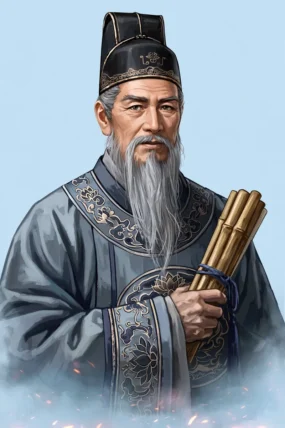
Ying Shao, courtesy name Zhongyuan (or Zhongyuan), was a distinguished Confucian scholar, imperial legalist, cultural historian, and regional administrator during the late Eastern Han dynasty. Hailing from Nandun County in Runan Commandery (modern-day Xiangcheng, Henan Province), Ying Shao belonged to an eminent gentry family renowned for moral integrity and civil administration. His father, Ying Feng, was an influential, incorruptible official who served as the Grand Administrator of Wuling during the reign of Emperor Ling of Han. Documented in Fan Ye’s official Book of the Later Han (Hou Hanshu, Volume 48) and Sima Guang’s Zizhi Tongjian, Ying Shao was historically revered as one of the most prolific intellectuals of his era, leaving behind monumental legal treatises and cultural encyclopedias that shaped Han administrative tradition.
Famous from his youth for his vast learning and deep mastery of the Han penal codes and court rituals, Ying Shao entered civil service during the reign of Emperor Ling. In 189 AD, as the Yellow Turban Rebellion and local banditry ravaged the Central Plains, Ying Shao was appointed Grand Administrator of Taishan Commandery (Taishan Taishou). Over several years of dedicated governance, Ying Shao organized local militia, fortified mountain passes, and successfully defended Taishan against numerous insurgent incursions, restoring peace and economic stability to the strategic district.
However, in 193 AD, Ying Shao became entangled in a tragic geopolitical catastrophe that indirectly ignited one of the most brutal massacres of the era. As Cao Cao consolidated his authority over Yan Province, he dispatched emissaries to Langya to escort his father, Cao Song, and his extended family to his capital at Puyang. The grand convoy was required to pass through Taishan Commandery. Cao Cao sent a formal memorial to Ying Shao, requesting that he dispatch an armed escort to protect his family. Before Ying Shao’s troops could meet Cao Song, Tao Qian, the Inspector of Xu Province, sent his subordinate officer Zhang Kai with two hundred cavalry to escort Cao Song across the border, hoping to curry favor with Cao Cao. Driven by insatiable greed, Zhang Kai murdered Cao Song and his entire family at an inn along the border, looted their massive wealth, and fled into hiding.
Realizing that Cao Song had been slaughtered immediately adjacent to his jurisdiction and before his own escort could arrive, Ying Shao was struck with sheer terror. Well aware of Cao Cao’s ruthless and unforgiving nature, Ying Shao surrendered his official seal, abandoned his post, and fled north across the Yellow River to seek political asylum under the powerful warlord Yuan Shao in Ye City. As Ying Shao anticipated, Cao Cao flew into an uncontrollable rage, holding both Tao Qian and the local border authorities responsible. Cao Cao launched a devastating retaliatory invasion of Xu Province, slaughtering over one hundred thousand innocent civilians and destroying dozens of towns in revenge for his father’s death.
Safe under Yuan Shao’s protection in Ji Province, Ying Shao withdrew from active military affairs and devoted the remainder of his life to monumental literary and historical scholarship. He authored the Fengsu Tongyi (Comprehensive Meaning of Customs), a legendary ten-volume cultural encyclopedia documenting Han folk mythology, court rituals, religious customs, and social phenomena. He also compiled the Han Guan Yi (Protocol of Han Officials) and extensive commentaries on Ban Gu’s Book of Han (Hanshu). His intellectual works provided later dynasties with invaluable records of Han legal and administrative traditions. Ying Shao passed away peacefully of natural causes in Ye City around 204 AD, leaving behind an immortal legacy as a master historian and cultural guardian of the Eastern Han dynasty.
Role in Romance of the Three Kingdoms
In Luo Guanzhong’s classic 14th-century historical novel Romance of the Three Kingdoms, Ying Shao appears in Chapter 10 as the Grand Administrator of Taishan Commandery. When Cao Cao requests his assistance in escorting Cao Song from Langya to Yan Province, Ying Shao fails to arrive before Tao Qian’s subordinate Zhang Kai intercepts and murders Cao Song’s family. Fearing Cao Cao’s wrathful retribution, Ying Shao abandons his seal and flees to seek refuge under Yuan Shao in Ji Province, setting the dramatic stage for Cao Cao’s vengeful invasion of Xu Province.
Ying Shao (應劭) — Historical & Literary Timeline
Appointment as Grand Administrator of Taishan
Appointed Grand Administrator of Taishan Commandery during the late Han rebellions; successfully pacifies local insurgents and restores civil order across the district.
Fleeing to Yuan Shao Following Zhang Kai’s Betrayal
Requested by Cao Cao to escort Cao Song’s family; after Tao Qian’s officer Zhang Kai murders Cao Song, Ying Shao abandons his official seal and flees to Ji Province to seek refuge under Yuan Shao.
Authoring Fengsu Tongyi & Scholarly Legacy
Devotes his final decade under Yuan Shao to literary scholarship, authoring the Fengsu Tongyi and Han Guan Yi before passing away peacefully in Ye City around 204 AD.
For detailed historical records, archives, and official chronicles, explore Ying Shao on Wikipedia.
Key Relationships
Family
- Ying Feng (应奉, Ứng Phụng): Father. An esteemed, incorruptible Han Dynasty official and scholar who served as the Grand Administrator of Wuling.
Friends
- No information
Enemies
- Zhang Kai (张闿, Trương Khải): Tao Qian’s subordinate officer whose mutinous murder of Cao Song along the Taishan border in 193 AD forced Ying Shao to forfeit his official post and flee in terror to avoid lethal retribution.
Other
- Yuan Shao (袁绍, Viên Thiệu): Warlord of Ji Province who granted Ying Shao political asylum and scholarly patronage in Ye City following his flight from Taishan in 193 AD, allowing him to finish monumental historical works such as the Fengsu Tongyi.
- Cao Cao (曹操, Tào Tháo): Warlord of Yan Province who requested Ying Shao to dispatch an escort for his father in 193 AD; fearing Cao Cao’s wrath after Cao Song was killed before the escort arrived, Ying Shao abandoned his commandery.
- Cao Song (曹嵩, Tào Tùng): Father of Cao Cao whose safe transit through Taishan Commandery Ying Shao was requested to oversee prior to Cao Song’s fatal ambush.
In Novel
Ying Shao (应劭, Ứng Thiệu) does not have a securely verified named appearance in the supplied edition under the exact Chinese name 应劭. His historical role as a Han official and author should not be imported into the novel timeline without an exact textual occurrence.
In History
Summary
- Ying Shao (应劭, Ứng Thiệu) was an Eastern Han scholar, administrator and author.
Official Career
- He served in several offices during the late Eastern Han, a period of severe political instability.
Scholarship
- He wrote on Han institutions, ritual, geography, customs and history.
- His Fengsu Tongyi became an important source for understanding Han customs and society, while quotations from his lost works preserve valuable historical information.
Legacy
- Ying Shao is important primarily as a scholar and compiler whose writings preserve evidence about late Han culture.
- Classification: Historical.