
Contents
The Legendary Blade of the God of War
In East Asian culture, literary tradition, and martial arts folklore, few weapons carry the awe-inspiring prestige of the Green Dragon Crescent Blade (青龙偃月刀, Qīng Lóng Yǎn Yuè Dāo, Thanh Long Yển Nguyệt Đao). Also famously known as the Frost Fair Blade (冷艳锯, Lěng Yàn Jù, Lãnh Diễm Cự), this legendary weapon is inseparable from its master, Guan Yu (关羽, Quan Vũ), the martial saint of China immortalized in Luo Guanzhong’s (罗贯中, La Quán Trung) 14th-century epic novel Romance of the Three Kingdoms (三国演义, Sān Guó Yǎn Yì, Tam Quốc Diễn Nghĩa).
Together with Guan Yu’s famous steed Red Hare (赤兔马, Chì Tù Mǎ, Ngựa Xích Thố), the Green Dragon Crescent Blade stands as an eternal symbol of righteousness, divine power, and peerless martial prowess.
Origin and Forging Legend
According to Chapter 1 of Romance of the Three Kingdoms, the creation of the blade coincided with the birth of the sworn brotherhood among Liu Bei (刘备, Lưu Bị), Guan Yu (关羽, Quan Vũ), and Zhang Fei (张飞, Trương Phi) in the Peach Garden (桃园, Đào Viên).



After taking their sacred oath in 184 AD, two wealthy horse merchants from Zhongshan (中山, Trung Sơn) named Zhang Shiping (张世平, Trương Thế Bình) and Su Shuang (苏双, Tô Sảng) gifted the brothers 1,000 catties of refined steel. Guan Yu commissioned a master blacksmith to forge a grand weapon worthy of his formidable stature.
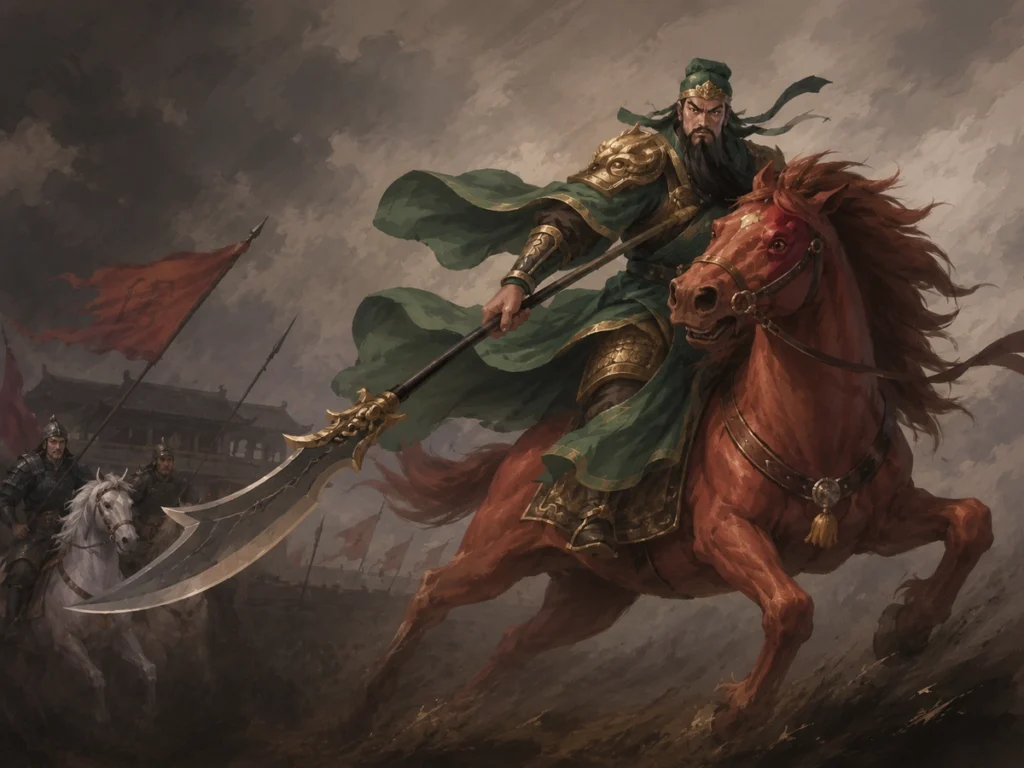
Guan Yu on Red Hare handling Green Dragon Crescent Blade
The Forging Legend
Mythological lore outside the novel tells that during the night the weapon was forged, a divine green dragon flew down from the heavens just as the steel was being quenched. The dragon’s spirit merged into the molten metal, leaving its likeness etched permanently onto the blade.
-
Weight: The novel explicitly specifies that the weapon weighed 82 catties (82 斤). In Han Dynasty measurements, this equals approximately 18.2 kilograms (40 pounds)—a staggering weight that required supernatural strength to wield fluidly in battle.
-
Alternative Name: The weapon was nicknamed “Frost Fair Blade” (Lěng Yàn Jù, Lãnh Diễm Cự) because, during cold winter battles, the blood wiped across its polished steel surface would freeze instantly into a brilliant, terrifying sheath of red ice.
Physical Design and Anatomy
The Green Dragon Crescent Blade belongs to a category of traditional Chinese polearms known as the Guan Dao (关刀, Guān Dāo, Quan Đao), named directly in honor of Guan Yu himself.
-
The Crescent Blade (Yan Yue): A large, heavy, single-edged curved blade shaped like a half-crescent moon. It was designed for powerful chopping, cleaving, and sweeping strikes on horseback.
-
The Dragon Motif: At the base where the blade connects to the shaft, a golden or bronze dragon’s head holds the heel of the blade in its open jaws.
-
The Counterweight Spike (Qian): The bottom end of the long shaft was fitted with a pointed iron spike. This balanced the heavy blade during spins and allowed the wielder to strike enemies behind them using the blunt butt-end.
Legendary Exploits Under Guan Yu
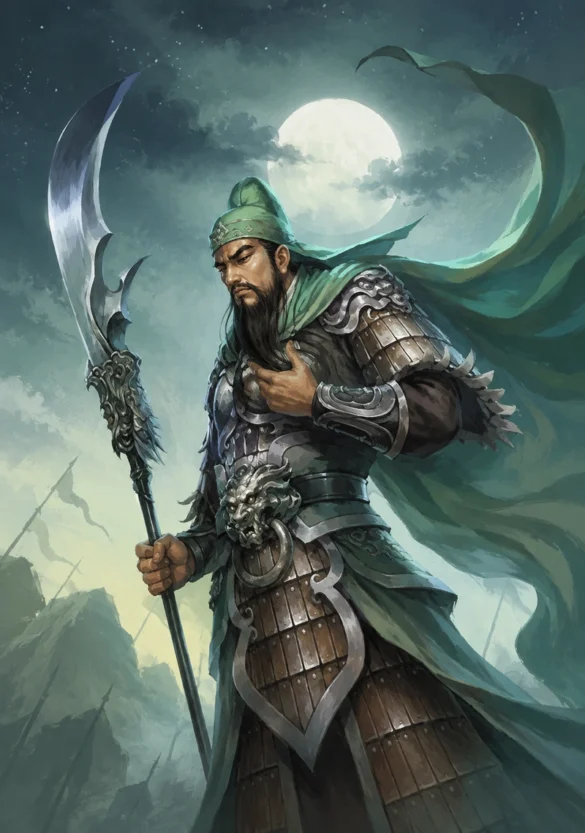
The Green Dragon Crescent Blade – 青龙偃月刀 – Thanh Long Yển Nguyệt Đao
The Green Dragon Crescent Blade served as Guan Yu’s primary instrument in achieving his most celebrated military triumphs throughout the Three Kingdoms era:
-
Slaying Hua Xiong (华雄, Hóa Hùng) at Hulao Pass (虎牢关, Hổ Lao Quan): In Chapter 5, while the coalition forces hesitated, Guan Yu stepped forward, rode out, and decapitated the formidable general Hua Xiong, returning to the camp before his offered cup of wine had even grown cold (Warm Wine Slaying Hua Xiong / 温酒斩华雄).
-
Slaying Yan Liang (颜良, Nhan Lương) and Wen Chou (文丑, Văn Sú): At the Battle of Baima (白马之战, Bạch Mã Chi Chiến) and Yanjin (延津之战, Diên Tân Chi Chiến), Guan Yu charged through thousands of enemy troops, cleaving Yuan Shao’s (袁绍, Viên Thiệu) top generals with a single strike of his blade.
-
Crossing Five Passes and Slaying Six Generals (过五关斩六将): During his peril-laden journey to reunite with Liu Bei, Guan Yu wielded his blade to slice through every enemy commander who barred his way across the Yellow River checkpoints.
The Lineage of the Blade After Guan Yu
Following Guan Yu’s tragic ambush and execution at Mai City (麦城, Mạch Thành) in 220 AD, the blade experienced a brief change of ownership before returning to Guan Yu’s lineage:
-
Pan Zhang (潘璋, Phan Chương): The Eastern Wu (东吴, Đông Ngô) general who ambushed Guan Yu claimed the Green Dragon Crescent Blade as a prize of war.
-
Guan Xing (关兴, Quan Hưng): During Liu Bei’s campaign of vengeance at the Battle of Yiling (夷陵之战, Di Lăng Chi Chiến) in 222 AD, Guan Yu’s son, Guan Xing, hunted down Pan Zhang inside a mountain house. Guan Xing decapitated Pan Zhang, reclaimed his father’s sacred weapon, and restored it to the Guan family line.
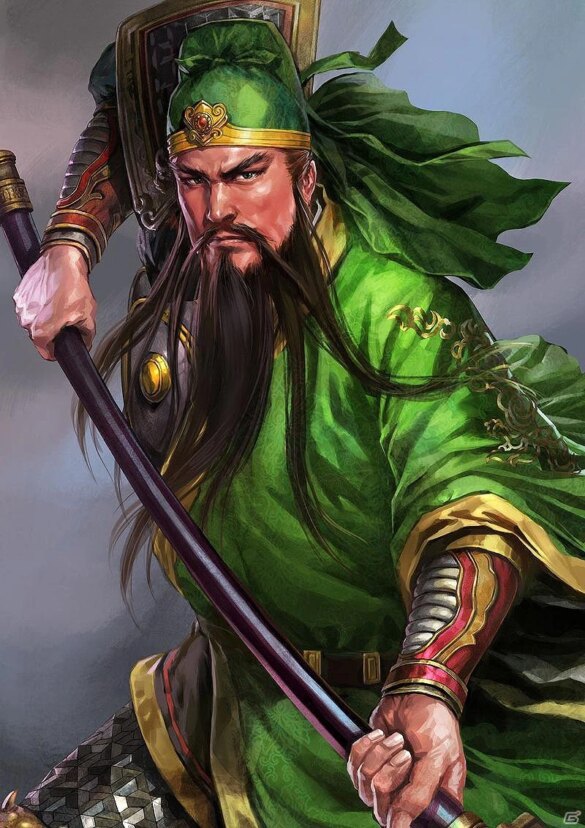
Guan Yu – 关羽 – Quan Vũ
Summary of Profile Details
| Aspect | Historical & Literary Details |
| Chinese Name | 青龙偃月刀 (Qīng Lóng Yǎn Yuè Dāo) |
| Vietnamese Name | Thanh Long Yển Nguyệt Đao |
| Literary Alias | Frost Fair Blade (冷艳锯, Lěng Yàn Jù, Lãnh Diễm Cự) |
| Stated Weight | 82 catties (~18.2 kg / 40 lbs) |
| Weapon Classification | Polearm / Guan Dao (关刀) |
| Primary Owners | Guan Yu → Pan Zhang → Guan Xing |
| Core Symbolism | Absolute Justice, Martial Virtue, Divine Protection |
Historical Reality vs. Literary Fiction
-
In History (Records of the Three Kingdoms / 三国志): The Guan Dao style of polearm was not invented during the Han Dynasty or Three Kingdoms era (3rd century AD). Historical records by Chen Shou (陈寿, Trần Thọ) note that Guan Yu primarily used a combination of a spear (Mao / 矛) for stabbing and a heavy sword (Dao / 刀) for cleaving.
-
Evolution of the Weapon: The Yan Yue Dao actually appeared centuries later during the Song Dynasty (960–1279 AD), where it was used primarily as a heavy training weapon for imperial military examinations to test an officer’s physical strength rather than for practical cavalry combat.
-
In Literature (Romance of the Three Kingdoms): Luo Guanzhong deliberately equipped Guan Yu with this magnificent polearm to visually set him apart from all other warriors, matching his imposing physique (nine chi tall) and long beard, thereby cementing his iconic image as the god of war (Wu Sheng / 武圣) for generations to come.
For detailed historical records, archives, and official chronicles, explore Green Dragon Crescent Blade on Wikipedia.
Green Dragon Crescent Blade (青龙偃月刀) — Literary Timeline
184 AD (novel)
Forged after Peach Garden
Merchants Zhang Shiping and Su Shuang supply steel; Guan Yu commissions the 82-catty crescent blade.
190 AD
Warm wine vs Hua Xiong
Guan Yu rides out and returns with Hua Xiong’s head before the wine cools.
200 AD
Yan Liang, Wen Chou, Six Generals
Cleaves Yuan Shao’s champions and the five-pass gatekeepers on the road to Liu Bei.
222 AD (novel)
Recovered by Guan Xing
After Pan Zhang seizes the blade, Guan Xing kills him and restores it to the Guan line.
In Novel
Chapter 1
- Green Dragon Crescent Blade (青龙偃月刀, Thanh Long Yển Nguyệt Đao): After the Peach Garden oath, steel from Zhang Shiping (张世平, Trương Thế Bình) and Su Shuang (苏双, Tô Sảng) is forged into Guan Yu (关羽, Quan Vũ)’s 82-catty crescent polearm, later called Frost Fair Blade (冷艳锯, Lãnh Diễm Cự).
Chapter 5
- Green Dragon Crescent Blade (青龙偃月刀, Thanh Long Yển Nguyệt Đao): Guan Yu volunteers against Hua Xiong (华雄, Hoa Hùng); with the blade he returns before the offered wine cools—Warm Wine Slaying Hua Xiong.
Chapter 25–27
- Green Dragon Crescent Blade (青龙偃月刀, Thanh Long Yển Nguyệt Đao): Beheads Yan Liang (颜良, Nhan Lương) and Wen Chou (文丑, Văn Sú) for Cao Cao (曹操, Tào Tháo), then cuts down the six generals on the five-pass journey escorting Lady Gan and Lady Mi.
Chapter 83
In History
Summary
- The iconic Green Dragon Crescent Blade (青龙偃月刀, Thanh Long Yển Nguyệt Đao) is a literary and later martial emblem of Guan Yu (关羽, Quan Vũ), not a securely documented Han-period battlefield weapon in Chen Shou’s text.
- Historical Guan Yu fought with spear/sword combinations typical of the age; the heavy yanyue/guan-dao form is associated with later Chinese polearm tradition (notably Song military culture and opera iconography).