



Contents
Biography & Historical Record
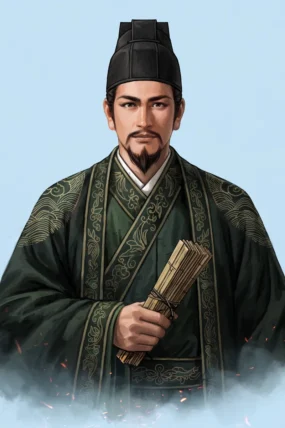
Liu Fang (died 250 AD) was a prominent court official and influential strategist for the state of Cao Wei during the turbulent Three Kingdoms period of ancient China. Born in Fangcheng, Zhuo Commandery, he was a proud descendant of Liu Jian, the Prince of Guangyang. Renowned for his literary refinement and bureaucratic skill, he initially served the warlord Yuan Xi before defecting to Cao Cao in 205 AD, where his administrative expertise quickly earned imperial favor.
Under the reigns of Emperor Wen (Cao Pi) and Emperor Ming (Cao Rui), his administrative career flourished. Alongside his close colleague Sun Zi, Liu Fang was appointed to lead the Palace Secretariat (Zhongshushu) as Joint Director. This critical agency drafted secret imperial edicts and archived sensitive state documents. Together, the formidable bureaucratic duo was known as “Sun-Liu,” wielding profound executive authority that frequently rivaled senior ministers.
Liu Fang and the Fate of the Wei Court
His defining political moment occurred during the succession crisis of 238 AD. As Emperor Cao Rui lay terminally ill, intense factional rivalry erupted over regency appointments for the young crown prince, Cao Fang. The imperial kinsman Cao Yu was originally slated to lead the government. However, fear of losing institutional influence drove the Secretariat directors to intervene. They successfully persuaded the dying monarch to dismiss the imperial clansmen and instead appoint Cao Shuang alongside Sima Yi as co-regents.
In literary lore, such as Luo Guanzhong’s historical epic Romance of the Three Kingdoms, Liu Fang is portrayed as a shrewd, calculating insider whose palace maneuvering inadvertently facilitated the rise of the Sima clan. Following the transition of power, the veteran official was granted prestigious titles and was posthumously honored as Marquess Jing upon his death in 250 AD.
In Novel
Chapter 106
- Liu Fang (刘放, Lưu Phóng): Liu Fang is a senior Wei court official and one of the men trusted with political affairs after Cao Rui’s death. He is involved in the succession and regency arrangements that place Cao Shuang and Sima Yi in control of Wei.
Chapter 107
- Liu Fang (刘放, Lưu Phóng): Liu Fang remains an important court figure during the political struggle between Cao Shuang and Sima Yi. His position places him among the officials who must navigate Sima Yi’s seizure of power and the subsequent restructuring of the Wei government.
In History
Early Career
- Liu Fang (刘放, Lưu Phóng), courtesy name Zizheng, was an important official and writer who served Cao Wei.
Service to Cao Cao and Cao Pi
- Liu Fang entered the administration of Cao Cao (曹操, Tào Tháo) and became valued for his literary ability and skill in drafting official documents. He continued to rise after Cao Pi (曹丕, Tào Phi) founded Wei.
Political Influence
- During the reign of Cao Rui (曹叡, Tào Duệ), Liu Fang became one of the court officials with significant influence over imperial communications and appointments. He worked alongside Sun Zi (孙资, Tôn Tư).
Regency
- Liu Fang remained influential during the succession crisis following Cao Rui’s death. His political connections placed him close to the central government during the regency for the young Cao Fang (曹芳, Tào Phương).
Legacy
- He is remembered as one of Wei’s important court secretaries and political intermediaries, especially for the role he played in the machinery of imperial government.