
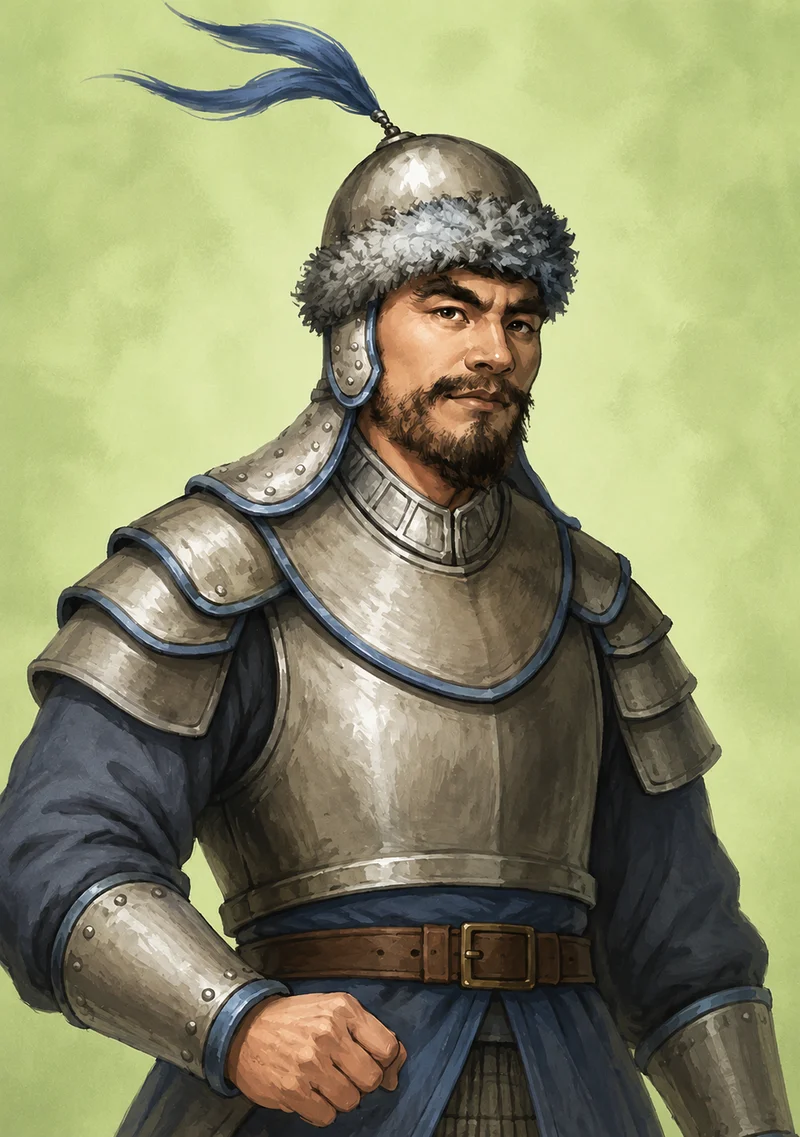
Contents
Biography & Historical Record
Tang Zhou was a senior disciple and close confidant of Zhang Jiao, the supreme leader and grand master of the Way of Taiping (Taiping Dao). Operating from the sect’s central stronghold in Julu Commandery during the late Eastern Han dynasty, Tang Zhou was entrusted with top-secret communications and high-stakes assignments during the years of clandestine preparation for the massive, nationwide Yellow Turban Rebellion in 184 AD.
In early 184 AD (the first year of the Zhongping era under Emperor Ling), following over a decade of widespread religious proselytizing, Zhang Jiao mobilized hundreds of thousands of devoted followers across eight major provinces of China. He structured his vast force into thirty-six divisions, known as ‘fang’, and meticulously scheduled a synchronized, empire-wide insurrection for the fifth day of the third lunar month. The movement rallied under the iconic revolutionary manifesto: ‘The Azure Sky is dead, the Yellow Sky shall arise; in the year of Jiazi, there shall be good fortune under Heaven.’ To ensure the immediate collapse of the Han government, Zhang Jiao dispatched his chief general Ma Yuanyi to organize tens of thousands of covert insurgents in Jing and Yang provinces, while using immense gold bribes to secure secret alliances with influential court eunuchs in Luoyang, most notably Feng Xu and Xu Feng, who agreed to open the capital gates from within.
In the second lunar month of 184 AD, Zhang Jiao entrusted Tang Zhou with a mission of paramount strategic importance: carrying confidential letters from Julu directly to Luoyang to notify Feng Xu and Xu Feng to finalize the exact timing and logistics of the internal coup. However, upon reaching the imperial capital, Tang Zhou committed a monumental act of betrayal. Whether motivated by fear of imperial extermination, internal ideological dissent, or self-preservation, Tang Zhou bypassed his contacts within the eunuch faction and ran directly into the imperial offices. He surrendered Zhang Jiao’s secret correspondence to government officials and exposed the entire underground infrastructure and leadership network of the Taiping Dao.
Tang Zhou’s sudden treason alerted Emperor Ling of Han and the imperial court to the impending catastrophe. Reacting with swift urgency, Emperor Ling appointed He Jin as Grand General and ordered the imperial palace guards to seal Luoyang. Government forces immediately raided the rebel hideouts, arresting the senior Yellow Turban commander Ma Yuanyi, who was subsequently subjected to public execution by quartering (dismemberment by horse-drawn carts) in the Luoyang marketplace. Imperial authorities proceeded to arrest and execute over one thousand Taiping Dao adherents in the capital while issuing urgent imperial warrants for the capture of Zhang Jiao and his brothers, Zhang Bao and Zhang Liang. Tang Zhou’s betrayal utterly destroyed the rebel secret network inside Luoyang and eliminated their element of surprise, forcing Zhang Jiao to prematurely ignite the Yellow Turban Rebellion across the provinces before their forces were fully prepared.
Following his fateful exposure of the conspiracy, Tang Zhou vanished completely from historical records. Key historical texts, including Fan Ye’s Book of Later Han (Hou Han Shu – Biography of Huangfu Song) and Sima Guang’s Zizhi Tongjian, record his decisive act of betrayal but offer no further mention of any imperial rewards, official appointments, or subsequent whereabouts. Historians generally deduce that Tang Zhou adopted an assumed identity and went into deep hiding to escape relentless, vengeful assassination attempts by surviving Yellow Turban fanatics across the empire.
Role in Romance of the Three Kingdoms
In Luo Guanzhong’s classic novel Romance of the Three Kingdoms, Tang Zhou serves as the ultimate catalyst that triggers the opening conflict of the entire epic. Introduced as a trusted disciple of Zhang Jiao, Tang Zhou is tasked with carrying secret letters to the court eunuch Feng Xu to coordinate an inside assault on Luoyang. Instead, Tang Zhou betrays his master and reports the plot directly to the government. His treason prompts Emperor Ling to elevate He Jin to Grand General, leading to the capture and execution of Ma Yuanyi. Deprived of internal support in Luoyang, Zhang Jiao is forced to launch the Yellow Turban Rebellion prematurely, initiating the wide-scale turmoil that leads to the Oath of the Peach Garden and the emergence of Liu Bei, Guan Yu, Zhang Fei, Cao Cao, and Sun Jian.
Tang Zhou (唐周) — Literary & Historical Timeline
184 AD
Dispatch on Secret Mission to Luoyang
Dispatched by Zhang Jiao from Julu to Luoyang carrying secret letters to notify the corrupt eunuch Feng Xu to initiate an internal coup.
184 AD
Betrayal and Informing Imperial Authorities
Turns traitor upon reaching Luoyang, surrendering secret correspondence to imperial officials and exposing the entire Taiping Dao plot.
184 AD
Execution of Ma Yuanyi and Premature Rebellion
Triggers an immediate military crackdown by Grand General He Jin, resulting in the execution of Ma Yuanyi and forcing Zhang Jiao to launch the Yellow Turban Rebellion prematurely.
After 184 AD — Historical Record
Disappearance from Historical Records
Vanishes from historical documentation following his betrayal, leaving no record of imperial rewards, subsequent residence, or eventual fate.
Key Relationships
- Family:
- ? — Unknown family lineage.
- Comrades / Allies:
- Emperor Ling of Han — Han monarch whose regime was saved from an internal surprise attack by Tang Zhou’s report.
- He Jin — Grand General of the Han who mobilized the imperial guard to execute Ma Yuanyi after receiving Tang Zhou’s betrayal.
- Enemies / Opponents:
- Zhang Jiao — Supreme Master of Taiping Dao whom Tang Zhou served as senior disciple before committing treason against him.
- Ma Yuanyi — Senior Yellow Turban general executed by quartering in Luoyang as a direct result of Tang Zhou’s informant report.
- Feng Xu — Corrupt court eunuch whose collusion with Zhang Jiao was exposed to the imperial court by Tang Zhou.
- Xu Feng — Imperial eunuch whose secret conspiracy with the Yellow Turbans was uncovered following Tang Zhou’s treason.
- Zhang Bao & Zhang Liang — Younger brothers of Zhang Jiao whose grand military coordination was disrupted by Tang Zhou’s betrayal.
For detailed historical records, archives, and official chronicles, explore Tang Zhou on Wikipedia.
In Novel
Chapter 1
- Tang Zhou (唐周, Táng Zhōu): Tang Zhou is a disciple of Zhang Jiao who is entrusted with carrying a message to the eunuch Feng Xu (封谞), an intended insider at the Han court. Instead of remaining loyal to Zhang Jiao, Tang Zhou goes directly to the government and exposes the Yellow Turban conspiracy. His betrayal forces Zhang Jiao to begin the rebellion earlier than planned. He is therefore the key informant whose report causes the Han court to arrest Ma Yuanyi and Feng Xu and precipitates the Yellow Turban uprising.
In History
Summary
- Tang Zhou (唐周, Đường Chu) was a historical figure associated with the early Yellow Turban movement.
Period I — Yellow Turban Conspiracy
- Tang Zhou was originally connected with the Yellow Turban organization led by Zhang Jiao.
- He betrayed the movement by reporting the planned uprising to the Han authorities, contributing to the government’s discovery of the conspiracy before the scheduled revolt.
Historical Record
- Tang Zhou was historical. His importance lies primarily in his role as an informant whose report helped trigger the final confrontation between the Yellow Turbans and the Han government.