


Contents
Biography & Historical Record
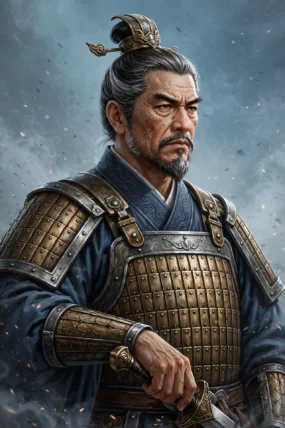
Tao Jun was a distinguished military commander and the final supreme naval commander (Grand Admiral) of the Eastern Wu dynasty during the closing stages of the Three Kingdoms period. Hailing from Moling County in Danyang Commandery (modern-day Nanjing, Jiangsu Province), he was the younger brother of the renowned southern frontier governor Tao Huang. Documented in Chen Shou’s Records of the Three Kingdoms (Sanguozhi – Book of Wu, Biography of Tao Huang) and Sima Guang’s Zizhi Tongjian, Tao Jun is historically remembered as a heroic, unwavering loyalist who directed the last-ditch naval defense of the Yangtze River against the overwhelming invasion force of the Western Jin dynasty in 280 AD, sacrificing his life in combat to defend the doomed Wu regime.
In late 279 AD, the Western Jin Emperor Sima Yan mobilized a massive 200,000-strong invasion force across six distinct military fronts to annihilate the decaying Eastern Wu state. Led by the brilliant naval strategist Wang Jun, the Western Jin fleet utilized formidable armored battleships to sweep down the Yangtze River, systematically destroying Eastern Wu’s outer defensive strongholds and fortress chains. As the capital Jianye (Nanjing) fell into panic, the desperate Emperor Sun Hao summoned his remaining commanders, eventually turning to Tao Jun to organize a final, grand defense of the river.
Displaying tactical ingenuity under immense pressure, Tao Jun proposed a sophisticated “steel-fortress” defensive network. He ordered the forging of tens of thousands of massive iron chains to be stretched across critical, narrow sections of the Yangtze, supplemented by thousands of sharp, heavy iron stakes driven deep into the riverbed. The strategy aimed to entangle and pierce the heavy Jin warships as they flowed southward, rendering them stationary targets for Wu fire-ships and flanking artillery. Impressed by this bold plan, Sun Hao granted Tao Jun supreme command over the remaining Wu naval forces, providing him with tens of thousands of elite veteran troops to hold the river crossings at Wuchang.
However, the Jin commander Wang Jun proved to be an equal in strategic foresight. To neutralize Tao Jun’s iron chain barricades, Wang Jun constructed hundreds of massive rafts made of bundled bamboo and reeds, heavily laden with dry brushwood and flammable oils. These fire-rafts were sent drifting downstream as vanguard decoys; upon impacting the iron chains, the intense heat generated by the burning rafts melted the iron connections and consumed the wooden stakes, effectively clearing a path for the main Jin fleet to steam southward. With his defensive network shattered and morale collapsing, Tao Jun retreated to Wuchang to mount a desperate final stand. Sun Hao dispatched several additional divisions of elite troops for a final counter-attack. Faced with the overwhelming military momentum of the Jin forces and the widespread desertion of his own subordinate officers, Tao Jun refused to surrender. Charging directly into the chaotic fray alongside his remaining few hundred loyal cavalry bodyguards, Tao Jun was surrounded by Jin forces and slain in the final melee of the Wuchang campaign in March 280 AD. His death signaled the total collapse of Eastern Wu’s naval resistance, leading to Sun Hao’s eventual capitulation and the unification of China under the Western Jin.
Famous Quotes & Historical Sayings
In the historical records of the Records of the Three Kingdoms (Sanguozhi), historian Chen Shou and later commentators in the Book of Jin (Jin Shu) recorded the final moments of Tao Jun’s struggle: ‘Tao Huang governed the southern frontier with benevolent virtue, while Tao Jun defended the Yangtze River with unyielding loyalty. The brothers stood as twin pillars of the falling Wu state. Though the fate of the dynasty was sealed by the inevitable movement of the heavens, Tao Jun’s refusal to submit to dishonor and his final, heroic charge into the wind-swept battlefield remain a tragic, immortal song of middle-kingdom loyalty.’
Tao Jun (陶濬) — Historical & Literary Timeline
Supreme Command & Design of the Steel Barricades
Appointed Grand Admiral by Sun Hao to defend the Yangtze against Western Jin’s 200,000-strong invasion fleet. Designs an elaborate network of iron chains and riverbed stakes to immobilize incoming enemy ships.
Jin Breakthrough at the Yangtze River
Wang Jun deploys massive fire-rafts to neutralize Tao Jun’s iron barricades. The Jin fleet breaks through the Wu defensive line, forcing Tao Jun to retreat toward Wuchang.
Leading a Final Charge & Slain in Battle
Commands the last remnants of the Eastern Wu naval forces at Wuchang; abandoned by his fleeing subordinates, he leads his personal bodyguards in a desperate final charge against the Jin army and is slain in the ensuing combat.
For detailed historical records, archives, and official chronicles, explore Tao Jun on Wikipedia.
Key Relationships
Family
- Tao Dan (陶丹, Đào Đan): Father; an Eastern Wu general and administrator.
- Tao Huang (陶璜, Đào Hoàng): Older brother; the celebrated Governor of Jiao Province who successfully governed and defended Eastern Wu’s southern frontier.
Friends
- No information
Enemies
- Wang Jun (王浚, Vương Tuấn): Western Jin naval commander and rival strategist during the 280 AD invasion; Wang Jun deployed flaming rafts to neutralize Tao Jun’s iron chain barricades on the Yangtze River, paving the way for the destruction of Wu’s naval forces.
- Sima Yan (司马炎, Tư Mã Viêm): Emperor Wu of Jin who orchestrated the six-pronged conquest of Eastern Wu in 279–280 AD, leading to the collapse of the Wu state and Tao Jun’s death in combat.
Other
- Sun Hao (孙皓, Tôn Hạo): The final Emperor of Eastern Wu; entrusted Tao Jun with supreme command over the remaining imperial fleet in 279–280 AD to make a desperate final stand along the Yangtze River.
In Novel
Chapter 120
- Tao Jun (陶濬, Đào Tuấn): Tao Jun is a senior Wu commander involved in the final crisis of Eastern Wu. When Jin prepares the final invasion, he is associated with the Wu defense preparations and the debate over whether the state can resist the Jin armies. His appearance belongs to the last chapter, when the Wu court is confronted with the collapse of its military position.
In History
Summary
- Tao Jun (陶濬, Đào Tuấn) was an Eastern Wu military commander active during the final years of the kingdom.
Final War against Jin
- When the Western Jin launched its major invasion of Wu in 279–280, Tao Jun was among the commanders involved in the defense of the collapsing kingdom.
- He was associated with the defense of the southern and central regions as Wu struggled to coordinate resistance against the Jin advance.
Fall of Wu
- The rapid collapse of Wu prevented the defenders from reversing the strategic situation.
- Classification: Historical.