



Contents
Biography & Historical Record
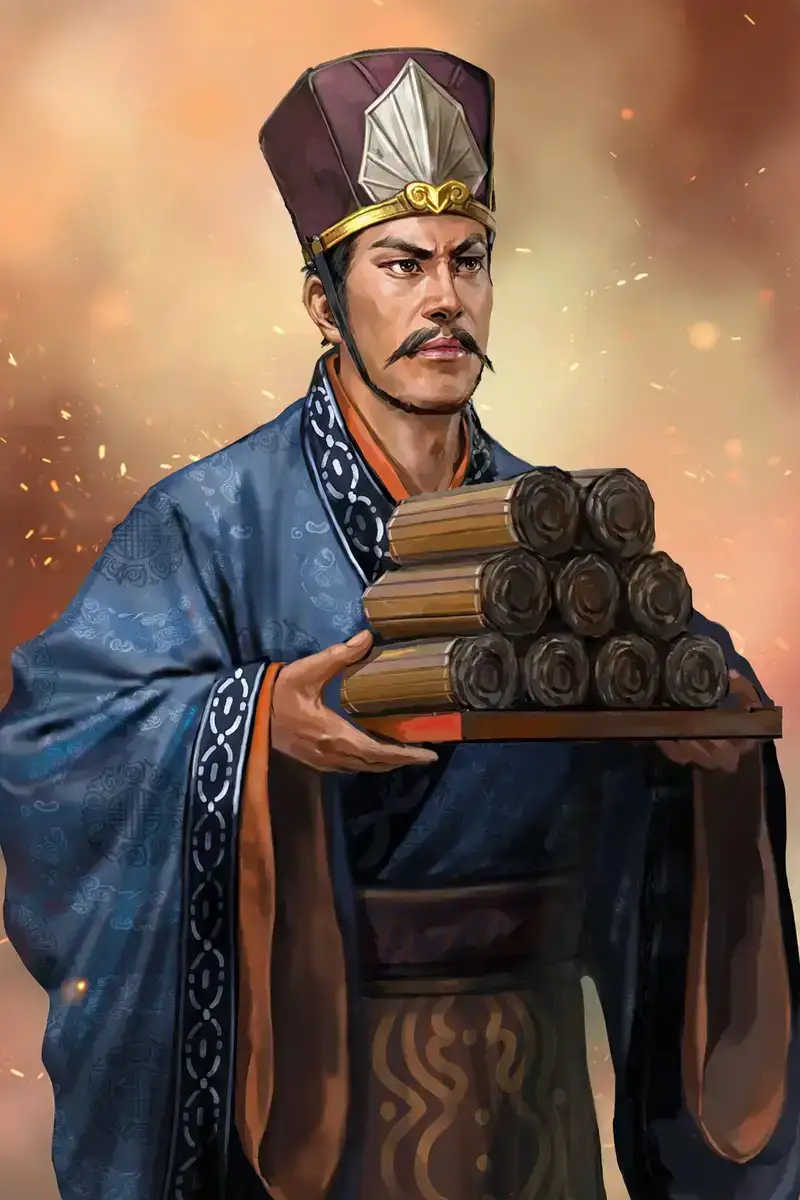
Chen Qun (died 237 AD), courtesy name Changwen, was a prominent statesman, politician, and legal reformer who served the state of Cao Wei during the late Eastern Han dynasty and Three Kingdoms period. Hailing from Xu County, Yingchuan Commandery, he belonged to one of the most prestigious scholar-gentry clans of the era, being the grandson of Chen Shi and son of Chen Ji. Early in his career, he served under Tao Qian and briefly advised Liu Bei when the latter was Governor of Xu Province, famously warning Liu Bei against taking control of Xu Province due to threats from Yuan Shu and Lu Bu. When Cao Cao secured control of Xu Province, Chen Qun entered Cao Cao’s administration, holding key legal and civil positions.
Chen Qun’s most historic contribution was formulating and implementing the Nine-Rank System (九品官人法) in 220 AD under Cao Pi. This civil service recruitment framework institutionalized the selection of officials based on talent and virtue evaluated by local gentry controllers, serving as the foundational bureaucratic recruitment system for Chinese dynasties through the Northern and Southern dynasties. Under Emperor Cao Pi and Emperor Cao Rui, Chen Qun rose to the pinnacle of state governance, holding offices such as Minister of Works (司空) and Supervisor of the Secretariat (錄尚書事). Prior to Cao Pi’s death, Chen Qun was appointed as an imperial regent alongside Cao Zhen, Cao Xiu, and Sima Yi to guide the young Emperor Cao Rui. He was renowned for his strict adherence to legal standards, moral integrity, and defense of institutional protocol. Chen Qun passed away peacefully of natural causes in 237 AD and was posthumously honored as Marquis Jing.
Role in Romance of the Three Kingdoms
In Luo Guanzhong’s historical novel Romance of the Three Kingdoms, Chen Qun appears as a high-ranking minister and incorruptible statesman serving Cao Wei across three generations. Introduced during Cao Cao’s rise, Chen Qun is featured prominently in Chapter 78 following Cao Cao’s death, where he helps formulate the transitional state protocol that secures Cao Pi’s ascension. In Chapter 79 and Chapter 80, Chen Qun acts as one of the chief officials drafting legal reforms and imperial protocols during the abdication of Emperor Xian of Han and the formal establishment of the Cao Wei dynasty. Later in Chapter 91, on his deathbed, Emperor Cao Pi entrusts his heir Cao Rui to Chen Qun, Sima Yi, and Cao Zhen as imperial regents. Throughout the subsequent Northern Expeditions led by Shu Han, Chen Qun serves in Luoyang as a senior minister of state, offering sound civil and financial advice to Emperor Cao Rui to maintain domestic stability while frontline armies engage in border defenses.
Chen Qun (陳群) — Historical & Literary Timeline
Warning to Liu Bei
Serves as a advisor in Xu Province and counsels Liu Bei against accepting the governorship of Xu Province, accurately foreseeing betrayal by Lu Bu and aggression from Yuan Shu.
Entry into Cao Cao’s Service
Joins Cao Cao’s administration after the defeat of Lu Bu at Xiapi, receiving appointments in civil and judicial administration.
Implementation of the Nine-Rank System and Dynastic Succession
Proposes the Nine-Rank System for civil recruitment; assists Cao Pi in establishing the state structure of Cao Wei following the abdication of Emperor Xian of Han.
Appointed Imperial Regent
Designated on Cao Pi’s deathbed as one of four senior regents alongside Cao Zhen, Cao Xiu, and Sima Yi to assist Emperor Cao Rui.
Death
Passes away peacefully of natural causes while holding the highest office of Minister of Works, posthumously honored as Marquis Jing.
For detailed historical records, archives, and official chronicles, explore Chen Qun on Wikipedia.
Key Relationships
Family
- Chen Shi (陈寔, Trần Thực): Grandfather, a renowned scholar and moral leader of the Yingchuan gentry whose reputation bolstered the family’s prestige.
- Chen Ji (陈纪, Trần Kỷ): Father, a high-ranking official of the Eastern Han dynasty who provided Chen Qun with his initial political foundation.
- Xun Yu (荀彧, Tuân Úc): Father-in-law, the preeminent strategist of Cao Cao whose daughter married Chen Qun, solidifying the alliance between the Yingchuan clans.
- Chen Tai (陈泰, Trần Thái): Son, who continued the family legacy by serving as a distinguished general and minister for the state of Cao Wei.
Friends
- Cao Pi (曹丕, Tào Phi): Sovereign and close political ally who relied on Chen Qun’s expertise to implement the Nine-Rank System and secure the transition of the Cao Wei dynasty.
- Sima Yi (司马懿, Tư Mã Ý): Fellow imperial regent appointed by Cao Pi to guide Emperor Cao Rui, with whom Chen Qun shared the burden of state administration.
- Cao Zhen (曹真, Tào Chân): Fellow imperial regent and senior military leader who served alongside Chen Qun in the regency council established in 226 AD.
- Cao Xiu (曹休, Tào Hưu): Fellow imperial regent who, along with Chen Qun, Sima Yi, and Cao Zhen, was entrusted with the protection of the young Emperor Cao Rui.
Enemies
- Lu Bu (吕布, Lữ Bố): Warlord whose treacherous seizure of Xu Province was accurately predicted by Chen Qun, leading to Chen’s departure from the region.
- Yuan Shu (袁术, Viên Thuật): Warlord whose aggressive expansionist policies against Xu Province were identified by Chen Qun as a primary threat to regional stability.
Other
- Liu Bei (刘备, Lưu Bị): Early employer whom Chen Qun served as an advisor in Xu Province, famously counseling him against accepting the governorship of the province.
- Cao Cao (曹操, Tào Tháo): Ruler who recognized Chen Qun’s administrative talent after the defeat of Lu Bu, bringing him into the central government of the Han and later Wei.
- Emperor Cao Rui (曹叡, Tào Duệ): Sovereign whom Chen Qun served as a senior minister and regent, providing essential civil and financial guidance during the Northern Expeditions.
In Novel
Chapter 22
- Chen Qun (陈群, Trần Quần): Chen Qun serves Liu Bei as an administrator and adviser during the unstable period before Cao Cao’s takeover of Xuzhou. His presence reflects Liu Bei’s reliance on civil officials as well as military commanders.
Chapter 30
- Chen Qun (陈群, Trần Quần): Chen Qun serves Cao Cao after Liu Bei’s defeat and becomes part of the Wei administrative establishment.
Chapter 39
- Chen Qun (陈群, Trần Quần): Chen Qun remains a Wei civil official during Cao Cao’s campaigns against Liu Bei.
Chapter 80
- Chen Qun (陈群, Trần Quần): Chen Qun becomes one of Cao Pi’s important advisers after the transition from Cao Cao’s rule. He supports the organization of the new Wei government.
Chapter 83
- Chen Qun (陈群, Trần Quần): Chen Qun remains among Cao Pi’s senior officials as Wei manages the political consequences of Liu Bei’s invasion of Wu.
In History
Summary
- Chen Qun (陈群, Trần Quần), courtesy name Changwen (长文), was one of the most important political theorists and administrators of early Cao Wei.
- He was closely associated with the development of the Wei civil administration and is especially famous for the system later known as the Nine-Rank System (九品中正制).
Early Career
- Chen Qun came from a prominent family in Yingchuan. He first served Liu Bei in Xu Province before entering the service of Cao Cao.
- His administrative abilities and reputation for integrity made him valuable to the emerging Wei government.
Period I — Service under Cao Cao
- Chen Qun served in Cao Cao’s administration and became involved in questions of government organization and personnel selection.
- He was among the officials who helped transform Cao Cao’s military regime into a more formal state structure.
Year: 220 AD — Foundation of Wei
- When Cao Pi established Cao Wei, Chen Qun became one of the new regime’s leading ministers.
- He played an important role in the early organization of the imperial government and in the system for evaluating and recommending officials.
Nine-Rank System
- Chen Qun is traditionally associated with the creation of the Nine-Rank System, which classified local candidates for office and became a major mechanism of personnel selection in the Wei and later Jin political order.
- The system was designed to improve official recruitment, although over time it became strongly associated with aristocratic family influence.
Death
- Chen Qun died in 236 AD. His son Chen Tai later became an important Wei commander and statesman.
Historical Record
- Chen Qun was a securely documented historical figure. His biography appears in Wei Book 22 of the Records of the Three Kingdoms.