
Contents
Biography & Historical Record
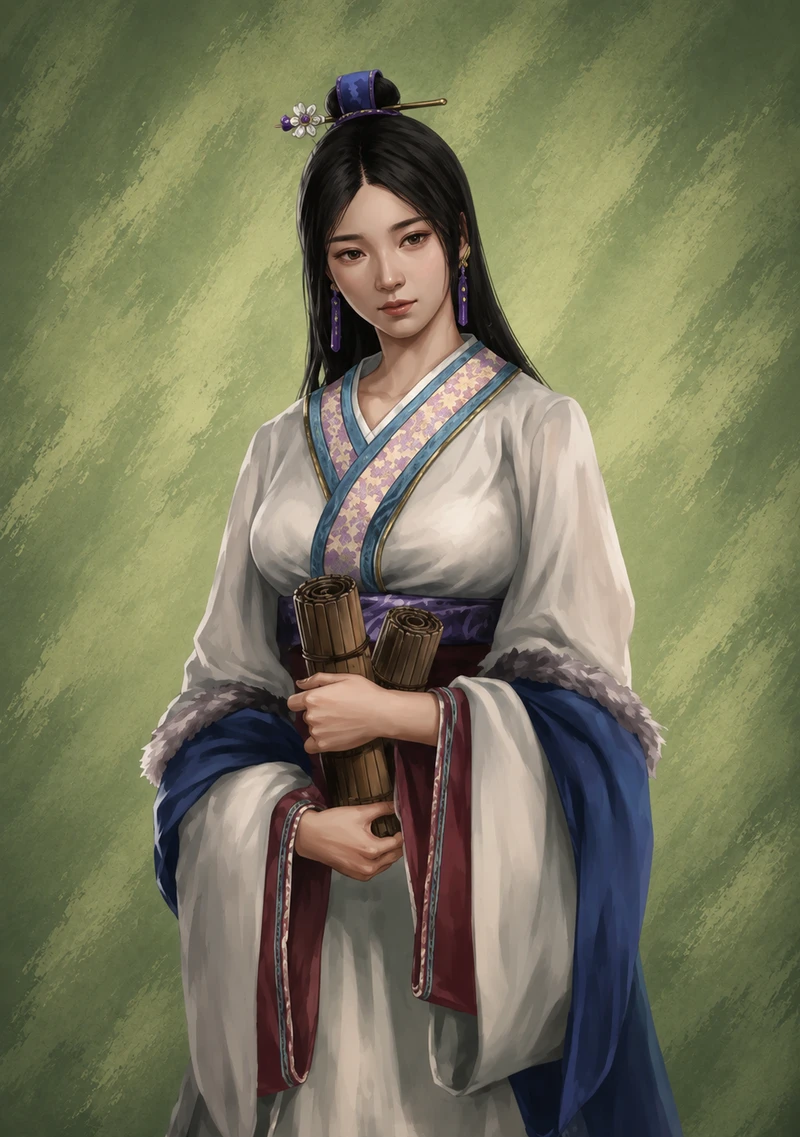
Lady Cai (Cai Shi), the wife of the renowned gentry scholar Huang Chengyan and mother-in-law of Zhuge Liang, was a prominent aristocratic matriarch in Jing Province during the late Eastern Han dynasty. Historical records omit her personal given name, referring to her respectfully as Lady Cai. She hailed from the distinguished Cai clan of Xiangyang, one of the most powerful military, political, and financial gentry families controlling Jing Province. She was the eldest daughter of Cai Feng, an influential senior statesman of the region.
Through her marriage to Huang Chengyan, Lady Cai established a powerful network of family alliances across the Jing-Xiang region. Her younger sister married Liu Biao, the Governor of Jing Province, as his secondary wife (also known as Lady Cai), making Liu Biao her brother-in-law. Her younger brother was Cai Mao, the supreme military commander of Jing Province. This intricate family web provided immense political leverage. When Zhuge Liang married her daughter, Huang Yueying, he transitioned from an obscure, impoverished scholar living in seclusion at Longzhong into an insider within the highest aristocratic circles of Jing Province. Backed by the prestige of Lady Cai’s mother family, Zhuge Liang earned the recognition of master scholars like Pang Degong and Sima Hui, elevating his reputation as the ‘Sleeping Dragon’ (Wolong).
Unlike her treacherous younger sister, folklore traditions describe Lady Cai as a modest, highly educated, and virtuous mother. Alongside her husband Huang Chengyan, she raised their daughter Huang Yueying to become a exceptionally gifted woman. Though rumored to possess plain features with dark skin and yellow hair, Huang Yueying was thoroughly educated by Lady Cai in astronomy, geography, military strategy, and mechanical engineering, becoming Zhuge Liang’s ultimate intellectual partner.
Role in Romance of the Three Kingdoms
In Luo Guanzhong’s Romance of the Three Kingdoms, Lady Cai’s influence is implicitly woven into the social background of Jing Province in Chapter 35 and Chapter 37. As the wife of Huang Chengyan and sister of Cai Mao and Liu Biao’s wife, her aristocratic background forms the structural bridge connecting Zhuge Liang to the ruling elite of Jing Province. Her daughter Huang Yueying’s match with Zhuge Liang brings together scholar nobility and regional political power, setting the stage for Liu Bei’s Three Visits to the Thatched Cottage.
Lady Cai (蔡氏) — Literary Timeline
Aristocratic Matrimony and Political Influence
Maintains a prominent position among Xiangyang gentry as Huang Chengyan’s wife and elder sister to Cai Mao and Lady Cai (Liu Biao’s wife).
Family Alliance with Zhuge Liang
Facilitates the marriage of her daughter Huang Yueying to Zhuge Liang, integrating the ‘Sleeping Dragon’ into the aristocratic networks of Jing Province prior to Liu Bei’s Visits.
Key Relationships
Family
- Cai Feng (蔡讽, Thái Phúng) — Father and a prominent senior elder of the influential Cai clan in Xiangyang.
- Huang Chengyan (黄承彦, Hoàng Thừa Ngạn) — Husband and a distinguished scholar who served as a central figure among the Jing Province gentry.
- Huang Yueying (黄月英, Hoàng Nguyệt Anh) — Daughter, a highly educated woman skilled in strategy and mechanics who married Zhuge Liang.
- Zhuge Liang (诸葛亮, Gia Cát Lượng) — Son-in-law, the renowned strategist who gained access to the Jing Province elite circles through his marriage to her daughter.
- Lady Cai (蔡夫人, Thái phu nhân) — Younger sister, the secondary wife of Liu Biao who exerted significant political influence over the Jing Province succession.
- Cai Mao (蔡瑁, Thái Mạo) — Younger brother, the supreme military commander of Jing Province who held substantial regional power.
- Cai Xun (蔡勋, Thái Huân) — Younger brother, a military officer serving within the Jing Province forces.
- Cai Zhong (蔡中, Thái Trung) — Younger brother, a military officer serving within the Jing Province forces.
- Liu Zong (刘琮, Lưu Tông) — Nephew, son of Liu Biao and her younger sister, who succeeded his father as Governor of Jing Province.
Friends
- Pang Degong (庞德公, Bàng Đức Công) — A senior master scholar of Jing Province and a close associate of her husband, Huang Chengyan.
- Sima Hui (司马徽, Tư Mã Huy) — A respected scholar and hermit of Jing Province who maintained close ties with the gentry circle surrounding her family.
Enemies
- Cao Cao (曹操, Tào Tháo) — The northern warlord whose invasion of Jing Province in 208 AD destabilized the regional gentry hierarchy and the power of the Cai clan.
Other
- Liu Biao (刘表, Lưu Biểu) — Governor of Jing Province and brother-in-law, whose marriage to her sister solidified the Cai family’s political dominance in the region.
In Novel
Lady Cai (Wife of Huang Chengyan) (蔡氏, Thái thị) does not have a securely verified named appearance in the supplied Vietnamese edition under the exact identity 蔡氏 as Huang Chengyan’s wife. The novel mentions Huang Chengyan and his family connections, but this does not provide sufficient evidence to assign a separate chapter timeline to this character. No chapter is therefore assigned.
In History
Summary
- Lady Cai (蔡氏, Thái phu nhân), the wife of Huang Chengyan, belonged to the prominent Cai family of Xiangyang.
Family Background
- The Xiangyang local tradition records Cai Feng’s daughters as including a daughter who became Huang Chengyan’s wife and another who became Liu Biao’s later wife.
- This makes Lady Cai an important link between the Cai family, Huang Chengyan’s household and the political elite of Jing Province.
Historical Record
- The existence of Huang Chengyan’s wife from the Cai family is preserved in local historical tradition. However, the surviving sources do not securely preserve a personal given name for her. The forms “Lady Cai,” “Cai Shi,” “Tai Shi” and similar later names should therefore be treated as customary identifiers rather than a securely documented personal name.