


Contents
Biography & Historical Record
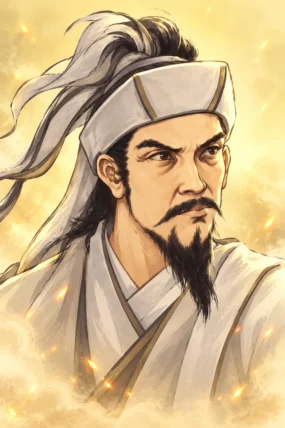
Deng Ai (courtesy name Shai) was a brilliant military general, strategist, and politician who served the state of Cao Wei during the late Three Kingdoms period[cite: 3]. Born into a impoverished, orphaned family in Yiyang Commandery (present-day Xinxian, Henan Province), Deng Ai suffered from a severe stutter in his youth, which led many to look down upon his prospects. Despite his humble origins as a minor agricultural clerk, he possessed a passionate fascination with military topography, constantly surveying mountains, rivers, and terrain, sketching potential fortification plans and troop movement routes.
His profound intellect was discovered by Sima Yi, who recognized Deng Ai’s genius and appointed him to his executive staff. Deng Ai gained immense prominence by submitting the landmark state treatise ‘Jianhe Liu’ (Treatise on Water Control and Agriculture), advocating for massive agricultural colonies (Tuntian) and canal networks along the Huai River basin. This economic strategy secured agricultural surpluses and logistical superiority for Cao Wei’s armies. As a military officer, Deng Ai rose through the ranks to become Inspector of Yanzhou and Grand General Who Guards the West. He repeatedly thwarted the Northern Expeditions launched by Shu Han’s commander Jiang Wei, analyzing enemy movements with uncanny accuracy and fortifying key positions like Mount Duan, Duan Valley, and Qi Mountain before Shu forces could arrive.
In 263 AD, Deng Ai achieved one of the most audacious military feats in ancient Chinese history during Cao Wei’s campaign to conquer Shu Han. Finding the main Shu defenses under Jiang Wei impassable at the formidable sword-gate pass of Jiange, Deng Ai led an elite force of 10,000 soldiers on a death-defying mountain trek through 700 li of uninhabited, treacherous terrain across Yinping. Navigating precipitous cliffs and wrapping themselves in felt blankets to roll down sheer mountain faces, Deng Ai’s army bypassed Shu’s main line of defense, caught the Shu interior completely off-guard, defeated Zhuge Zhan at Mianzhu, and forced the unconditional surrender of Liu Shan in Chengdu, bringing an end to the Shu Han state.
Following his triumph, Deng Ai acted magnanimously toward the surrendered Shu court, granting titles to Liu Shan and former Shu officials. However, his swift actions aroused intense envy from rival Wei general Zhong Hui. Conspiring with the court official Wei Guan, Zhong Hui forged treasonous letters to frame Deng Ai for rebellion. Sima Zhao ordered Deng Ai’s arrest. Stripped of his command, Deng Ai and his son Deng Zhong were bound in prisoner carts to be taken back to Luoyang. Fearing that Deng Ai’s name would be cleared once he reached the capital, Wei Guan dispatched Tian Xu to intercept the prisoner convoy, executing Deng Ai and Deng Zhong at Mianyang in 264 AD.
Role in Romance of the Three Kingdoms
In Luo Guanzhong’s Romance of the Three Kingdoms, Deng Ai is portrayed in Chapters 107 through 119 as an indispensable strategist and rival to Shu Han’s commander Jiang Wei. Depicted as a stuttering but exceptionally sharp mind, Deng Ai frequently engages in legendary tactical duels with Jiang Wei along the western border. His masterpiece operational maneuver occurs in Chapter 117, where he leads his brave troops across 700 li of trackless mountains at Yinping, descending upon Mianzhu like divine soldiers and forcing Liu Shan to surrender. His sudden downfall due to Zhong Hui’s slander and Wei Guan’s treachery highlights one of the most tragic episodes in the novel’s final act.
Deng Ai (鄧艾) — Literary Timeline
249 AD–255 AD — Chapters 107–110
Defense of the Western Frontier
Promoted under Sima Yi; anticipates Jiang Wei’s strategy at Mount Xiying and Nanan, building fortifications in advance to turn back Shu offensives.
256 AD
Victory at Duan Valley
Outmaneuvers Jiang Wei at Duan Valley by anticipating his secret signal fires and tactical route, inflicting a crushing defeat on the Shu army.
257 AD–262 AD — Chapters 113–115
Duels with Jiang Wei
Engages in repeated battles of wits, formations, and subterranean warfare near Mount Qi and Tazhong, consistently frustrating Jiang Wei’s attempts to advance into Wei territory.
263 AD
The Treacherous March Across Yinping
Bypasses Jiange by scaling 700 li of desolate mountains at Yinping; wraps himself in felt to roll down precipitous cliffs with his army, surprising Shu’s interior defense.
263 AD
Battle of Mianzhu and Fall of Chengdu
Defeats Zhuge Zhan at Mianzhu; marches directly onto Chengdu, receiving the unconditional surrender of Emperor Liu Shan and conquering the Shu Han state.
264 AD
Frame-up, Arrest, and Tragic Death
Framed for treason by the jealous Zhong Hui and Wei Guan; arrested in Chengdu and later assassinated by Tian Xu at Mianyang while bound in a prisoner cart.
Key Relationships
Family
- Deng Zhong (邓忠, Đặng Trung) — Son of Deng Ai who served as a military officer, accompanied his father on the daring Yinping expedition, and was executed alongside him in 264 AD.
- Deng Lang (邓朗, Đặng Lãng) — Grandson of Deng Ai who was later rehabilitated and restored to official status during the Jin dynasty.
Friends
- Shi Zan (师纂, Sư Toản) — A subordinate officer and vanguard commander who served under Deng Ai during the campaign to conquer Shu Han.
- Qi Hong (牵弘, Khiên Hoằng) — A military commander who served under Deng Ai during the expedition across Yinping and the subsequent fall of Chengdu.
Enemies
- Jiang Wei (姜维, Khương Duy) — The primary strategic rival of Deng Ai; the two engaged in numerous tactical duels and border skirmishes along the western frontier for many years.
- Zhuge Zhan (诸葛瞻, Gia Cát Chiêm) — The Shu Han general who led the final defense at Mianzhu in 263 AD, where he was defeated and killed by Deng Ai’s forces.
- Liu Shan (刘禅, Lưu Thiện) — The Emperor of Shu Han who surrendered his state to Deng Ai in 263 AD, effectively ending the Three Kingdoms conflict in the west.
- Zhong Hui (钟会, Chung Hội) — A fellow Wei general whose intense professional jealousy led him to forge evidence of treason, resulting in Deng Ai’s arrest.
- Wei Guan (卫瓘, Vệ Quán) — An official who collaborated with Zhong Hui to frame Deng Ai and subsequently dispatched Tian Xu to assassinate him in 264 AD.
- Tian Xu (田续, Điền Tục) — The officer who carried out the execution of Deng Ai and his son at Mianyang under the orders of Wei Guan.
Other
- Sima Yi (司马懿, Tư Mã Ý) — The Wei statesman and mentor who recognized Deng Ai’s talent for topography and military strategy, elevating him from a minor agricultural clerk to his executive staff.
- Sima Zhao (司马昭, Tư Mã Chiêu) — The regent of Cao Wei who authorized the campaign against Shu Han under Deng Ai’s command but later ordered his arrest based on false reports of rebellion.
- Sima Wang (司马望, Tư Mã Vọng) — A senior commander and member of the Sima clan who served alongside Deng Ai during various defensive operations against Shu Han.
In Novel
Chapter 107
- Deng Ai (邓艾, Đặng Ngải): Deng Ai rises as one of Wei’s capable frontier commanders during the later campaigns. He is recognized for practical military judgment and becomes increasingly important as Wei faces repeated Shu attacks.
Chapter 110
- Deng Ai (邓艾, Đặng Ngải): Deng Ai participates in the defense against Jiang Wei’s northern expeditions. He uses terrain and fortified positions to slow the Shu advance and begins establishing himself as one of Wei’s principal commanders.
Chapter 112
- Deng Ai (邓艾, Đặng Ngải): Deng Ai continues fighting Jiang Wei and develops defensive strategies designed to exhaust the Shu army rather than allow it to choose the battlefield.
Chapter 114
- Deng Ai (邓艾, Đặng Ngải): Deng Ai opposes Jiang Wei’s repeated attacks and helps Wei preserve its frontier positions. His ability to anticipate Shu movements makes him one of the most effective Wei commanders of the late period.
Chapter 116
- Deng Ai (邓艾, Đặng Ngải): Deng Ai plays a major role in the final war against Shu. He supports the strategic decision to invade Shu through a route that bypasses the main Shu defenses, preparing the way for the fall of Chengdu.
Chapter 117
- Deng Ai (邓艾, Đặng Ngải): Deng Ai leads his army through the dangerous Yinping route. The march is extremely difficult, but he reaches the rear of Shu’s defenses unexpectedly. He defeats the forces sent against him and advances toward Chengdu, forcing Liu Shan’s government into a crisis.
Chapter 118
- Deng Ai (邓艾, Đặng Ngải): Deng Ai reaches Chengdu and accepts Liu Shan’s surrender. Shu is destroyed as an independent state, and Deng Ai becomes the Wei commander most directly associated with the conquest of Shu. His success later creates conflict with Zhong Hui and the Wei court.
Chapter 119
- Deng Ai (邓艾, Đặng Ngải): Deng Ai is accused of abusing his authority after the conquest. Zhong Hui and Wei officials use the political situation to turn the court against him. Deng Ai is arrested while attempting to defend his actions and is eventually killed after the Wei command collapses into factional conflict.
In History
Summary
- Deng Ai (邓艾, Đặng Ngải), courtesy name Shizai (士载), was one of the most important Wei generals of the late Three Kingdoms period.
- He rose from a comparatively humble background through his administrative and military abilities and became a leading commander against Shu Han.
Period I — Rise in Wei Service
- Deng Ai became known for his ability to manage agricultural colonies and frontier administration. His practical knowledge of logistics contributed to his rise within the Wei military establishment.
- He later became a major commander on the western frontier and repeatedly fought against Shu forces.
Period II — Shu Campaign, 263 AD
- During the final Wei invasion of Shu, Deng Ai proposed an audacious route through difficult mountain terrain rather than following the main invasion route.
- His army crossed the Yinping region and unexpectedly emerged near Chengdu. The sudden appearance of Wei forces contributed decisively to the collapse of Shu resistance.
- Liu Shan surrendered, ending the Shu Han state.
Period III — Death
- Deng Ai was subsequently accused of misconduct and political disloyalty by rivals, particularly Zhong Hui.
- He was arrested during the political turmoil following the conquest of Shu and was killed while being transported.
Historical Record
- Deng Ai was a historical figure. His biography is preserved in the Wei Book of the Records of the Three Kingdoms.