





Contents
Biography & Historical Record
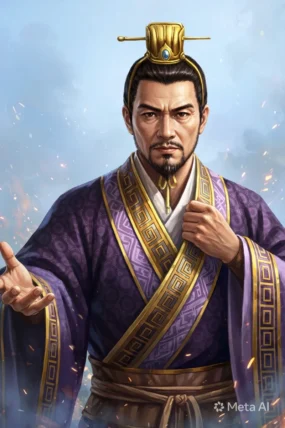
Liu Chen was an imperial prince of Shu Han during the late Three Kingdoms period who became immortally celebrated as the supreme martyr of the Han dynasty. As the fifth son of the Second Emperor Liu Shan (Houzhu) and a grandson of the founding sovereign Liu Bei, Liu Chen was ennobled as the Prince of Beidi (Beidi Wang) in 259 AD. Documented in Chen Shou’s official dynastic history Records of the Three Kingdoms (Sanguozhi – Book of Shu, Biographies of the Two Sovereigns and Royal Sons) and Sima Guang’s Zizhi Tongjian, Liu Chen possessed an unyielding, fiery spirit, exceptional martial pride, and an uncompromising loyalty to the legacy of the Han imperial house.
In the winter of 263 AD, the Cao Wei state launched a monumental invasion of Shu Han. While Jiang Wei successfully held Zhong Hui at Jiange, the Wei grand general Deng Ai executed an audacious, perilous march across seven hundred li of desolate, cliffside mountain terrain through Yinping. After bypassing the fortifications, Deng Ai crushed the imperial vanguard led by Zhuge Zhan and his son Zhuge Shang at the Battle of Mianzhu, advancing unimpeded to the gates of the capital, Chengdu. Plunged into terror and paralyzing despair, the imperial court collapsed into chaos. Corrupted by the sycophantic eunuch Huang Hao and persuaded by the surrender memorials of Chief Clerk Qiao Zhou, Liu Shan resolved to submit unconditionally to Deng Ai, dispatching envoys with the imperial seal and binding himself as a captive prince.
Upon hearing of his father’s impending capitulation, Liu Chen rushed into the palace halls, weeping tears of blood as he passionately confronted Liu Shan. Liu Chen vehemently argued: ‘If our situation is desperate and our strength exhausted, disaster and ruin are upon us! Yet father and son, sovereign and subjects, should make one final stand outside the city walls, dying together for the altars of state and soil! In doing so, we would be worthy to face the First Emperor in the underworld. How can we shamelessly surrender to the invaders?’ Despite Liu Chen’s agonized pleas, Liu Shan was overwhelmed by fear, angrily rejecting his son’s counsel and ordering him driven from the throne room. Realizing that the Han dynasty was doomed to subjugation, Liu Chen returned to his estate and informed his virtuous consort, Lady Cui. Lady Cui resolutely declared that she would rather die as an imperial noblewoman than live in chains, taking her own life and that of their three sons. Liu Chen then carried the severed heads of his wife and children into the Grand Ancestral Temple of the First Emperor Liu Bei. Weeping bitterly before his grandfather’s altar, Liu Chen bowed in reverence, cried out in despair over the loss of the Han mandate, and drew his ancestral sword to cut his own throat, dying heroically as the final unyielding prince of Shu Han.
Role in Romance of the Three Kingdoms
In Chapter 118 of Luo Guanzhong’s classic 14th-century historical novel Romance of the Three Kingdoms, Liu Chen stands as the towering, tragic hero of the entire finale. His fiery defiance, righteous indignation against cowardice, and supreme self-sacrifice in the Ancestral Temple provide the epic masterpiece with its most emotionally shattering and noble climax.
The novel dramatizes the tragic collapse of Chengdu in Chapter 118 with monumental pathos. When Liu Shan summons his ministers to announce his surrender to Deng Ai, Liu Chen steps forth from the ranks, his eyes blazing with fury. He addresses his father in a thunderous voice: ‘Grandfather fought countless battles across the realm to establish this empire! Shall we cast it away to northern traitors in a single morning? I beg Your Majesty to summon every soldier and citizen in Chengdu, don our armor, and fight Deng Ai to the last breath! If we perish, we perish with honor!’ When Liu Shan insults him and threatens him with execution for insubordination, Liu Chen leaves the palace wailing: ‘First Emperor! Grandfather! How could your vast toil end in such disgrace!’
Returning to his palace, Liu Chen weeps before his wife Lady Cui, stating: ‘The court has surrendered; tomorrow the Wei army enters Chengdu. I cannot bear to bend my knee to traitors.’ Lady Cui replies with equal valor: ‘A noble man dies for righteousness; a virtuous wife dies for honor. Do not mourn for me; I go before you to the yellow springs!’ Without hesitation, Lady Cui dashes her head against a pillar and expires, while Liu Chen personally slays their three young sons to spare them humiliation. Liu Chen then takes their heads, rushes into Liu Bei’s Grand Ancestral Temple, and throws himself onto the floor before the spirit tablets. Weeping tears of blood, he cries: ‘Your unworthy grandson could not preserve your sacred altars; our imperial house has fallen into the hands of cowards! Today I offer my blood to wash away our shame!’ With a single stroke of his sword, Liu Chen ends his life before the altar. When Deng Ai enters Chengdu and learns of Liu Chen’s martyrdom, even the hardened Wei conqueror sighs in reverence, ordering Liu Chen and his family buried with supreme imperial honors. Luo Guanzhong commemorates Liu Chen with immortal verse: ‘Loudly weeping in the ancestral temple, the filial prince sacrificed his life; how can the coward who danced in Luoyang compare to the hero of the Han?’
Liu Chen (劉諶) — Historical & Literary Timeline
Ennobled as Prince of Beidi
Formally granted the aristocratic title and fief of Prince of Beidi (Beidi Wang) by his father, the Second Emperor Liu Shan, taking his place among the imperial royalty of Shu Han.
Vehement Opposition to Surrendering to Deng Ai
Fiercely denounces Qiao Zhou’s surrender counsel; passionately implores Liu Shan to rally Chengdu’s garrison for a glorious fight to the death, but is rejected and expelled from court.
Self-Sacrifice for the Altars of the Han Dynasty
Witnesses his consort Lady Cui take her life; executes his three sons to prevent enslavement, carries their heads to Liu Bei’s Ancestral Temple, and slits his throat before his grandfather’s altar.
For detailed historical records, archives, and official chronicles, explore Liu Chen on Wikipedia.
Key Relationships
Family
- Liu Bei (刘备, Lưu Bị) – Grandfather; founding emperor of Shu Han whose legacy Liu Chen sought to protect.
- Liu Shan (刘禅, Lưu Trì) – Father; the second emperor of Shu Han whose decision to surrender to Wei prompted Liu Chen’s protest and martyrdom.
- Lady Cui (崔, Thôi) – Consort/wife; chose suicide rather than live under Wei rule and died alongside Liu Chen’s three sons.
- Three unnamed sons (三子, Tam tử) – Liu Chen’s young heirs; slain by their father to spare them from captivity before his own death.
- Liu Xuan (刘璿, Lưu Huyền) – Elder brother and Crown Prince of Shu Han; perished during the turmoil following Zhong Hui’s rebellion in Chengdu.
Friends
- Zhuge Zhan (诸葛瞻, Chú Giá Chiêm) – Senior Shu general who fell at the Battle of Mianzhu; Liu Chen shared his loyalty to the Han cause.
- Zhuge Shang (诸葛尚, Chú Giá Thượng) – Son of Zhuge Zhan, also killed at Mianzhu; fought alongside Liu Chen against Wei forces.
- Jiang Wei (姜维, Tương Vệ) – Grand General of Shu who defended Jiange; allied with Liu Chen in the final defense of Chengdu.
- Liao Hua (廖化, Liệu Hóa) – Veteran Shu general who lamented the kingdom’s fall together with Liu Chen.
- Zhang Yi (张郁, Trương Dục) – Senior Shu commander; part of the same loyal circle opposing surrender.
Enemies
- Deng Ai (邓艾, Đăng Ngải) – Wei grand general whose daring mountain crossing forced Liu Shan’s surrender and precipitated Liu Chen’s rebellion.
- Huang Hao (黄皓, Hoàng Hạo) – Corrupt Shu eunuch whose manipulation contributed to the capitulation decision.
- Qiao Zhou (乔州, Kiêu Châu) – Chief clerk whose surrender memorial convinced Liu Shan to yield to Wei.
- Sima Zhao (司马昭, Tư Mã Chiếu) – Regent of Cao Wei who orchestrated the overall campaign that led to Shu’s conquest.
Other
- No information
In Novel
Chapter 119
- Liu Chen (刘谌, Lưu Sầm): Liu Chen is Liu Shan’s son and the Prince of Beidi. When Wei forces enter Chengdu and Liu Shan decides to surrender, Liu Chen strongly opposes the decision. He urges his father to fight to the death rather than abandon Shu. After Liu Shan refuses, Liu Chen kills his wife and children and then commits suicide at the ancestral temple, choosing death rather than living under Wei rule.
History
Summary
- Liu Chen (刘谌, Lưu Sầm) was a Shu Han prince and son of Liu Shan.
Final Defense of Shu
- When Wei forces conquered Shu in 263, Liu Chen was associated with the royal family during the final crisis.
- He opposed surrender and urged continued resistance rather than accepting the destruction of the Shu state.
Death
- After Liu Shan decided to surrender, Liu Chen killed himself rather than live under the new regime.
- His death became one of the strongest examples of loyalty to Shu among Liu Shan’s sons.
- Classification: Historical.