


Contents
Biography & Historical Record
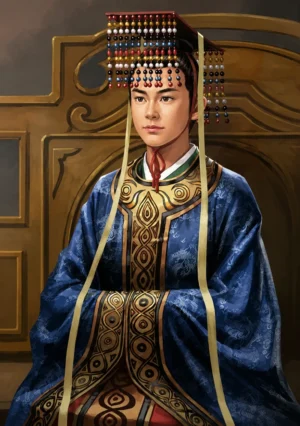
Liu Xian (Han) (刘羡, Lưu Tiến) was an Eastern Han imperial prince who held the titles Prince of Chen (陈王, Trần Vương) and later Prince of Donghai (东海王, Đông Hải Vương). He belonged to the old imperial Liu line memorialized in Fan Ye’s Hou Hanshu (biographies of Emperor Ming’s princely houses) and related Three Kingdoms-era notices. He is not Liu Xian (刘贤, Lưu Hiền), son of Liu Du of Lingling — different hanzi and career.
After Cao Cao (曹操, Tào Tháo) moved Emperor Xian (刘协, Lưu Hiệp) to Xuchang (196), high princes of the blood lived under tight surveillance: ceremonial titles and stipends remained, military and administrative power did not. Unlike militant relatives such as Dong Cheng (董承, Đổng Thừa) or Fu Wan (伏完, Phục Hoàn), Liu Xian kept a low profile, avoided girdle-decree conspiracies, and died peacefully in 207 — before Cao Pi’s usurpation — leaving his household intact through the darkest years of the puppet court.
Role in Romance of the Three Kingdoms
Romance does not give Liu Xian a speaking battlefield role. He stands in the background of the Xuchang court chapters (roughly Ch. 14–20): when Cao Cao holds the Emperor to command the lords, princes of Chen / Donghai rank attend assemblies as living proof that the Liu house still exists — and that it no longer rules. His literary function is witness and contrast: the prudent prince who survives by silence while Dong Cheng’s girdle plot and other loyalist schemes end in massacre.
Liu Xian (刘羡) — Historical & Literary Timeline
Prince of Chen to Prince of Donghai
Holds successive royal titles within the Eastern Han imperial house; ceremonial duties and ancestral sacrifices replace frontier command.
Xuchang surveillance
Resides under Cao Cao’s capital regime with other princes; stripped of real military power while Emperor Xian is hosted at Xuchang.
Avoids girdle-decree purge
Stays clear of Dong Cheng’s assassination plot; household survives the loyalist bloodletting that follows Cao Cao’s discovery of the decree.
Death at court
Dies in 207 while the Han throne still nominally stands — a quiet end for a prince who chose prudence over conspiracy.
Homonym caution: not Liu Du’s son 刘贤; not Emperor Xian 刘协.
Key Relationships
Family
- Imperial Liu clan: Prince of Chen / Donghai within Emperor Ming’s branched houses (Hou Hanshu). Exact father–son links in surviving notices are thinner than for militant kinsmen — treat as court-kin of the blood, not a reconstructed nuclear tree.
- Liu Chong (刘宠, Lưu Sủng): Earlier famed Prince of Chen whose regional defense and death (197) mark the same princely title-stream Liu Xian later occupies in court memory (no dedicated site page — plain text; regional kinsman context, not proven father).
Friends
- Emperor Xian (刘协, Lưu Hiệp): Reigning sovereign and clan head at Xuchang; Liu Xian’s court life is defined by attendance on this puppet emperor under Cao Cao’s guard — the closest patron bond the sources allow a non-militant prince.
- Fellow Han princes at Xuchang: Other titled Liu princes kept under the same surveillance regime after 196 — a court-kin cohort rather than named sworn friends; they share ceremonial duties, stipends, and the need to avoid Cao Cao’s purges.
- Honest court-kin note: No private bosom friends are recorded in novel scenes or SGZ personal biography; the substantive network is imperial attendance and prudent distance from conspirators — friendship here means shared clan survival, not battlefield camaraderie.
Enemies
- Cao Cao (曹操, Tào Tháo): Chancellor who relocates the court to Xuchang and keeps princes like Liu Xian under political watch while stripping real power — structural antagonist of the imperial house, not a personal duel opponent.
Other
- Dong Cheng (董承, Đổng Thừa): Imperial relative whose 200 girdle-decree plot Liu Xian carefully avoided.
- Fu Wan (伏完, Phục Hoàn): Emperor Xian’s father-in-law and covert anti-Cao figure — the active loyalist path Liu Xian did not take.
- Homonym — Liu Xian (刘贤): Son of Liu Du of Lingling; different person — do not merge pages or family fields.
In Novel
Chapters 14–20 (Xuchang court arc)
- Liu Xian (Han) (刘羡, Lưu Tiến): Background imperial prince at Cao Cao’s Xuchang court. He does not speak battlefield lines; his presence among titled Liu nobles underlines that the Han house still sits in ceremony while real power rests with Cao Cao (曹操, Tào Tháo) and Emperor Xian (刘协, Lưu Hiệp) is a guest-hostage sovereign.
Chapter 20 (girdle-decree aftermath colour)
- Liu Xian (Han) (刘羡, Lưu Tiến): Literary contrast to Dong Cheng (董承, Đổng Thừa) and other militant loyalists — the prudent prince who is not named among the conspirators and thus models the survival path of court-kin who refuse the decree plot.
In History
Summary
- Liu Xian (刘羡, Lưu Tiến) was Prince of Chen and later Prince of Donghai. Under Cao Cao’s Xuchang regime he retained title without military power, avoided anti-Cao conspiracies, and died in 207.
Year: 196 AD
- Emperor Xian established at Xuchang; high princes including Liu Xian live under Chancellor surveillance.
Year: 200 AD
- Dong Cheng’s girdle decree exposed; Liu Xian is not recorded among the executed conspirators — consistent with a policy of non-involvement.
Year: 207 AD
- Dies at court; household preserved into the final Han years.
Historical Record
- Hou Hanshu notices of Eastern Han princely houses (Emperor Ming’s eight princes tradition and related Chen / Donghai titles); Three Kingdoms-era court context in Sanguozhi / ZZTJ for Xuchang. Distinguish carefully from Liu Xian (刘贤) of Lingling.