
Contents
Biography & Historical Record
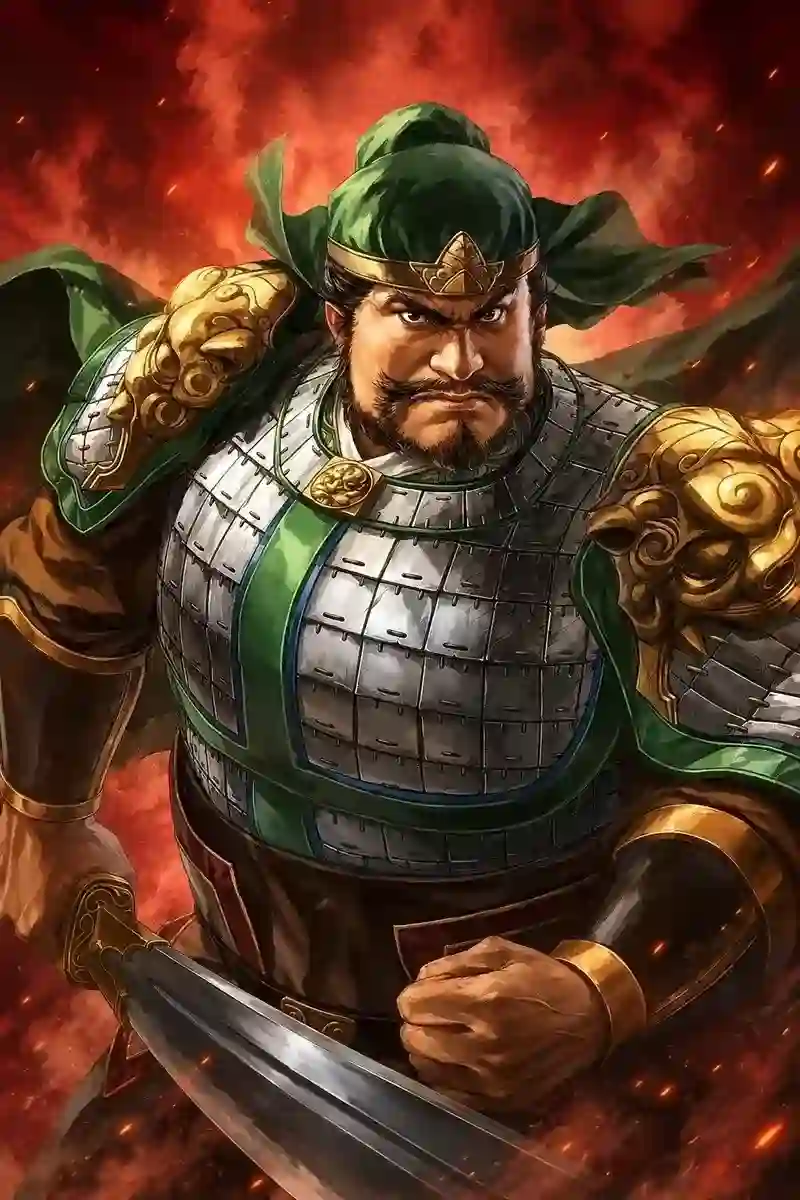
Xu Zhu (许褚, Hứa Chử) was a military general of immense strength and unwavering loyalty who served the warlord Cao Cao (曹操, Tào Tháo) during the late Eastern Han dynasty and subsequent Cao Wei state. Standing over eight feet tall with a waist of massive proportions, Xu Zhu was renowned for his physical prowess and simple, honest character, which earned him the famous moniker “Tiger Fool” (虎痴). Unlike many ambitious generals of his era, Xu Zhu was characterized by his quiet, stern demeanor, his strict adherence to duty, and his complete devotion to protecting the life of his lord.
Historically, Xu Zhu first made a name for himself during the chaos of the Yellow Turban Rebellion. He gathered thousands of families from his clan and constructed a defensive fort to ward off bandit raids. When the fort ran out of projectiles, Xu Zhu hurled massive stones to crush the attackers. During a temporary truce to exchange oxen for food, the traded oxen ran back to his camp. In a legendary display of raw power, Xu Zhu grabbed an ox by its tail and dragged it backward for over a hundred paces, completely terrifying the bandits who fled without the livestock.
In 197 AD, Xu Zhu submitted to Cao Cao (曹操, Tào Tháo) and was immediately appointed as a commander of the bodyguards alongside Dian Wei (典韦, Điển Vi). Following Dian Wei’s heroic death at the Battle of Wancheng, Xu Zhu became the sole leader of Cao Cao’s elite “Tiger Guard” (虎衛軍). He saved Cao Cao’s life on multiple occasions, most notably at the Battle of Guandu in 200 AD when he sniffed out an assassination plot by Xu Ta (徐他, Từ Tha) and executed the conspirators on the spot. At the Battle of Tong Pass in 211 AD, Xu Zhu protected Cao Cao from a hail of arrows during a river crossing by using a horse saddle as a makeshift shield while steering the boat with his other hand. His fierce reputation was so great that the formidable enemy general Ma Chao (马超, Mã Siêu) aborted an ambush plot simply upon seeing Xu Zhu standing guard, glaring at him. Following Cao Cao’s death in 220 AD, Xu Zhu was so grief-stricken that he wept tears of blood. He continued to serve Cao Pi (曹丕, Tào Phi) and Cao Rui (曹叡, Tào Duệ) with equal devotion until his natural death around 230 AD, after which he was posthumously honored as Marquis Zhuang (壯侯).
Role in Romance of the Three Kingdoms
In Luo Guanzhong’s 14th-century historical novel, Romance of the Three Kingdoms, Xu Zhu’s martial prowess is highly romanticized, elevating him to one of the premier duelists of the era. He is introduced in Chapter 12, where he engages in an epic, day-long duel with Dian Wei (典韦, Điển Vi) that ends in a complete stalemate. Impressed by his strength, Cao Cao (曹操, Tào Tháo) orchestrates a trap to capture Xu Zhu, who willingly surrenders and pledges his eternal loyalty.
The novel highlights several of his most iconic combats. During the campaign against Lu Bu (吕布, Lã Bố), Xu Zhu duels the mighty warrior for twenty rounds before receiving assistance from other Wei generals. His most famous literary episode occurs in Chapter 59 during the Battle of Tong Pass, where he faces Ma Chao (马超, Mã Siêu) in a duel of titans. Becoming overheated and frustrated during the ferocious clash, Xu Zhu rides back to camp, strips off his heavy armor, and returns to the field bare-chested to fight Ma Chao. This duel, known popularly as “Naked Xu Zhu Fights Ma Chao,” symbolizes his raw, untamed spirit. Later in the novel, his human vulnerability is depicted when he gets heavily intoxicated while guarding a supply convoy and is subsequently defeated and wounded by Zhang Fei (张飞, Trương Phi).
“I only know the orders of the King; I know nothing of personal relations!”
— Xu Zhu’s stern declaration to Cao Ren (曹仁, Tào Nhân) when refusing him private entry to Cao Cao’s bedchamber.
“I am Xu Zhu of Qiao! Do you dare face me in mortal combat?”
— Xu Zhu’s booming challenge to Ma Chao (马超, Mã Siêu) during the Battle of Tong Pass.
Xu Zhu — Historical & Literary Timeline
197 AD
Joining Cao Cao and Dueling Dian Wei
After defending his village from bandits, Xu Zhu encounters the forces of Cao Cao (曹操, Tào Tháo). He duels Dian Wei (典韦, Điển Vi) to a standstill. Cao Cao traps and recruits him, establishing him as a core bodyguard.
200 AD
Foiling Assassination at Guandu
During the Battle of Guandu against Yuan Shao (袁紹, Viên Thiệu), Xu Zhu senses a conspiracy led by Xu Ta (徐他, Từ Tha). He returns to Cao Cao’s tent just in time to slay the assassins, solidifying his role as the ultimate defender.
211 AD
The Shield of Tong Pass
During a disastrous retreat across the Yellow River, Xu Zhu protects Cao Cao (曹操, Tào Tháo) from Ma Chao’s (马超, Mã Siêu) archers. He holds a saddle in one hand to shield his lord while paddling the boat with the other, despite being wounded.
211 AD
The Shirtless Duel with Ma Chao
Xu Zhu engages Ma Chao (马超, Mã Siêu) in a legendary duel. Frustrated by the stalemate, he strips off his armor to fight bare-chested, battling until both of their spears shatter into pieces.
219 AD
Defeat by Zhang Fei
While escorting a critical grain convoy during the Hanzhong Campaign, Xu Zhu drinks too much wine. He is ambushed by Zhang Fei (张飞, Trương Phi), who wounds him and forces a retreat.
220 AD
Grief at Cao Cao’s Passing
Upon learning of Cao Cao’s (曹操, Tào Tháo) death, Xu Zhu is so consumed by grief that he weeps until he spits blood. He is subsequently promoted by Cao Pi (曹丕, Tào Phi) to oversee the defense of the palace.
230 AD
Death and Posthumous Honor
Xu Zhu dies of natural illness during the reign of Cao Rui (曹叡, Tào Duệ). He is posthumously honored as Marquis Zhuang (壯侯) for his lifetime of peerless, loyal service.
For detailed historical records, archives, and official chronicles, explore Xu Zhu on Wikipedia.
Key Relationships
Family
- Xu Yi (许仪, Hứa Nghi): Son of Xu Zhu who inherited his father’s title of Marquis Zhuang, though he was later executed by Zhong Hui (钟会, Chung Hội) for negligence during the campaign against Shu Han.
- Xu Ding (许定, Hứa Định): Elder brother

Friends
- Dian Wei (典韦, Điển Vi): A fellow elite bodyguard and comrade-in-arms; after an initial stalemate duel, they served together as the primary protectors of Cao Cao (曹操, Tào Tháo) until Dian Wei (典韦, Điển Vi) died at the Battle of Wancheng.
Enemies
- Ma Chao (马超, Mã Siêu): A formidable rival whom Xu Zhu fought in a legendary, bare-chested duel at the Battle of Tong Pass in 211 AD; his reputation was such that Ma Chao (马超, Mã Siêu) once aborted an ambush simply upon seeing Xu Zhu on guard duty.
- Zhang Fei (张飞, Trương Phi): During the Hanzhong Campaign in 219 AD, he exploited Xu Zhu’s intoxicated state to ambush and wound him, forcing a retreat during a grain convoy escort mission.
- Xu Ta (徐他, Từ Tha): A conspirator who plotted to assassinate Cao Cao (曹操, Tào Tháo) at the Battle of Guandu in 200 AD, only to be discovered and executed by Xu Zhu.
Other
- Cao Cao (曹操, Tào Tháo): His lord and master to whom he was completely devoted; Xu Zhu served as his personal bodyguard, saved his life multiple times, and was so grief-stricken by his death in 220 AD that he wept blood.
- Cao Pi (曹丕, Tào Phi): The successor to Cao Cao (曹操, Tào Tháo) whom Xu Zhu continued to serve with unwavering loyalty after the transition of power.
- Cao Rui (曹叡, Tào Duệ): The emperor under whom Xu Zhu served during his final years until his natural death around 230 AD.
- Cao Ren (曹仁, Tào Nhân): A high-ranking general and cousin to Cao Cao (曹操, Tào Tháo) whom Xu Zhu famously denied private access to the lord’s chambers, citing strict adherence to military security protocols.




Appearance
In Novel
Chapter 12
- Xu Zhu (许褚, Hứa Chử): Introduced as a Qiao warrior who organized clan militia against bandits — hurling boulders when arrows ran out and dragging an ox backward by the tail. Cao Cao (曹操, Tào Tháo) recruited him after a stalemate duel with Dian Wei (典韦, Điển Vi).
Chapter 13–16
- Xu Zhu (许褚, Hứa Chử): Served as Cao Cao’s personal champion during the Zhang Xiu (张绣, Trương Hủ) campaign at Wancheng; after Dian Wei’s death in the night ambush, Xu Zhu became sole captain of the Tiger Guard (虎卫军) and escorted Cao Cao through the burning camp.
Chapter 22–30
- Xu Zhu (许褚, Hứa Chử): Bodyguard during Guandu preparations and the Yuan Shao (袁绍, Viên Thiệu) campaign; at Guandu he detected Xu Ta’s (徐他, Từ Tha) assassination plot and slew the conspirators in Cao Cao’s tent.
Chapter 39
- Xu Zhu (许褚, Hứa Chử): Marched in Cao Cao’s advance against Liu Bei (刘备, Lưu Bị), guarding the commander’s person through the Xu Province operations.
Chapter 59
- Xu Zhu (许褚, Hứa Chử): At Tong Pass fought Ma Chao (马超, Mã Siêu) in a hundreds-of-rounds duel, stripped to fight bare-chested when overheated, and shielded Cao Cao with a saddle during the Wei River retreat — feats that made Ma Chao abort a later night ambush upon seeing Xu Zhu on watch.
Chapter 60
- Xu Zhu (许褚, Hứa Chử): Remained at Cao Cao’s side through the closing stages of the Tong Pass campaign against Ma Chao’s shattered coalition.
Chapter 71–72
- Xu Zhu (许褚, Hứa Chử): Escorted grain convoys in the Hanzhong Campaign; got drunk on duty and was wounded when Zhang Fei (张飞, Trương Phi) ambushed the supply train — a rare literary humbling of the Tiger Fool.
Appearance
In History
Summary
- Xu Zhu (许褚, Hứa Chử), courtesy name Zhongkang (仲康), was Cao Cao’s (曹操, Tào Tháo) most famous personal guard — nicknamed “Tiger Fool” (虎痴) for his strength and single-minded loyalty.
Early Life
- From Qiao in Peiguo, Xu Zhu gathered thousands of clan followers into a fortified settlement during late-Han disorder before submitting to Cao Cao circa 197 AD.
Year: 200 AD — Guandu
- Xu Zhu protected Cao Cao during the campaign against Yuan Shao (袁绍, Viên Thiệu) and was trusted with the elite bodyguard corps after Dian Wei (典韦, Điển Vi) fell at Wancheng.
Year: 211 AD — Tong Pass
- During the campaign against Ma Chao (马超, Mã Siêu) and the Guanzhong coalition, Xu Zhu helped cover Cao Cao’s dangerous river crossing; historical sources stress courage rather than the novel’s bare-chested duel.
Career under Cao Wei
- After Cao Pi (曹丕, Tào Phi) founded Wei, Xu Zhu held honored guard commands until his death circa 230 AD, posthumously enfeoffed as Marquis Zhuang (壮侯).
Historical Record
- Biography in Sanguozhi, Wei Book 18. Chen Shou records his ox-dragging feat, clan fort, and role as Cao Cao’s closest fighting protector; most escort scenes and the Ma Chao duel are novel elaborations.
Appearance
Gallery