


Contents
Biography & Historical Record
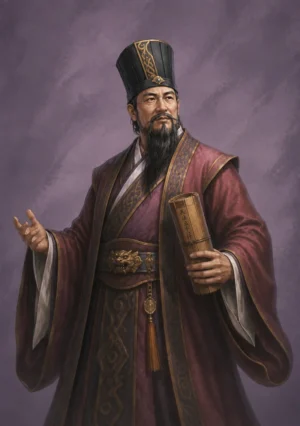
Zhao Wen, courtesy name Zirou, born in 137 AD and died in 208 AD, was a eminent high-ranking imperial minister and Excellency over the Masses (Situ) during the late Eastern Han dynasty. Hailing from Chengdu in Shu Commandery (modern-day Chengdu, Sichuan Province), Zhao Wen hailed from one of the most politically influential ministerial houses of the Han court. He was the grandson of Grand Commandant Zhao Jie, the nephew of Minister Guards Zhao Dian (one of the Eight Worthies), and the younger brother of Grand Commandant Zhao Qian. Across three consecutive generations, the Zhao clan of Shu Commandery produced four high ministers holding Three Excellencies ranks, rivaling the illustrious Yuan clan of Runan.
Early in his administrative career, Zhao Wen was appointed Assistant Administrator of Jingzhao Commandery. Disillusioned by the restrictive administrative trivialities and pervasive corruption of imperial bureaucracy, Zhao Wen famously voiced a celebrated historical declaration: “A true man should soar like a male eagle; how can he bow his head and remain compliant like a female bird!” (Dàzhàngfū dāng xióngfēi, ān néng cí fú!). Immediately resigning his official post, Zhao Wen returned to his hometown in Chengdu. Shortly thereafter, a devastating famine struck Shu Commandery. Demonstrating extraordinary philanthropy and public spirit, Zhao Wen unlocked his family’s private granaries to distribute relief food, saving over ten thousand lives during the famine.
When Dong Zhuo coerced Emperor Xian to relocate the imperial capital westward to Chang’an, Zhao Wen was recalled to imperial service as Palatine Attendant and enfeoffed as Marquis of Jiangnam Pavilion. In 193 AD (Chuping 4th year), Zhao Wen succeeded Yang Biao as Excellency over the Masses (Situ) and Director of the Secretariat. In 195 AD, as rogue warlords Li Cui and Guo Si broke into open civil war across Chang’an, Li Cui took Emperor Xian hostage in his military camp. Demonstrating fierce moral courage, Zhao Wen dispatched a stern letter directly admonishing Li Cui for massacring imperial ministers, destroying the capital, and terrorizing the populace. Infuriated, Li Cui ordered Zhao Wen’s immediate execution. However, Li Cui’s cousin Li Ying repeatedly interceded for several days, persuading Li Cui to spare Zhao Wen’s life.
In 196 AD, when Cao Cao escorted Emperor Xian to the new capital at Xuchang, Zhao Wen retained his exalted position as Excellency over the Masses (Situ). Amidst rapid court upheavals, Zhao Wen maintained his position among the Three Excellencies for nearly fifteen years. However, in the first month of 208 AD, Zhao Wen committed a fatal political error: in his capacity as Situ, he issued an imperial order recruiting Cao Cao’s eldest surviving son, Cao Pi, to serve as a staff officer in his ministerial headquarters. Offended by what he perceived as sycophantic patronage and improper recruitment based on clan status rather than merit, Cao Cao submitted a stern impeachment memorial to the throne, stripping Zhao Wen of all official posts. Broken by the scandal, Zhao Wen passed away a few months later at the age of 72. In the sixth month of 208 AD, Cao Cao officially abolished the traditional Three Excellencies system and established himself as Imperial Chancellor.
Role in Romance of the Three Kingdoms
In Luo Guanzhong’s classic 14th-century historical novel Romance of the Three Kingdoms, Zhao Wen stands as a prominent loyalist minister of the Eastern Han court in Luoyang, Chang’an, and Xuchang. Appearing amidst the chaotic aftermath of Dong Zhuo’s assassination in Chapter 13 and Chapter 14, Zhao Wen represents the heroic moral backbone of the Han civil court who risked his life to protect Emperor Xian during the wild rampages of Li Cui and Guo Si. His courageous letter confronting Li Cui in Chang’an showcases the unyielding Confucian dignity that preserved the Han imperial house through its darkest hours.
In Chapter 13 of Romance of the Three Kingdoms, Zhao Wen bravely confronts the murderous warlord Li Cui in Chang’an, admonishing him for terrorizing Emperor Xian and destroying the capital. His famous personal motto—declaring that a true man should soar like an eagle rather than submit like a female bird—epitomizes the unyielding spirit of the late Han ministerial elite.
Zhao Wen (趙溫) — Literary & Historical Timeline
160s AD
Famous Motto and Famine Relief in Shu
Resigns as Assistant Administrator of Jingzhao after declaring ‘A true man should soar like an eagle’; opens family granaries in Chengdu to save over 10,000 victims from starvation.
193 AD
Elevation to Excellency over the Masses in Chang’an
Appointed Palatine Attendant and Marquis of Jiangnam Pavilion; succeeds Yang Biao as Excellency over the Masses (Situ) under Emperor Xian in Chang’an.
195 AD
Confronting Li Cui during the Chaos of Chang’an
Writes a stern letter condemning Li Cui for holding Emperor Xian hostage and destroying Chang’an; narrowly escapes execution through the intercession of Li Ying.
208 AD
Recruiting Cao Pi, Impeachment, and Death
Recruits Cao Pi into his Situ ministry; impeached and dismissed from office by Cao Cao for improper recruitment, dying of illness at age 72 shortly before Cao Cao abolishes the Three Excellencies.
Key Relationships
- Family:
- Zhao Jie — Grand Commandant of the Eastern Han dynasty and grandfather of Zhao Wen.
- Zhao Dian — Minister Guards of the Eastern Han court, one of the Eight Worthies, and uncle of Zhao Wen.
- Zhao Qian — Grand Commandant and Grand Administrator of Runan, elder brother of Zhao Wen.
- Comrades / Allies:
- Emperor Xian of Han — Last emperor of the Eastern Han dynasty whom Zhao Wen protected as Situ in Chang’an and Xuchang.
- Yang Biao — Imperial minister and elder statesman who served alongside Zhao Wen in protecting Emperor Xian.
- Li Ying — Cousin of Li Cui who interceded to save Zhao Wen’s life after Zhao Wen condemned Li Cui’s rebellion.
- Zhu Jun — Co-commander and loyalist minister who protected Emperor Xian alongside Zhao Wen.
- Huangfu Song — Supreme imperial commander and fellow court loyalist in Chang’an.
- Enemies / Opponents:
- Li Cui — Rogue warlord who held Emperor Xian hostage in Chang’an and attempted to execute Zhao Wen.
- Guo Si — Rogue warlord who ravaged Chang’an alongside Li Cui.
- Cao Cao — Supreme warlord who impeached Zhao Wen in 208 AD and abolished the Three Excellencies system.
- Dong Zhuo — Tyrannical warlord who usurped power in Luoyang and forced the court move to Chang’an.
For detailed historical records, archives, and official chronicles, explore Zhao Wen on Wikipedia.
In Novel
Zhao Wen (赵温, Zhào Wēn) does not have a securely verified named appearance in the supplied edition under the exact Chinese name 赵温. His historical career as a Han minister should not be imported into the novel timeline without an exact textual occurrence.
In History
Summary
- Zhao Wen (赵温, Triệu Ôn) was a historical Eastern Han statesman and official.
Period I — Eastern Han Official
- Zhao Wen held important offices in the late Eastern Han administration and was recognized as a senior civil official.
- His career continued through the period of political upheaval surrounding the collapse of central Han authority.
Historical Record
- Zhao Wen was historical. He should be distinguished from other late-Han figures whose names are rendered Zhao Wen in English but use different Chinese characters.