

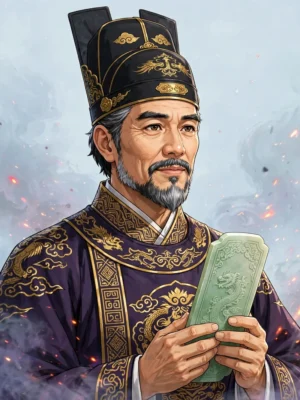
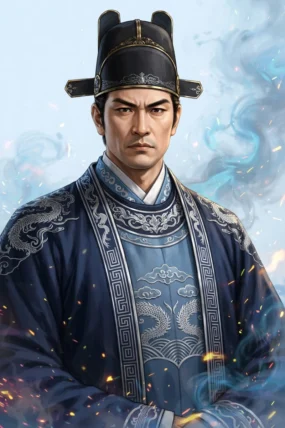


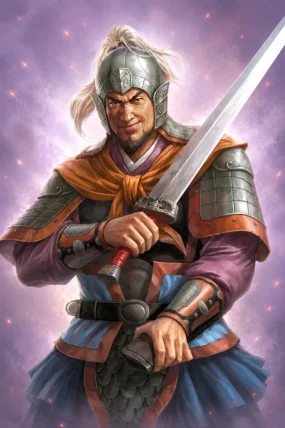
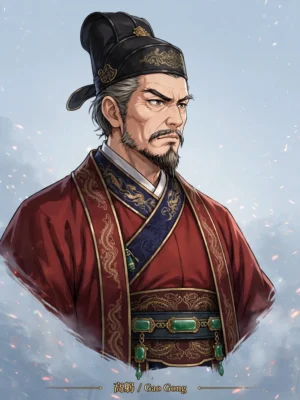
Here is the exhaustive biography of Gao Rou (高柔), courtesy name Wenhui (文惠) (174 – 263), a long-serving official of Cao Wei who rose from a minor post under Yuan Shao to Grand Commandant, incorporating historical records and his brief appearance in Romance of the Three Kingdoms.
Contents
Early Life and Service under Yuan Shao
Gao Rou was born in 174 in Yu County, Chenliu Commandery (present-day Qi County, Kaifeng, Henan). He was a younger relative (cousin) of Gao Gan. When rebellion spread in Yan Province, Zhang Miao advised the young men of Chenliu to seek safety elsewhere. Gao Rou, still in mourning for his father Gao Jing, made the dangerous journey north and joined Gao Gan under Yuan Shao in Hebei. He served Yuan Shao in a minor capacity until the collapse of the Yuan family after Guandu.
Surrender to Cao Cao and Early Career
After Yuan Shao’s defeat and the fall of Ye, Gao Rou surrendered to Cao Cao around 204 together with (or shortly after) his cousin Gao Gan. Cao Cao appointed him magistrate of a troubled county; Gao Rou restored order by persuading previously corrupt officials to perform their duties properly. When Gao Gan later rebelled, Gao Rou refused to join him. Cao Cao initially ordered Gao Rou’s arrest after crushing the rebellion, but was persuaded of his loyalty and retained him in office.
In 211 Gao Rou advised Cao Cao against sending Zhong Yao and Xiahou Yuan westward through Guanzhong to attack Zhang Lu, warning that Ma Chao and Han Sui would interpret the movement as a threat and rebel. Cao Cao ignored the advice; the prediction proved correct. In 213 Gao Rou was made Gentleman of Writing (尚書郎). He later urged leniency toward the families of deserters, arguing that harsh punishment would only encourage further desertion; Cao Cao agreed and placed him under Cao Pi.
Service under Cao Pi, Cao Rui and Later Emperors
Under Cao Pi, Gao Rou served as Imperial Clerk Preparing Documents and then Minister of Justice (廷尉). He worked to reduce reliance on secret denunciations and to moderate excessive punishments. Under Cao Rui he continued as Minister of Justice and later Minister of Ceremonies (太常). He repeatedly remonstrated against wasteful palace construction, extravagant hunting parks, and the miscarriage of justice (notably the case in which an official shifted blame for hunting imperial game onto a commoner). Cao Rui received the memorials favourably, though practical change was limited.
Gao Rou rose steadily: Minister of Works (司空) in 245, Minister over the Masses (司徒) in 248, and finally Grand Commandant (太尉) from 256 until his death. He was enfeoffed as Marquis of Anguo and received the posthumous title Marquis Yuan (元侯).
Role in the Incident at Gaoping Tombs (249)
By 249 Gao Rou, then 75 years old and Minister over the Masses, controlled the labour battalions and their guards around Luoyang. When Sima Yi launched his coup against Cao Shuang while the latter was visiting the Gaoping Tombs, Sima Yi granted Gao Rou imperial authority, appointed him acting General-in-Chief, and ordered him to take command of Cao Shuang’s remaining troops in the capital. Sima Yi compared him to the Han loyalist Zhou Bo. Gao Rou’s cooperation secured Luoyang for the Sima clan and was decisive in the success of the coup. In the novel he and Wang Guan are shown securing Cao Shuang’s and Cao Xi’s forces that threatened Sima Yi’s plan.
Gao Rou (高柔) — Historical & Literary Timeline
174 AD — Birth
Chenliu Commandery
Born in Yu County, Chenliu. Younger relative of Gao Gan; son of Gao Jing.
c. 190s–204 AD — Service under Yuan Shao
Flight to Hebei
Fled the disorder in Yan Province and joined Gao Gan under Yuan Shao. Served until the collapse of the Yuan forces after Guandu and the fall of Ye.
204 AD onward — Service under Cao Cao
Magistrate and Adviser
Surrendered to Cao Cao. Restored order as a county magistrate. Refused to join Gao Gan’s later rebellion. In 211 correctly predicted that a western campaign would provoke Ma Chao and Han Sui. Made Gentleman of Writing in 213.
220–245 AD — Rise under Cao Pi and Cao Rui
Minister of Justice and Minister of Ceremonies
Served as Imperial Clerk, then Minister of Justice. Advocated restraint in punishments and against wasteful expenditure. Continued remonstrances under Cao Rui.
245–256 AD — High Offices
Minister of Works → Minister over the Masses
Appointed Minister of Works (245) and Minister over the Masses (248). Controlled the labour forces and guards around Luoyang—an office of critical strategic importance.
249 AD — Incident at Gaoping Tombs
Support for Sima Yi’s Coup
At age 75, granted imperial authority by Sima Yi, appointed acting General-in-Chief, and ordered to seize Cao Shuang’s remaining troops in the capital. Compared by Sima Yi to Zhou Bo. His cooperation secured Luoyang and ensured the success of the coup. In the novel he and Wang Guan secure the forces of Cao Shuang and Cao Xi.
256–263 AD — Grand Commandant and Death
Final Years
Appointed Grand Commandant in 256. Died in October or November 263 at the age of 89. Posthumously honoured as Marquis Yuan; enfeoffed as Marquis of Anguo. Sons: Gao Jun, Gao Dan, Gao Guang.
Historical Note
Gao Rou’s career spanned nearly the entire existence of Cao Wei. From a minor Yuan Shao adherent he became one of the most senior and longest-serving civil officials of the state, ending as Grand Commandant. His decisive cooperation with Sima Yi in 249, when he was already an old man, made him an important facilitator of the transfer of real power from the Cao family to the Sima clan. The novel gives him only a brief appearance in Chapter 107, but the historical record shows a consistent, pragmatic official who valued order, moderation in punishment, and loyalty to the regime he served.
For detailed historical records, archives, and official chronicles, explore Gao Rou on Wikipedia.
Key Relationships
Family
- Gao Jing (高靖, Cao Tĩnh): Father. Official of the Eastern Han dynasty.
- Gao Gan (高干, Cao Cán): Elder cousin. Governor of Bingzhou under Yuan Shao.
- Gao Jun (高儁, Cao Tuấn): Son.
- Gao Dan (高诞, Cao Đản): Son. Official of Cao Wei.
- Gao Guang (高光, Cao Quang): Son. Eminent legal official and minister in Western Jin.
Friends
- Cao Cao (Cao Cao, Tào Tháo): Sovereign and patron who recognized Gao Rou’s legal precision, appointing him as chief judicial and secretarial officer.
- Cao Pi (Cao Pi, Tào Phi): Emperor Wen of Wei who elevated Gao Rou to Minister of Justice (Tingwei).
- Cao Rui (Cao Rui, Tào Duệ): Emperor Ming of Wei whom Gao Rou repeatedly remonstrated against excessive palace construction and executions.
- Sima Yi (司马懿, Tư Mã Ý): Supreme commander during the Incident at Gaoping Tombs in 249 AD; Gao Rou took control of Cao Shuang’s camp to ensure the coup’s success.
Enemies
- Cao Shuang (曹爽, Tào Sảng): Regent of Wei whose faction monopoly was overthrown by Sima Yi and Gao Rou in 249 AD.
- Guanqiu Jian (毌丘俭, Quán Khâu Kiệm): Wei general who rebelled in Huainan; Gao Rou assisted the central government in quelling the rebellion.
Others
- No information
In Novel
Chapter 33
- Gao Rou (高柔, Cao Nhu): Nephew of Gao Gan, courtesy name Wenhui (文惠), who counseled Gao Gan against resisting Cao Cao (曹操, Tào Tháo) and subsequently pledged allegiance to Cao Cao, serving as a respected judicial consultant.
Chapter 66
- Gao Rou (高柔, Cao Nhu): Served in the Secretariat under Cao Cao (曹操, Tào Tháo), strictly maintaining imperial legal statutes and administrative discipline.
Chapter 106
- Gao Rou (高柔, Cao Nhu): Elevated to Grand Commandant under Cao Rui (曹叡, Tào Duệ) and oversaw judicial governance in Luoyang.
Chapter 107
- Gao Rou (高柔, Cao Nhu): Cooperated with Sima Yi (司马懿, Tư Mã Ý) during the Gaoping Tombs incident by taking command of Cao Shuang’s (曹爽, Tào Sảng) military headquarters to disarm the imperial guard.
In History
Period I
- Gao Rou (高柔, Cao Nhu), courtesy name Wenhui, was a relative of Gao Gan (高干, Cao Cán). He served first in the late Eastern Han political order and later entered the administration of Cao Cao (曹操, Tào Tháo).
Year: 213 AD
- Gao Rou (高柔, Cao Nhu) entered Cao Cao’s service and subsequently held several administrative positions. His career developed primarily through civil and judicial offices rather than battlefield command.
Year: 220 AD
- Gao Rou (高柔, Cao Nhu) continued serving the Cao Wei government after Cao Pi (曹丕, Tào Phi) replaced the Han dynasty. He became an important legal and administrative official.
Year: 245 AD
- Gao Rou (高柔, Cao Nhu) was appointed Minister of Works. He later rose to Minister over the Masses and eventually Grand Commandant, becoming one of the highest-ranking officials of Wei.
Year: 263 AD
- Gao Rou (高柔, Cao Nhu) died in the ninth month of the fourth year of the Jingyuan era, aged about ninety by traditional East Asian reckoning. He was posthumously honored as Marquis Yuan.
Gallery


