Contents
Biography & Historical Record
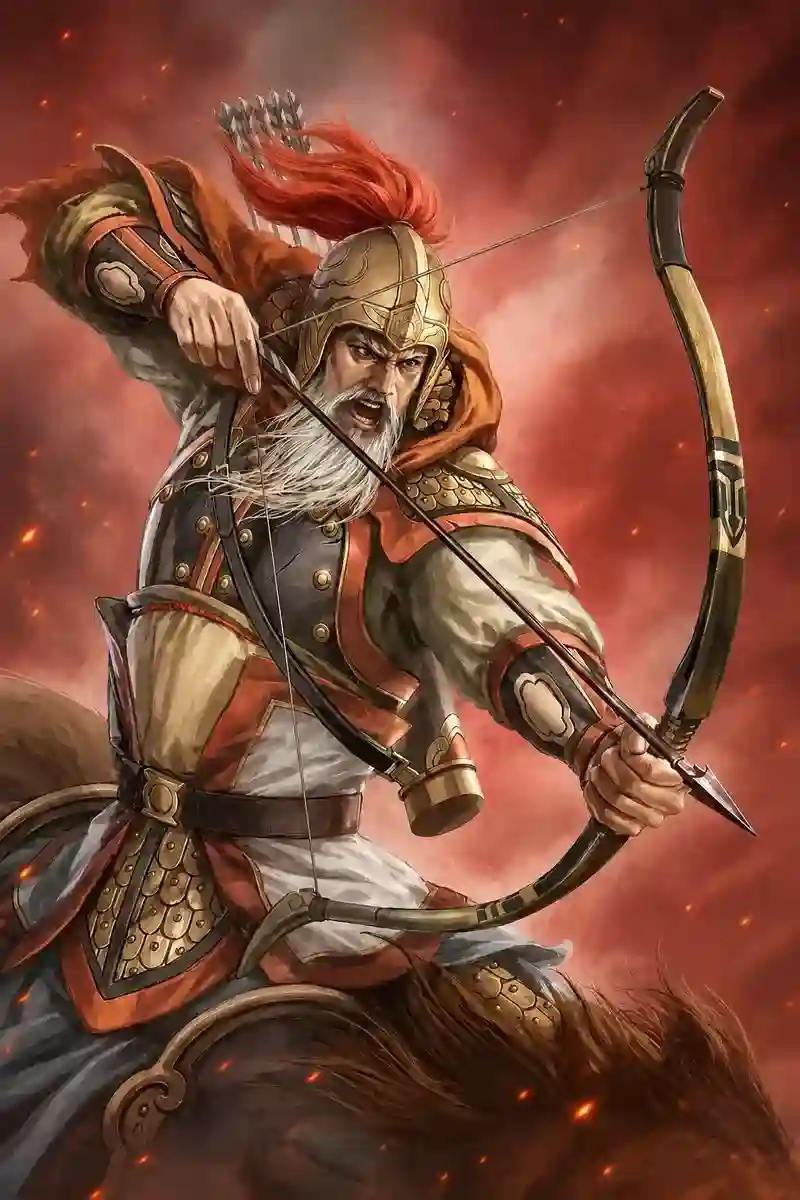
Huang Zhong (黄忠, Hoàng Trung), courtesy name Hansheng (汉升, Hán Thăng), was a Shu Han general famed for archery and for killing Xiahou Yuan (夏侯渊, Hạ Hầu Uyên) at Mount Dingjun (定军山) in 219 AD — the victory that let Liu Bei (刘备, Lưu Bị) hold Hanzhong and declare himself King of Hanzhong. Chen Shou ranks him among Liu Bei’s foremost commanders in Sanguozhi, Shu 6; the novel magnifies him into the archetype of the white-haired warrior and one of the Five Tiger Generals (五虎上将).
He began under Liu Biao (刘表, Lưu Biểu) as a middle commandant in Nanyang, then served in Changsha under Liu Biao’s nephew Liu Pan (刘磐, Lưu Bàn) against Eastern Wu raids. After Liu Biao’s death and Cao Cao’s takeover of Jing Province, he remained at Changsha under administrator Han Xuan (韩玄, Hàn Huyền) until Liu Bei’s southern campaign. Huang Zhong joined Liu Bei, fought as vanguard in the Yi Province war against Liu Zhang (刘璋, Lưu Chương), and rose to General Who Subdues the West (讨虏将军). At Dingjun, coordinated by strategist Fa Zheng (法正, Pháp Chính), he charged downhill and slew Xiahou Yuan. Liu Bei promoted him to General of the Rear (后将军) alongside Guan Yu (关羽, Quan Vũ), Zhang Fei (张飞, Trương Phi), and Ma Chao (马超, Mã Siêu). He died of illness in 220 AD; Liu Shan (刘禅, Lưu Thiện) later posthumously enfeoffed him as Marquis Gang (刚侯).
Role in Romance of the Three Kingdoms
Chapter 53 (Guan Yu Slays Cai Yang; Sun Quan Defeats Huang Zu / Changsha arc): Guan Yu besieges Changsha and duels Huang Zhong over several meetings — horse falls, Guan Yu spares him; Han Xuan orders Huang Zhong to shoot Guan Yu dead, but Huang Zhong shoots only the helmet tassel in return for mercy. Han Xuan condemns him to death; Wei Yan (魏延, Ngụy Diên) rebels, kills Han Xuan, and surrenders Changsha to Liu Bei.
Chapters 62–65 (Yi Province): Huang Zhong serves as Liu Bei’s vanguard — assaults around Luocheng, rescues Wei Yan from an ambush (slaying Ling Bao in the novel), and shares in the capture of Chengdu.
Chapters 70–71 (Hanzhong): With veteran Yan Yan (严颜, Nghiêm Nhan), Huang Zhong takes Mount Tiandang (天荡山), killing Xiahou De (夏侯德, Hạ Hầu Đức) and Han Hao (韩浩, Hàn Hạo). At Mount Dingjun he protests that age has not dulled his bow — then, on Fa Zheng‘s drum-and-flag signal, charges the slope and cuts Xiahou Yuan down, breaking Wei’s hold on Hanzhong.
Chapter 83 (Liu Bei Avenges Guan Yu at Yiling, novel death): Though historically dead by 220 AD, the romance sends Huang Zhong to Yiling at age seventy-five. Stung by talk of useless old generals, he charges deep into Wu lines, is wounded by an arrow from Ma Zhong (马忠, Mã Trung), and dies in Liu Bei’s camp that night.
Huang Zhong (黄忠) — Historical & Literary Timeline
Changsha duel & surrender
Fights Guan Yu to a draw; spares him via helmet-tassel shot; Wei Yan kills Han Xuan — Huang Zhong joins Liu Bei.
Yi Province vanguard
Leads assaults on Luocheng and the road to Chengdu; rewarded when Liu Zhang surrenders.
Mount Dingjun
Fa Zheng’s ambush plan; Huang Zhong slays Xiahou Yuan — Hanzhong secured; named General of the Rear.
Death in Chengdu
Dies of illness after Liu Bei’s Hanzhong kingship; posthumous Marquis Gang under Liu Shan.
Yiling death
Novel-only: wounded by Ma Zhong’s arrow at Yiling; dies in camp — literary end for the aged archer.
For detailed historical records, archives, and official chronicles, explore Huang Zhong on Wikipedia.
Key Relationships
Family
- Son Huang Xu (黄叙, Hoàng Tự): Died young in historical tradition — Huang Zhong left no direct heir (Sanguozhi note).
Friends
- Liu Bei (刘备, Lưu Bị): Lord who promoted him to General of the Rear after Dingjun.
- Guan Yu (关羽, Quan Vũ): Mutual respect after the Changsha duels — Guan Yu initially resented ranking beside the “old soldier” in history and fiction.
- Zhang Fei (张飞, Trương Phi) and Ma Chao (马超, Mã Siêu): Fellow Five Tiger Generals in the novel roster.
- Fa Zheng (法正, Pháp Chính): Strategist whose flags and drums timed the Dingjun charge.
- Yan Yan (严颜, Nghiêm Nhan): Partner at Mount Tiandang — two veterans outwit younger Wei commanders.
- Wei Yan (魏延, Ngụy Diên): Killed Han Xuan and opened Changsha to Liu Bei — Huang Zhong’s path into Shu service.
Enemies
- Xiahou Yuan (夏侯渊, Hạ Hầu Uyên): Wei western commander slain at Dingjun (219 AD).
- Han Xuan (韩玄, Hàn Huyền): Changsha administrator who ordered Huang Zhong’s execution after the helmet-tassel incident.
- Zhang He (张郃, Trương Cáp): Defeated at Mount Tiandang (Chapter 70).
- Xiahou De (夏侯德, Hạ Hầu Đức) and Han Hao (韩浩, Hàn Hạo): Killed at Tiandang in the novel.
- Ma Zhong (马忠, Mã Trung): Wu officer whose arrow fatally wounds Huang Zhong at Yiling in Chapter 83.
- Liu Zhang (刘璋, Lưu Chương): Warlord defeated during the Yi Province campaign.
Other
- Liu Biao (刘表, Lưu Biểu): First lord in Jing Province; stationed Huang Zhong with Liu Pan at Changsha.
- Liu Pan (刘磐, Lưu Bàn): Liu Biao’s nephew — shared the Changsha defense against Wu.
- Cao Cao (曹操, Tào Tháo): Held Jing Province after 208 AD; Huang Zhong remained under Han Xuan in Changsha until Liu Bei’s advance.
- Sima Yi (司马懿, Tư Mã Ý) and Wei forces: Opponents in the broader Hanzhong war, though Xiahou Yuan was the decisive personal rival at Dingjun.
In Novel
Chapter 53
- Huang Zhong (黄忠, Hoàng Trung): Veteran under Han Xuan (韩玄, Hàn Huyền); duels Guan Yu (关羽, Quan Vũ) to a standstill, is spared when his horse falls, then shoots only Guan Yu’s helmet tassel when ordered to kill him — saved by Wei Yan (魏延, Ngụy Diên), who slays Han Xuan and surrenders Changsha to Liu Bei (刘备, Lưu Bị).
Chapters 62–65
- Huang Zhong (黄忠, Hoàng Trung): Liu Bei’s vanguard in the Yi Province war — storms fortresses around Luocheng, rescues Wei Yan, and enters Chengdu when Liu Zhang surrenders.
Chapter 70
- Huang Zhong (黄忠, Hoàng Trung): With Yan Yan (严颜, Nghiêm Nhan), captures Mount Tiandang; protests that white hair has not weakened his bow; kills Xiahou De (夏侯德, Hạ Hầu Đức) and Han Hao (韩浩, Hàn Hạo).
Chapter 71
- Huang Zhong (黄忠, Hoàng Trung): On Fa Zheng‘s (法正, Pháp Chính) signal, charges Mount Dingjun and slays Xiahou Yuan (夏侯渊, Hạ Hầu Uyên) — the novel’s defining feat.
Chapter 73
- Huang Zhong (黄忠, Hoàng Trung): Named among Liu Bei’s Five Tiger Generals (五虎上将) when the King of Hanzhong enfeoffs his top commanders.
Chapter 83
- Huang Zhong (黄忠, Hoàng Trung): At Yiling, charges Wu troops despite his age; wounded by Ma Zhong (马忠, Mã Trung)’s arrow and dies in Liu Bei’s camp — novel death, not historical chronology.
In History
Summary
- Huang Zhong (黄忠, Hoàng Trung), styled Hansheng, served Liu Biao, then Liu Bei, and became one of Shu’s most celebrated field commanders. His 219 AD killing of Xiahou Yuan at Mount Dingjun is fully attested; the novel adds Changsha archery, Tiandang, Five Tigers, and Yiling death.
Year: c. 192–208 AD
- Middle commandant under Liu Biao; stationed in Changsha with Liu Pan against Wu.
Year: 209 AD onward
- Joins Liu Bei after Changsha; Assistant General (裨将军); vanguard in Yi Province — “always first to scale walls” per Sanguozhi praise.
Year: 219 AD
- Mount Dingjun: kills Xiahou Yuan; promoted General of the Rear (后将军) with Guan Yu, Zhang Fei, Ma Chao; enfeoffed as secondary marquis.
Year: 220 AD
- Dies of illness in Chengdu shortly after Liu Bei’s Hanzhong kingship.
Historical Record
- Sanguozhi, Shu 6 (黄忠传): biography, Dingjun victory, rank among Liu Bei’s generals.
- Pei Songzhi annotations: son Huang Xu died young; no heir.
- Novel amplifies age, archery at Changsha, and Yiling death — classify feats beyond 219 as literary unless noted.
Gallery