

Contents
Biography & Historical Record
Jiang Gan (dates of birth and death unknown), courtesy name Ziyi, was a Chinese scholar, debater, and diplomat who lived during the late Eastern Han dynasty. Hailing from Jiujiang Commandery, Jiang Gan was famous in the Jianghuai region from his youth for his exceptional eloquence, refined intellect, handsome physical appearance, and sharp rhetorical skills.
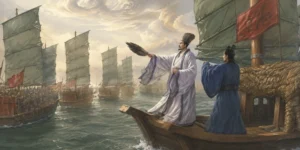
In 208 AD, following Cao Cao’s occupation of Jing Province, Jiang Gan volunteered to travel across the Yangtze River as Cao Cao’s special envoy to persuade Zhou Yu, the Grand Commander of Eastern Wu, to defect. Jiang Gan wore casual scholar robes and a simple headband to present himself as a private friend rather than a political representative. Zhou Yu welcomed him with lavish hospitality, hosting a grand military banquet where he displayed Eastern Wu’s armed forces, naval fleets, and military armories to demonstrate unshakeable morale. Zhou Yu explicitly forbade any discussion of political or military affairs during the reunion, famously stating that anyone attempting to talk about state politics would be executed on the spot. Realizing that Zhou Yu’s loyalty to Sun Quan was absolute and that his mind could not be swayed by words, Jiang Gan refrained from attempting persuasion, smiled throughout the visit, and returned north to report to Cao Cao that Zhou Yu possessed a mind of solid iron that could not be moved by rhetoric.
Role in Romance of the Three Kingdoms
In Luo Guanzhong’s historical novel Romance of the Three Kingdoms, Jiang Gan is portrayed as a well-meaning but hopelessly gullible and overly confident scholar whose foolish miscalculations inadvertently cause catastrophic disasters for Cao Cao’s army during the Red Cliffs Campaign.
Jiang Gan makes his famous debut in Chapter 45 when Cao Cao’s newly formed naval force suffers a defeat against Zhou Yu at Sanjiangkou. Desperate to eliminate Zhou Yu, Cao Cao accepts Jiang Gan’s boastful offer to cross the river and persuade his former classmate to surrender. Zhou Yu immediately recognizes the threat and devises a brilliant ‘alienation strategy’ (estrangement plot). Zhou Yu hosts the ‘Gathering of Heroes’ banquet, feigns heavy intoxication, and shares a bed with Jiang Gan. During the night, while Zhou Yu pretends to sleep, Jiang Gan secretly sneaks over to Zhou Yu’s desk and discovers a forged letter planted by Zhou Yu, appearing to be a secret treasonous correspondence from Cao Cao’s naval commanders Cai Mao and Zhang Yun. Panicked by this discovery, Jiang Gan steals the letter, flees back across the river, and presents it to Cao Cao. Enraged, Cao Cao immediately orders the execution of Cai Mao and Zhang Yun, inadvertently destroying his own experienced naval commanders and leaving his fleet without competent leadership.
In Chapter 49, attempting to redeem himself after realizing his mistake, Jiang Gan offers to return to Eastern Wu as a spy. Zhou Yu feigns fury over the stolen letter, refusing to see him, and confines Jiang Gan to a secluded retreat at Xishan Temple. There, Jiang Gan meets the famous strategist Pang Tong (Phoenix Fledgling). Believing he has stumbled upon a brilliant reclusive genius who harbors resentment against Eastern Wu, Jiang Gan enthusiastically smuggles Pang Tong back to Cao Cao’s camp. Pang Tong subsequently presents Cao Cao with the disastrous ‘Chain-Links Strategy’ (chaining the warships together), directly setting the stage for Eastern Wu’s legendary fire attack that utterly destroys Cao Cao’s grand fleet at the Battle of Red Cliffs.
Jiang Gan (蔣幹) — Historical & Literary Timeline
Mission to Eastern Wu and Stolen Letter
Volunteers to cross the Yangtze River to persuade Zhou Yu to defect; tricked by Zhou Yu’s fake drunk act at the ‘Gathering of Heroes’ banquet into stealing a forged letter, which leads Cao Cao to execute his naval commanders Cai Mao and Zhang Yun.
Xishan Temple and Pang Tong’s Plot
Returns to Eastern Wu to spy; confined at Xishan Temple, where he meets Pang Tong and unwittingly smuggles him into Cao Cao’s camp to propose the disastrous chained ships strategy.
Key Relationships
Family
- No information
Friends
- No information
Enemies
- Zhou Yu (周瑜, Chu Du) — A former classmate and Grand Commander of Eastern Wu who twice outmaneuvered Jiang Gan during the 208 AD Red Cliffs Campaign, using deception to ruin Cao Cao’s naval command and facilitate the introduction of the fatal chain-links strategy.
- Pang Tong (庞统, Bàng Thống) — A strategist who exploited Jiang Gan’s gullibility at Xishan Temple in 208 AD, allowing himself to be “rescued” to Cao Cao’s camp to ensure the implementation of the disastrous chained-ships plan.
- Cai Mao (蔡瑁, Thái Mạo) — A naval commander under Cao Cao whose execution in 208 AD was directly caused by Jiang Gan’s theft of a forged letter planted by Zhou Yu.
- Zhang Yun (张允, Trương Doãn) — A naval commander under Cao Cao executed alongside Cai Mao in 208 AD due to the misinformation Jiang Gan provided to Cao Cao.
Other
- Cao Cao (曹操, Tào Tháo) — The Northern warlord and Prime Minister who employed Jiang Gan as a special envoy during the 208 AD campaign; Jiang Gan’s failures while serving him led to significant losses for the Cao forces.
Appearance
In Novel
Chapter 45
- Jiang Gan (蒋干, Tưởng Cán): Jiang Gan, a former acquaintance of Zhou Yu, volunteers to cross to the Wu camp as Cao Cao’s envoy. Zhou Yu receives him warmly but deliberately creates the impression that Cai Zhong and Cai He are traitors. Jiang Gan notices a forged letter and believes he has discovered secret information.
Chapter 46
- Jiang Gan (蒋干, Tưởng Cán): Jiang Gan secretly reads the forged correspondence and carries it back to Cao Cao. Cao Cao believes the information and becomes suspicious of Cai Zhong and Cai He. Zhou Yu has therefore used Jiang Gan’s curiosity against Cao Cao.
Chapter 47
- Jiang Gan (蒋干, Tưởng Cán): Jiang Gan returns to Cao Cao but fails to provide useful intelligence about Zhou Yu’s actual plans. Cao Cao nevertheless continues to use him because Jiang Gan believes he can persuade his former acquaintance to defect.
Chapter 48
- Jiang Gan (蒋干, Tưởng Cán): Jiang Gan again becomes involved in Cao Cao’s attempts to communicate with Zhou Yu. His presence provides Zhou Yu another opportunity to feed Cao Cao misleading information while the Wu side prepares the Red Cliffs deception.
Chapter 49
- Jiang Gan (蒋干, Tưởng Cán): Jiang Gan remains part of the chain of failed intelligence operations that leaves Cao Cao badly informed before the naval battle. His inability to penetrate Zhou Yu’s plans contributes to Cao Cao’s false confidence.
Appearance
In History
Summary
- Jiang Gan (蒋干, Tưởng Cán), courtesy name Ziyi (子翼), was a scholar and official associated with the late Han period.
- Historical sources record him as a man of talent and learning who was connected with Cao Cao, although his famous role in the Battle of Red Cliffs is heavily shaped by literary tradition.
Year: 208 AD — Red Cliffs Tradition
- Romance of the Three Kingdoms famously depicts Jiang Gan as Cao Cao’s eloquent emissary who visits Zhou Yu, is tricked into obtaining the forged correspondence of Cai Zhong and Cai He, and unintentionally causes Cao Cao to execute his naval commanders Cai Mao and Zhang Yun.
- These dramatic episodes are not supported as described by the standard historical accounts of the Red Cliffs campaign.
Historical Record
- Jiang Gan is historically attested, but his detailed espionage role in the novel should be treated as literary rather than documentary history.