

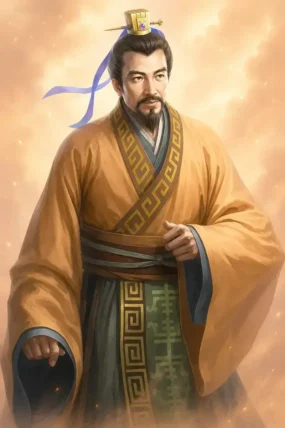

Here is the exhaustive biography of Kuai Yue (蒯越, Khoái Việt), courtesy name Yidu (异度 / 異度, Dị Độ) (? – 214), younger brother of Kuai Liang (蒯良, Khoái Lương) and a key adviser to Liu Biao (刘表, Lưu Biểu) who later served Cao Cao (曹操, Tào Tháo), incorporating historical records and the narrative of Romance of the Three Kingdoms.
Contents
Historical Career
Kuai Yue was a native of Zhonglu in Nan Commandery (南郡中庐; huyện Trung Lư, near present-day Xiangyang). A descendant of the early-Han rhetorician Kuai Tong (蒯通, Khoái Thông), he was described as deep, resourceful, and imposing in appearance. Early in his career he served under Grand Marshal He Jin (何进, Hà Tiến) and urged decisive action against the eunuchs; when He Jin hesitated, Kuai Yue left and became Prefect of Ruyang. In 190 he returned to Jing Province and joined his elder brother Kuai Liang in serving the newly appointed Inspector Liu Biao.
At Yicheng the brothers advised Liu Biao on how to pacify the powerful local “clan bandits.” While Kuai Liang stressed benevolence, Kuai Yue offered a pragmatic scheme: lure the bandit chiefs with promises of reward, then execute them for their cruelty. Liu Biao adopted the plan, executed some fifty chiefs, absorbed their followers, and rapidly secured most of Jing Province. Liu Biao praised Kuai Yue’s counsel as “the strategy of Jiu Fan.” Kuai Yue was appointed Administrator of Zhangling.
In 199–200 he urged Liu Biao to support Cao Cao rather than Yuan Shao (袁绍, Viên Thiệu) during the Guandu confrontation; Liu Biao remained neutral. After Liu Biao’s death in 208, Kuai Yue, together with Fu Xun (傅巽, Phó Tốn) and others, successfully persuaded the heir Liu Cong (刘琮, Lưu Tông) to surrender Jing Province to Cao Cao. When Kuai Yue presented himself, Cao Cao famously wrote to Xun Yu (荀彧, Tuân Úc): “I am not so pleased at obtaining Jing Province as I am at obtaining Kuai Yidu.” Cao Cao enfeoffed him as Marquis of Fan Village (or Faning) and appointed him Minister of the Household (Guanglu Xun). Kuai Yue died in 214; before his death he wrote to Cao Cao entrusting his family to the warlord’s care, and Cao Cao replied with a warm letter of assurance.
Role in Romance of the Three Kingdoms
Ch. 6–7: As Liu Biao’s commander, Kuai Yue helps intercept Sun Jian (孙坚, Tôn Kiên) after the Imperial Seal affair and coordinates Jing’s counter-stroke after Sun Jian’s death.
Ch. 34–35: With Cai Mao (蔡瑁, Sái Mạo) he treats Liu Bei (刘备, Lưu Bị) as a threat at Xiangyang; novel colour includes the Hex Mark / Dilu horse warning attributed in Jing court talk.
Ch. 40–41: After Liu Biao’s death he and Fu Xun persuade Liu Cong to surrender; Cao Cao’s praise of Kuai Yidu is retained. He restrains Cai Mao from killing the loyalist Wang Wei (王威, Vương Uy).
History vs novel: The banquet purge of local chiefs and Cao Cao’s letter praising Kuai Yue are historical; Hex Mark horse colour and the Cai Mao / Wang Wei beat are novel dramatization.
Kuai Yue (蒯越, Khoái Việt) — Historical & Literary Timeline
c. 189 AD — Service under He Jin
Early Career & Withdrawal
Served under Grand Marshal He Jin (何进, Hà Tiến) and urged action against the eunuchs. When He Jin proved indecisive, Kuai Yue left office and became Prefect of Ruyang.
190 AD — Pacification of Jing Province
Counsel of “Jiu Fan”
Joined Liu Biao with brother Kuai Liang. Proposed luring and executing clan-bandit chiefs; Liu Biao adopted it and secured Jing. Appointed Administrator of Zhangling. Praised as “the strategy of Jiu Fan.”
199–200 AD — Guandu Crisis
Advice to Support Cao Cao
Urged Liu Biao to ally with Cao Cao rather than Yuan Shao. Liu Biao stayed neutral; Kuai Yue’s pro-Cao stance was already clear.
208 AD — Surrender of Jing Province
Persuading Liu Cong
With Fu Xun persuaded Liu Cong to surrender. Cao Cao valued obtaining Kuai Yue more than Jing itself, enfeoffed him, and made him Minister of the Household. Novel Ch.40–41 dramatizes the same political turn.
214 AD — Death
Final Trust in Cao Cao
Died of natural causes. Before death he entrusted his family to Cao Cao; Cao Cao replied with a letter of warm assurance (historical).
Historical Note
Kuai Yue was a genuine historical figure whose pragmatic counsel helped Liu Biao establish Jing and whose advocacy of surrender facilitated Cao Cao’s bloodless acquisition of the region. Cao Cao’s remark that he valued Kuai Yue more than Jing is in the historical record. The novel keeps that outline and adds Hex Mark colour and the restraint of Cai Mao. In both history and fiction he is a successful bridge between the old Jing regime and Cao power.
For detailed historical records, archives, and official chronicles, explore Kuai Yue on Wikipedia.
Key Relationships
Family
- Kuai Tong (蒯通, Khoái Thông): Ancestor (historical genealogy). Renowned Western Han rhetorician/strategist; not a novel co-actor in Jing chapters.
- Kuai Liang (蒯良, Khoái Lương): Elder brother. Fellow chief adviser to Liu Biao (刘表, Lưu Biểu); novel and history both treat the brothers as Jing’s Kuai pair (Yidu / Zirou).
- Kuai Qi (蒯祺, Khoái Kỳ): Clan kinsman (historical). Later associated with Wei office; tradition links him by marriage to the elder sister of Zhuge Liang (诸葛亮, Gia Cát Lượng) — kinship note, not a ROTK battlefield companion of Kuai Yue.
Friends
- Liu Biao (刘表, Lưu Biểu): Patron Inspector of Jing. History: adopts Kuai Yue’s “Jiu Fan” purge of local chiefs (c. 190). Novel: same court; Kuai Yue remains a senior Jing voice until the surrender arc.
- Cai Mao (蔡瑁, Sái Mạo): Close Xiangyang political ally steering Jing toward accommodation with the north; novel Ch.34–41 pairs them against Liu Bei and for surrender.
- Cao Cao (曹操, Tào Tháo): Later patron. History: praises obtaining Kuai Yidu above Jing; enfeoffs him and receives his dying family trust (214). Novel Ch.40–41: same honour after the surrender.
- Han Song (韩嵩, Hàn Tung): Fellow senior Jing statesman in the pro-negotiation circle around Liu Biao’s court.
- Fu Xun (傅巽, Phó Tốn): Co-persuader of Liu Cong (刘琮, Lưu Tông) to surrender Jing to Cao Cao (history and novel Ch.40).
Enemies
- Sun Jian (孙坚, Tôn Kiên): Jiangdong warlord opposed at Xiangyang. Novel Ch.6–7: Kuai Yue helps intercept him over the seal / Jing war; Sun Jian dies in the Jing fighting. History: Jing–Sun clash is real; Kuai Yue’s exact novel ambush beats are dramatized.
- Liu Bei (刘备, Lưu Bị): Stationed in Xinye as a security threat in Jing eyes. Novel: Kuai Yue and Cai Mao plot against him (Xiangyang banquet / flight arcs). History: Jing factional hostility to Liu Bei is political, not always the novel’s banquet script.
- Yuan Shu (袁术, Viên Thuật): Rival pressure on Jing’s borders in the early warlord scramble (historical context; not Kuai Yue’s personal duel opponent).
Other
- Liu Cong (刘琮, Lưu Tông): Heir Kuai Yue helps persuade to surrender Jing (208 / novel Ch.40).
- Xun Yu (荀彧, Tuân Úc): Recipient of Cao Cao’s letter praising the acquisition of Kuai Yidu (historical anecdote).
- Wang Wei (王威, Vương Uy): Jing loyalist. Novel: Kuai Yue restrains Cai Mao from killing him during the surrender crisis.
- He Jin (何进, Hà Tiến): Early superior; Kuai Yue leaves when He Jin will not strike the eunuchs (historical start of career).
- Huang Zu (黄祖, Hoàng Tổ): Liu Biao’s eastern Jing general in the same provincial military system Kuai Yue advised as a civil strategist.
- Hex Mark / Dilu horse warning: Novel Jing-court colour linked to Liu Bei’s steed; keep separate from Kuai Yue’s historical offices and Cao Cao letter.


Appearance

In Novel
Chapter 6
- Kuai Yue (蒯越, Khoái Việt): Liu Biao (刘表, Lưu Biểu) commander who helps intercept Sun Jian (孙坚, Tôn Kiên) after the Imperial Seal crisis on the Jing frontier.
Chapter 7
- Kuai Yue (蒯越, Khoái Việt): Coordinates Jing counter-operations after Sun Jian falls in the Xiangyang fighting.
Chapter 34
- Kuai Yue (蒯越, Khoái Việt): With Cai Mao (蔡瑁, Sái Mạo) treats Liu Bei (刘备, Lưu Bị) as a threat at Xiangyang; novel court talk includes the Hex Mark / Dilu horse warning.
Chapter 40
- Kuai Yue (蒯越, Khoái Việt): With Fu Xun (傅巽, Phó Tốn) advises Liu Cong (刘琮, Lưu Tông) to surrender Jing unconditionally to Cao Cao (曹操, Tào Tháo).
Chapter 41
- Kuai Yue (蒯越, Khoái Việt): Honored by Cao Cao for the peaceful submission of Jing; restrains Cai Mao from killing Wang Wei (王威, Vương Uy). History: same political reward and Cao Cao letter praising Kuai Yidu — without the novel Wang Wei beat.
Appearance
In History
Summary
- Kuai Yue (蒯越, Khoái Việt), courtesy Yidu, was Liu Biao (刘表, Lưu Biểu)’s pragmatic Jing adviser, later Minister of the Household under Cao Cao (曹操, Tào Tháo); died 214 after entrusting his family to Cao Cao.
Year: 190 AD
- With brother Kuai Liang (蒯良, Khoái Lương) advises the Yicheng purge of local clan chiefs; Liu Biao secures Jing; Kuai Yue becomes Administrator of Zhangling (“strategy of Jiu Fan”).
Year: 199–200 AD
- Urges Liu Biao to support Cao Cao against Yuan Shao (袁绍, Viên Thiệu); Liu Biao stays neutral.
Year: 208 AD
- With Fu Xun persuades Liu Cong to surrender Jing. Cao Cao writes that obtaining Kuai Yidu pleases him more than obtaining Jing; enfeoffs Kuai Yue.
Year: 214 AD
- Dies of natural causes; final letter entrusts family to Cao Cao, who replies warmly.
Historical Record
- Notices in Sanguozhi (Jing / Cao Cao materials) and Pei annotations; separate novel Ch.6–7 / 34 / 40–41 colour from the historical purge, surrender, and Cao Cao letter.
Appearance
Gallery