


Contents
Biography & Historical Record
Cao Yu, courtesy name Pengzu, was a high-ranking imperial prince, statesman, and noble of the Cao Wei state during the Three Kingdoms period. He was the younger son of the legendary warlord Cao Cao and Lady Huan, making him the full younger brother of the renowned child prodigy Cao Chong. Documented in Chen Shou’s official dynastic history Records of the Three Kingdoms (Sanguozhi – Book of Wei, Volume 20, Biography of the Sons of Emperor Wu) and Sima Guang’s Zizhi Tongjian, Cao Yu is historically renowned for his calm, gentle temperament, cautious humility, and his remarkable political survival skills. Unlike his more aggressive or ambitious brothers, Cao Yu deliberately avoided factional power struggles, allowing him to navigate the violent political purges of the late Wei dynasty and live to a ripe old age.
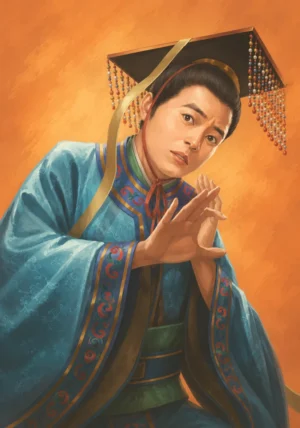
Following the establishment of Cao Wei by Cao Pi, Cao Yu was enfeoffed as the Prince of Dunqiu and later elevated to Prince of Yan. He maintained a close and trusted relationship with his nephew, the second Wei emperor Cao Rui, who held deep personal affection for his uncle’s mild and compliant nature. The defining moment of Cao Yu’s political life occurred in 239 AD, when a severely ill Emperor Cao Rui prepared for death. Initially, Cao Rui issued an imperial decree appointing Cao Yu as the Grand General (Da Jiangjun), placing him at the head of the regency council to guide the seven-year-old crown prince Cao Fang. However, recognizing that accepting supreme military command would place him directly in the deadly crosshairs of court factions and potentially destroy his family, Cao Yu demonstrated profound political wisdom by weeping, kowtowing, and repeatedly begging the emperor to rescind the order. Yielding to Cao Yu’s desperate pleas and the whispered advice of eunuchs, Cao Rui replaced him with the incompetent kinsman Cao Shuang and the veteran strategist Sima Yi. This act of self-preservation kept Cao Yu entirely out of the bloody Gao Ping Ling Coup in 249 AD, sparing him and his immediate lineage from the extermination that wiped out Cao Shuang’s faction.
Decades later, Cao Yu’s political fortunes reached a unique zenith when his biological son, Cao Huan (originally named Cao Huang), was elevated to the imperial throne as the fifth and final emperor of Cao Wei in 260 AD by the powerbroker Sima Zhao. Though Cao Yu technically became the father of a reigning monarch, the state was entirely controlled by the Sima family. When Sima Yan pressured Cao Huan to abdicate and establish the Western Jin dynasty in 265 AD, Cao Yu wisely advised his son to comply peacefully. In recognition of his royal lineage, compliant demeanor, and high prestige, the newly established Western Jin court allowed Cao Yu to retain his high rank, demoting his title back to Prince of Yan. He lived out his remaining years in peaceful retirement, passing away of natural causes in 278 AD as one of the longest-living sons of Cao Cao.
Role in Romance of the Three Kingdoms
In Luo Guanzhong’s classic 14th-century historical novel Romance of the Three Kingdoms, Cao Yu appears during the dramatic transition chapters surrounding the deathbed of Emperor Cao Rui. The novel vividly captures the historic scene where Cao Rui appoints Cao Yu as the Grand General to head the imperial regency. True to historical records, the novel depicts Cao Yu’s sheer terror and tearful refusal of the post, kneeling before the emperor and begging to be excused from such a perilous burden. This act of cautious avoidance is highlighted as a moment of supreme self-preservation, contrasting sharply with Cao Shuang’s reckless hunger for absolute power.
Cao Yu (曹宇) — Historical & Literary Timeline
Ennoblement as Prince of Yan
Granted feudal titles by Cao Cao and Cao Pi, serving as a peaceful and unassuming imperial prince within the Cao Wei royal household.
Declining Cao Rui’s Appointment as Grand General
Appointed by a dying Emperor Cao Rui as Grand General to head the regency council; weeping and pleading, Cao Yu successfully declines the dangerous post, avoiding the future purges.
Son Cao Huan Ascends the Throne
His son Cao Huang is installed as the final Emperor of Cao Wei (Cao Huan) by Sima Zhao following the martyrdom of Emperor Cao Mao.
Peaceful Passing in Retirement
Passes away peacefully of old age under the protection of the Western Jin dynasty, holding the title of Prince of Yan as one of Cao Cao’s longest-surviving sons.
For detailed historical records, archives, and official chronicles, explore Cao Yu on Wikipedia.
Key Relationships
Family
- Cao Cao (曹操, Tào Tháo): Father; supreme warlord, King of Wei, and posthumously honored founder of the Cao Wei dynasty.
- Lady Huan (环夫人, Hoàn phu nhân): Biological mother; concubine of Cao Cao who gave birth to Cao Chong, Cao Ju, and Cao Yu.
- Cao Chong (曹冲, Tào Xung): Full brother; famous child prodigy who was deeply cherished by Cao Cao before dying prematurely in 208 AD.
- Cao Pi (曹丕, Tào Phi): Half-brother; founding Emperor of Cao Wei who enfeoffed Cao Yu as Duke of Dunqiu and later elevated his titles.
- Cao Rui (曹叡, Tào Duệ): Nephew; second Emperor of Cao Wei who maintained deep personal affection for Cao Yu and sought to appoint him Grand General to lead the imperial regency on his deathbed in 239 AD.
- Cao Huan (曹奂, Tào Hoán): Biological son; originally named Cao Huang, chosen to ascend the throne as the fifth and final emperor of Cao Wei (reigned 260–265 AD).
Friends
- No information
Enemies
- No information
Other
- Cao Shuang (曹爽, Tào Sảng): Imperial clansman; appointed Grand General and co-regent in 239 AD after Cao Yu tearfully begged Cao Rui to decline the post, which ultimately spared Cao Yu from the factional purge during the Gao Ping Ling Incident in 249 AD.
- Sima Zhao (司马昭, Tư Mã Chiêu): Paramount regent of Cao Wei; selected Cao Yu’s son Cao Huan to serve as the figurehead emperor in 260 AD following the death of Emperor Cao Mao.
- Sima Yan (司马炎, Tư Mã Viêm): Founding Emperor of the Western Jin dynasty; accepted the abdication of Cao Yu’s son in 265 AD and permitted Cao Yu to live out his remaining years in peaceful retirement as Prince of Yan until his death in 278 AD.
In Novel
Chapter 106
- Cao Yu (曹宇, Tào Vũ): Cao Yu is Cao Pi’s son and the father of Cao Huan. In the later Wei succession narrative he is identified as the Yan Prince and as part of the Cao imperial family surrounding the succession after Cao Rui’s death. His role is dynastic rather than military. citeturn0search0turn1search0
In History
Summary
- Cao Yu (曹宇, Tào Vũ), courtesy name Pengzu, was a son of Cao Cao and a prince of Cao Wei.
Family
- His mother was Consort Huan, making Cao Yu a brother of Cao Chong and Cao Ju.
- His son Cao Huan later became the fifth and final emperor of Wei.
Political Career
- Cao Yu received successive noble titles under the late Han and early Wei governments.
- Near the end of Cao Rui’s reign, he was initially considered for a regency role, but Cao Rui ultimately selected Cao Shuang and Sima Yi instead.
Later Life
- After the fall of Wei, Cao Yu retained a princely status under Jin before dying in 278.
- Classification: Historical.